Moving on a circle takes a net force towards the centre, of size m·v²/r. What supplies it, how strong is it, and why is there no force pushing outward?
Step 1 of 5 · What pulls the ball
Step 1 of 5
What pulls the ball
In the last lesson you saw that the ball is accelerating towards the peg all the time, at . By Newton’s second law, , so there has to be a net force on it towards the centre:
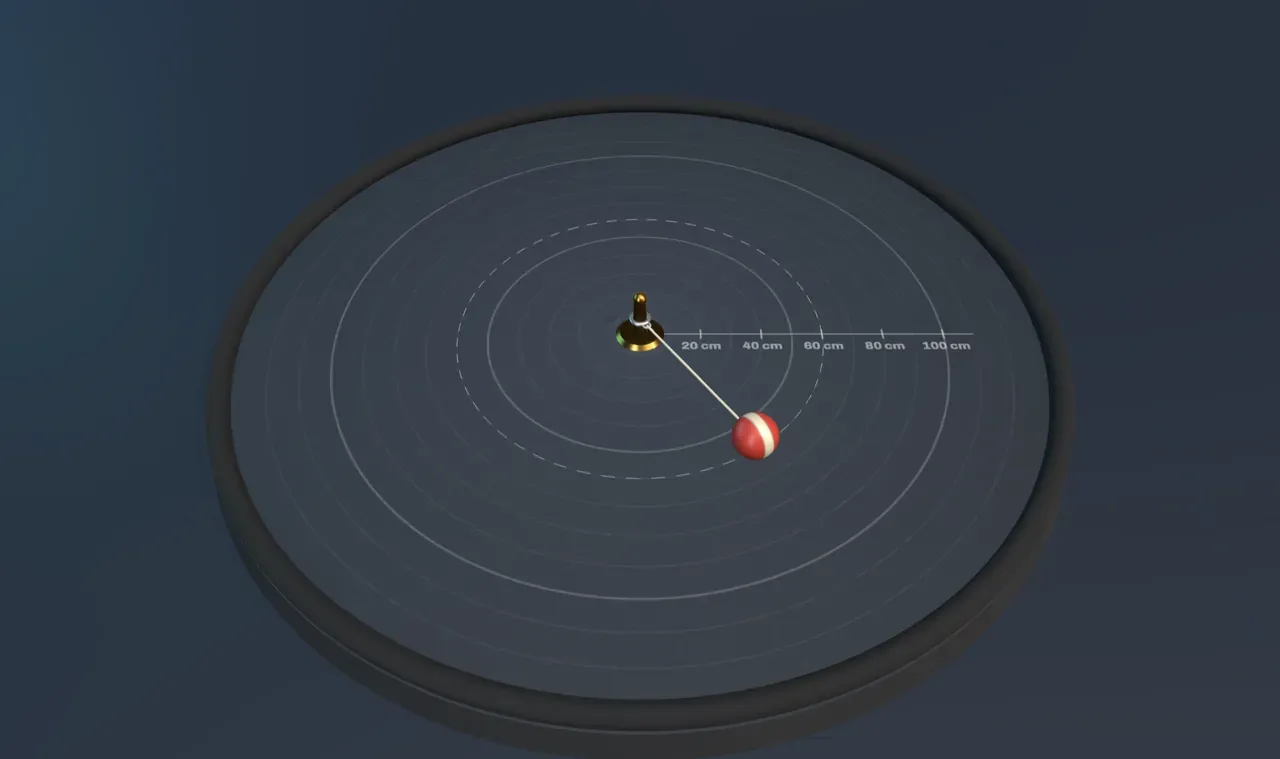
This force is called the centripetal force. To find out what supplies it, draw a free-body diagram: what touches the ball, and what pulls on it from a distance? The Earth pulls it down, the table pushes it up, and the string pulls it towards the peg. The orange arrow is that pull, and the number on it is its size: 1.33 N for a 0.2 kg ball moving at 2 m/s on a 0.6 m string.
Step 2 of 5
How strong
Swap the ball for a heavier one, of 0.5 kg. The Scene draws it the same size, but works out the pull from the new mass. It moves at 2 m/s on a string 0.8 m long, and the arrows are hidden so that you work it out yourself.
Step 3 of 5
A pull of two newtons
We are back to the 0.2 kg ball, with the arrows showing. Now it is slow, and the string pulls with only 0.33 N. The speed enters the formula squared and the radius sits underneath: work it out before you move anything, then check against the number on the arrow.
Step 4 of 5
A longer string
The ball is moving at 2 m/s on a short string, 0.5 m long, and the string pulls with 1.6 N. What will happen to the pull if the string is made longer, at the same speed? Make your prediction, and the Scene will then switch to a 1 m string.
Step 5 of 5
Who does the string’s job
The centripetal force is not a new kind of force but a job: the net force pointing at the centre. In every circular motion something different does it. Here it is the string. For the Moon it is the Earth’s gravity, in the next two lessons. And for a car going round a bend?
Speaking of cars: in a bend you feel something throwing you outward, and it is tempting to call it a centrifugal force. But there is no such force on your body. Your body simply carries straight on, by Newton’s first law, until the door or the seat belt pulls it inward, onto the circle. The same goes for the ball: the ball pulls the string outward, and the hand holding the string feels that, but it is a force on the string, not on the ball.
Try it: move Forces, then cut all the way, to Cut the string. The moment the string is cut the centripetal force is gone, and the ball goes straight on, just like your body in the car.
Loading the interactive version…
Loading the interactive version…
Each step sets up the Scene for you, and a control marked “fixed” stays put for that step.
Practice · Choose
Look at the ball from above while it goes round. Which sideways forces act on it?
Practice · Choose
Look at the ball from above while it goes round. Which sideways forces act on it?
Practice · Calculate
A 0.5 kg ball goes round at 2 m/s on a string 0.8 m long. How hard does the string pull on it?
Practice · Calculate
A 0.5 kg ball goes round at 2 m/s on a string 0.8 m long. How hard does the string pull on it?
Practice · Reach the target
The 0.2 kg ball. Change the Speed and the String length until the string pulls with 2 N, then press Check.
Practice · Reach the target
The 0.2 kg ball. Change the Speed and the String length until the string pulls with 2 N, then press Check.
Practice · Predict, then look
The ball moves at 2 m/s on a string 0.5 m long, and the string pulls with 1.6 N. The string is lengthened to 1 m, at the same speed. What happens to the pull?
Practice · Predict, then look
The ball moves at 2 m/s on a string 0.5 m long, and the string pulls with 1.6 N. The string is lengthened to 1 m, at the same speed. What happens to the pull?
Practice · Choose
A car drives at a steady speed round a roundabout, on a level road. Which force keeps it on the circle?
Practice · Choose
A car drives at a steady speed round a roundabout, on a level road. Which force keeps it on the circle?
Lesson complete. Every practice question here is done.