Any two masses pull on each other, with the same force, which grows with the masses and weakens with the square of the distance. From the pull between two bodies in the Scene to your own weight.
Step 1 of 6 · Who pulls whom
Step 1 of 6
Who pulls whom
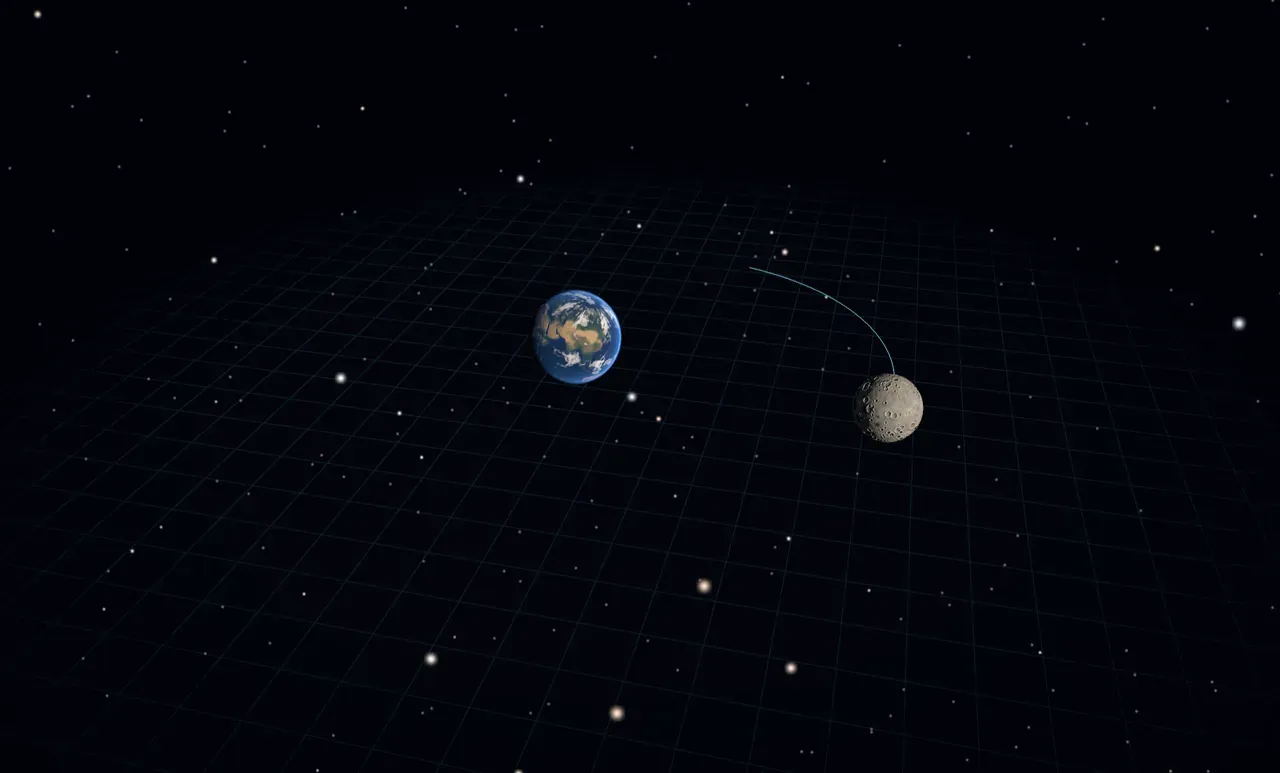
In the Scene two bodies go round each other, drawn as the Earth and a Moon. The second body has of the first one’s mass, like a big moon. There is no string between them: what holds them on their circles is gravity, the pull every mass exerts on every other mass.
Before seeing the forces, make a prediction: which one pulls harder?
Step 2 of 6
Newton’s law
Newton realised that the force that brings an apple down is the same force that holds the Moon in its orbit, and wrote one law for it, the law of universal gravitation:
Here and are the masses, is the distance between their centres, and is the gravitational constant. It is tiny, which is why the pull between two people goes completely unnoticed, and only a mass the size of a planet pulls hard enough to feel.
The Scene has units of its own: the first body’s mass is the unit of mass, and distance is in the Scene’s units. The pull on the arrows is in a Scene unit too: is the force with which two bodies like the first pull on each other, apart. That is exactly the situation now, and both arrows read .
Try it: lower the Second mass to . The pull halves, on both bodies.
Step 3 of 6
The square of the distance
Two equal bodies, apart, pull on each other with . Gravity weakens with distance, and quickly: the distance is squared in the law. What will happen to the pull when they are moved three times as far apart, to ? Make your prediction, and the Scene will then move them.
The reason for the square: picture the influence of a mass spreading out in every direction, like the light from a lamp. At twice the distance it is spread over a sphere with four times the area, so each point gets a quarter.
Step 4 of 6
Mass and distance together
The mass is on top, the distance underneath and squared. To see what happens when both change, multiply the two changes together.
Try it: change the Second mass and the Distance apart, and check against the number on the arrows.
Step 5 of 6
Your weight
The same law gives your weight. You stand on the Earth’s surface, so the distance between the centres is the Earth’s radius, 6370 km. Put your mass and the Earth’s mass into the law, and you get the force with which it pulls on you. Divide by your mass, and you get the acceleration of anything falling beside you:
Your own mass cancels out: that is why all bodies fall with the same acceleration.
Step 6 of 6
The centre of mass
The same force acts on both bodies, but their accelerations differ: . The heavy body accelerates a little, the light one a lot. Both go round one point, the centre of mass, with the same period, and each one’s circle is as big as its acceleration. So their distances from the centre of mass are in the inverse ratio of their masses:
Now the second mass is of the first, and they are apart.
Loading the interactive version…
Loading the interactive version…
Each step sets up the Scene for you, and a control marked “fixed” stays put for that step.
Practice · Predict, then look
The second body has of the first one’s mass. Which body pulls harder on the other?
Practice · Predict, then look
The second body has of the first one’s mass. Which body pulls harder on the other?
Practice · Predict, then look
Two equal bodies apart pull on each other with a force of , in the Scene’s unit. They are moved to apart, three times as far. What will the pull be?
Practice · Predict, then look
Two equal bodies apart pull on each other with a force of , in the Scene’s unit. They are moved to apart, three times as far. What will the pull be?
Practice · Choose
The second body’s mass is doubled, and so is the distance between the bodies. What happens to the pull between them?
Practice · Choose
The second body’s mass is doubled, and so is the distance between the bodies. What happens to the pull between them?
Practice · Calculate
The Earth’s mass is and its radius is 6370 km. How hard does it pull on a 70 kg person standing on its surface? Use .
Practice · Calculate
The Earth’s mass is and its radius is 6370 km. How hard does it pull on a 70 kg person standing on its surface? Use .
Practice · Calculate
The second body’s mass is of the first one’s, and they are apart. How far is the first, heavy body from their shared centre of mass?
Practice · Calculate
The second body’s mass is of the first one’s, and they are apart. How far is the first, heavy body from their shared centre of mass?
Lesson complete. Every practice question here is done.