Lesson 4 of 5
Orbits: a fall that never ends.
A satellite is a body that keeps falling and keeps missing the Earth. Gravity is its centripetal force, and from that come its speed, its period, Kepler's third law, and why astronauts float.
Step 1 of 6 · Falling and missing
Step 1 of 6
Falling and missing
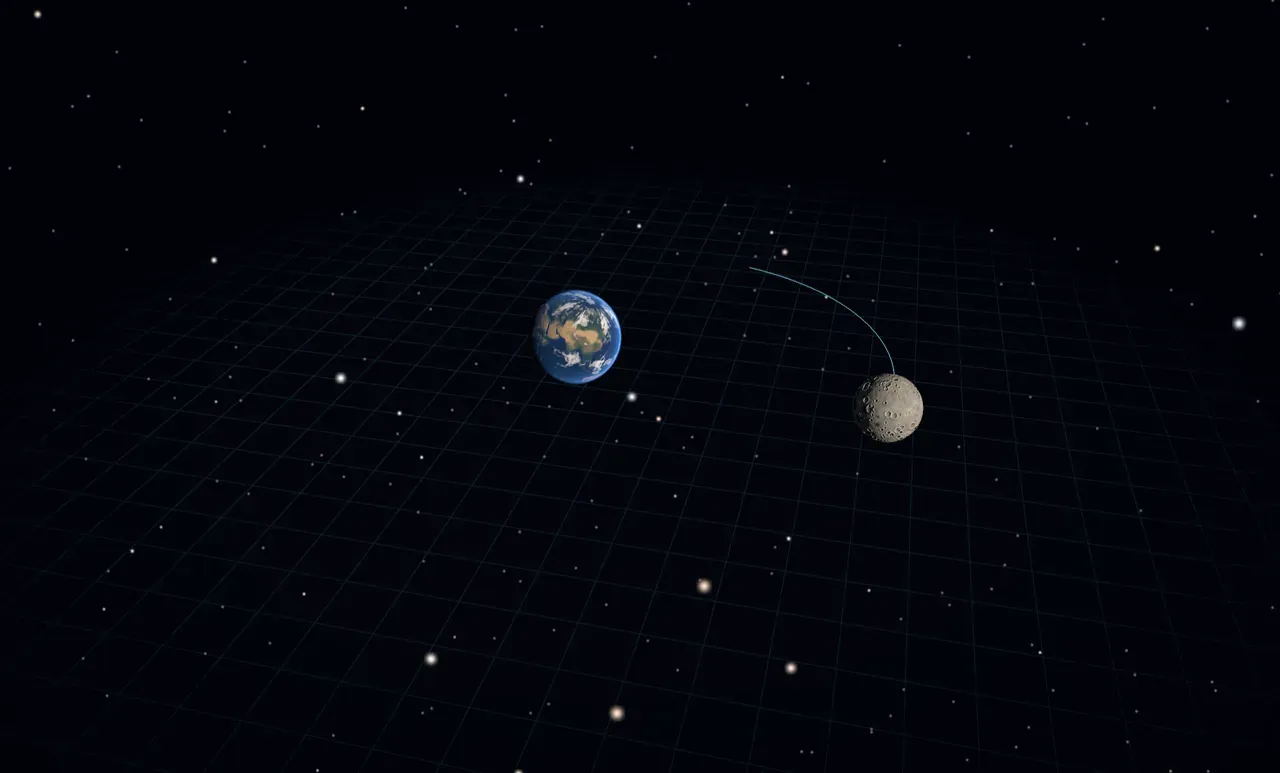
Picture a cannon on top of a high mountain, firing a ball horizontally. As in projectile motion, the ball falls while it moves forward, and lands some way off. Fire it faster, and it lands farther away. But the Earth is round: fast enough, and the ground curves away beneath the ball as quickly as it falls, so it never lands. That is an orbit: a fall that keeps missing.
In the Scene the small body is of the big one, like a small satellite beside a planet. The arrow on the small body shows the gravity on it: always towards the big body, and at right angles to the motion, just like the string in the earlier lessons. Here gravity is the centripetal force.
Step 2 of 6
How much gravity there is up there
The International Space Station orbits the Earth at a height of about 400 km. To know how much weaker gravity is there, you need the distance from the Earth’s centre, not from the ground: .
Step 3 of 6
Orbital speed
On a circular orbit, gravity is exactly the force needed to move on the circle:
Here is the Earth’s mass and the satellite’s. Any slower, and the satellite falls inward; any faster, and it swings out on a stretched orbit. This speed is set by and alone.
Step 4 of 6
Kepler’s third law
The period is the circumference divided by the speed, . Put in from the last step and you get
The square of the period is proportional to the cube of the distance. Kepler found this in measurements of the planets, about seventy years before Newton explained why. Strictly, the denominator is , and is the distance between the two bodies, as the Scene works it out; when the small body is negligible, that is very nearly .
The Scene’s clock is sped up enormously: an orbit here takes seconds, not hours or years. But the ratios between periods are exact. The small body is now away, and one orbit takes about 3.3 s.
Step 5 of 6
On the same orbit
The formula does not contain the satellite’s mass. It appeared on both sides of the equation, and cancelled.
Step 6 of 6
Twice the period
The small body is now away, and one orbit takes about 6.1 s in the Scene. When you press Check, you will see how long an orbit takes at the distance you chose. Use Kepler’s law to work it out first, rather than guessing.
Loading the interactive version…
Loading the interactive version…
Each step sets up the Scene for you, and a control marked “fixed” stays put for that step.
Practice · Choose
The International Space Station orbits the Earth at a height of about 400 km. Why do the astronauts inside it float?
Practice · Choose
The International Space Station orbits the Earth at a height of about 400 km. Why do the astronauts inside it float?
Practice · Calculate
What is the acceleration due to gravity at the height of the space station, 400 km above the Earth’s surface? The Earth’s mass is , its radius 6370 km, and .
Practice · Calculate
What is the acceleration due to gravity at the height of the space station, 400 km above the Earth’s surface? The Earth’s mass is , its radius 6370 km, and .
Practice · Calculate
How fast does the space station move on a circular orbit 400 km up? Use the same data: , and .
Practice · Calculate
How fast does the space station move on a circular orbit 400 km up? Use the same data: , and .
Practice · Predict, then look
In the Scene, a small body () orbits a big one away, and one orbit takes about 3.3 s. It is moved out to , four times as far. How many times longer will an orbit take?
Practice · Predict, then look
In the Scene, a small body () orbits a big one away, and one orbit takes about 3.3 s. It is moved out to , four times as far. How many times longer will an orbit take?
Practice · Choose
A second satellite, ten times heavier than the first, is put on the same circular orbit round the Earth. How fast must it move?
Practice · Choose
A second satellite, ten times heavier than the first, is put on the same circular orbit round the Earth. How fast must it move?
Practice · Reach the target
The small body orbits away, and one orbit takes about 6.1 s in the Scene. Change the Distance apart until one orbit takes twice as long, about 12.3 s, then press Check.
Practice · Reach the target
The small body orbits away, and one orbit takes about 6.1 s in the Scene. Change the Distance apart until one orbit takes twice as long, about 12.3 s, then press Check.
Lesson complete. Every practice question here is done.