A ball going round a circle at a steady speed is accelerating all the time. Which way, by how much, and how long does one turn take?
Step 1 of 6 · Letting go
Step 1 of 6
Letting go
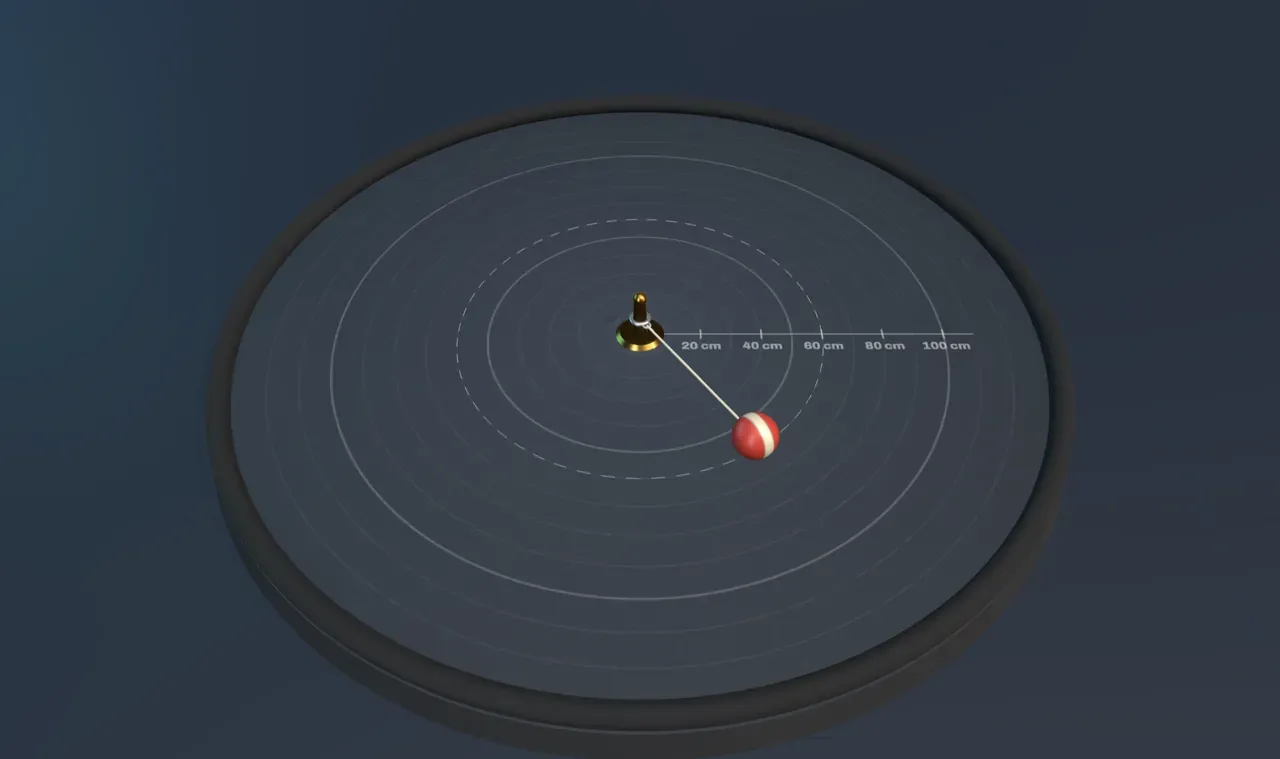
A ball rolls round a peg on a smooth, level table, tied to it by a string. The table carries the ball’s weight, so in the plane of the table the only force on it is the string’s pull. Right now the ball is moving at 2 m/s on a string 0.6 m long.
Motion like this, on a circle at a constant speed, is called uniform circular motion. Before looking closer, make a prediction: what will the ball do the moment the string is cut?
Step 2 of 6
The velocity turns
Forces, then cut now shows two arrows. The blue arrow is the ball’s velocity: always along the edge of the circle, along the tangent, and always the same length. The orange arrow is the string’s pull, always towards the peg and at right angles to the blue one.
The size of the velocity does not change, but its direction changes at every moment. Velocity is a vector, so a change of direction alone is still a change of velocity, which is to say an acceleration. And by Newton’s second law, an acceleration comes with a net force in the same direction.
Try it: change the Speed and watch both arrows. The blue arrow grows, and the orange arrow grows much faster.
Step 3 of 6
One turn
In one turn the ball covers the whole circumference of the circle, . The time for one turn is called the period, :
You can also measure the turning as an angle. In a full turn the ball sweeps radians round the peg, so every second it sweeps radians. This is the angular speed, in radians per second. It is the same link you met on the unit circle: an arc of length stands on an angle of radians, so .
The ball is now moving at 2.5 m/s on a string 0.8 m long, and both are fixed. Work out how long one turn takes.
Step 4 of 6
How fast the velocity turns
In a short time the ball moves round the peg through an angle , and the blue arrow turns through the same angle. Picture all the velocity arrows with their tails at one point: their heads move round a circle of radius . In the time the head covers an arc of length , and that is the change in velocity. So the acceleration is
That change is at right angles to the blue arrow, which means towards the centre, like the orange arrow. That is why this acceleration is called centripetal acceleration, “seeking the centre”.
The ball is now moving at 3 m/s on a string 0.5 m long.
Step 5 of 6
Twice the speed
The ball is moving at 1.5 m/s on a string 0.6 m long, and its acceleration is . What will happen to it when the speed doubles? Make your prediction, and the Scene will then switch to 3 m/s. Watch the number on the orange arrow too.
Step 6 of 6
An acceleration of ten
Now it is your turn to set it. The arrows are showing, and the string’s pull is printed on the orange arrow. The ball has a mass of 0.2 kg, so its acceleration is five times the number on the arrow: .
Try it: set String length to 0.5 m and Speed to 3 m/s, then the string to 1 m and the speed to 1 m/s. Which gives the larger acceleration?
Loading the interactive version…
Loading the interactive version…
Each step sets up the Scene for you, and a control marked “fixed” stays put for that step.
Practice · Predict, then look
The ball is going round at 2 m/s on a string 0.6 m long. The string is cut. What path will the ball take?
Practice · Predict, then look
The ball is going round at 2 m/s on a string 0.6 m long. The string is cut. What path will the ball take?
Practice · Choose
The ball moves on a circle at 2 m/s, and the size of its velocity does not change. Which way does its acceleration point?
Practice · Choose
The ball moves on a circle at 2 m/s, and the size of its velocity does not change. Which way does its acceleration point?
Practice · Calculate
The ball moves at 2.5 m/s on a string 0.8 m long. How long does one turn take?
Practice · Calculate
The ball moves at 2.5 m/s on a string 0.8 m long. How long does one turn take?
Practice · Calculate
The ball moves at 3 m/s on a string 0.5 m long. What is the size of its acceleration?
Practice · Calculate
The ball moves at 3 m/s on a string 0.5 m long. What is the size of its acceleration?
Practice · Predict, then look
On this circle the acceleration is 3.75 m/s². The speed is doubled, from 1.5 m/s to 3 m/s, on the same string. What will the acceleration be?
Practice · Predict, then look
On this circle the acceleration is 3.75 m/s². The speed is doubled, from 1.5 m/s to 3 m/s, on the same string. What will the acceleration be?
Practice · Reach the target
Change the Speed and the String length until the ball’s acceleration is 10 m/s², then press Check.
Practice · Reach the target
Change the Speed and the String length until the ball’s acceleration is 10 m/s², then press Check.
Lesson complete. Every practice question here is done.