A sound that changes as it passes
Stand by a road as an ambulance races past. As it approaches, the siren sounds high; the instant it passes, the note drops. The driver hears no change at all. The siren is making the same sound the whole time, so the change must come from the movement between the siren and you.
The effect is named after Christian Doppler, an Austrian physicist who predicted it in 1842. A few years later, in 1845, the Dutch scientist Christophorus Buys Ballot tested it with musicians playing a steady note on a moving train while others beside the track judged the pitch they heard.
Crests bunched and stretched
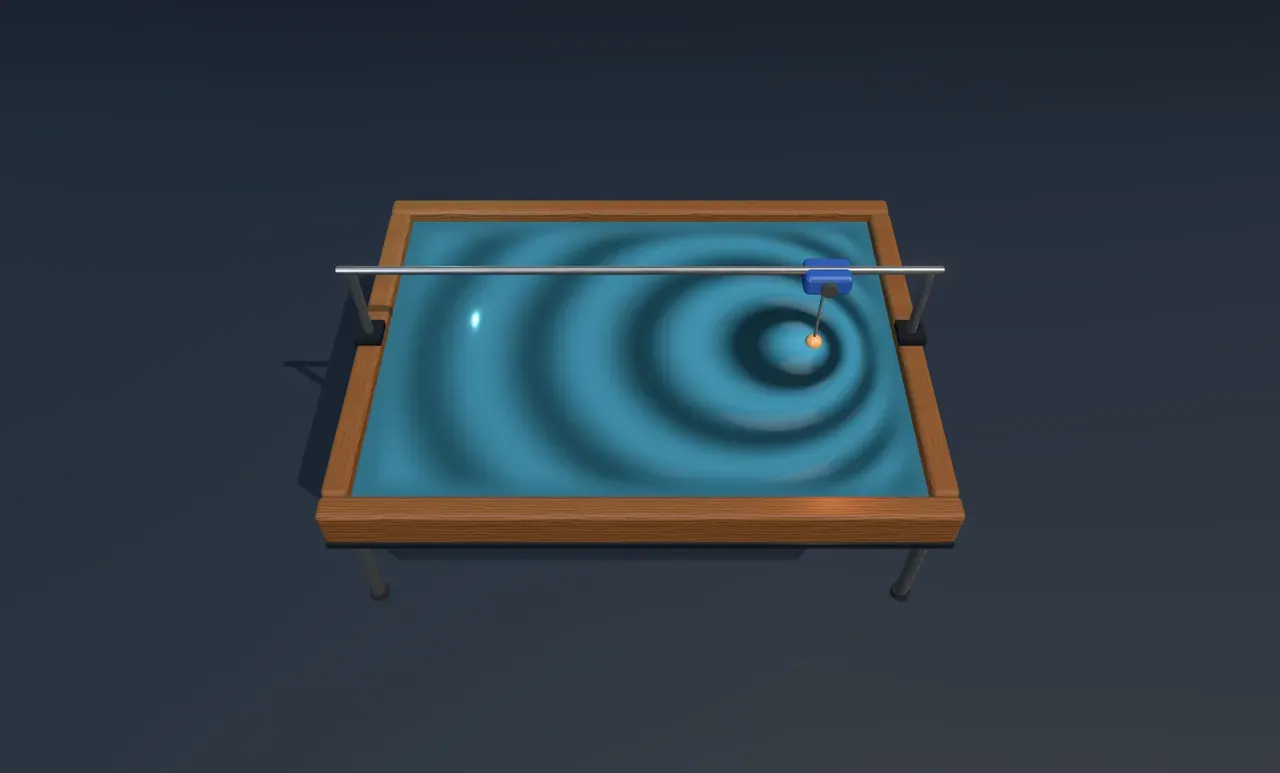
The tank shows why. A bead taps the water a fixed number of times a second, and each tap starts a ring that spreads out at the wave speed, centred on the spot where the bead was when it made it. If the bead stands still, every ring shares the same centre and the crests are evenly spaced in every direction.
Now let the bead move. Each new ring starts a little further along than the last. Ahead of the bead the crests are squeezed together, because the bead is following its own waves. Behind it they are spread apart, because the bead is moving away from them. The wave speed has not changed, so crests that arrive closer together also arrive more often. Ahead, a listener hears a higher frequency; behind, a lower one.
Try it: set Source speed to 0, then 0.5 × wave speed. Choose On under Show the crests and compare the spacing ahead of the bead with the spacing behind it.
At half the wave speed, the crests ahead are half as far apart as when standing still, so the pitch there is twice as high, an octave up. Behind, they are one and a half times as far apart, so the pitch is two thirds of the original.
The barrier and the boom
Slide Source speed up to 1 × wave speed. Now it keeps pace with every crest it makes, and they all pile up into a single tall front just ahead of it. For an aircraft this is the sound barrier: the air in front is piled into one sharp jump in pressure. The first aircraft confirmed to fly faster than sound in level flight was the Bell X-1, flown by Chuck Yeager in 1947.
Go faster still and the bead outruns its own waves. No ripples reach the water ahead of it at all. Behind, the rings it leaves overlap along two straight edges that form a V, or in three dimensions a cone. The faster the source, the narrower the cone. When the edge of that cone sweeps over you, you hear the whole pile-up at once: a sonic boom.
Where it is used
Doppler shifts are a way of measuring speed from a distance. Police radar compares the frequency of microwaves sent out with those reflected from a car. Doctors use ultrasound reflected from moving blood cells to measure blood flow. Astronomers measure how the colour of starlight shifts as a star moves towards or away from us, and have found many planets around other stars from the tiny wobble a planet’s pull gives its star.
What the model leaves out
The bead moves in a straight line at a steady speed, then is lifted out and dipped in again at the start of the tank, so the oldest ripples come from earlier passes. A real moving source also changes the loudness and shape of its waves, and a real shock wave is a steep jump in pressure that this gentle ripple model only sketches. The listener here is still; when the listener moves instead, the frequency changes too, by a slightly different rule.