A moving source squeezes the waves in front of it and stretches them behind: the wavelength and frequency ahead of the source and behind it, why a passing siren drops in pitch, and what happens at the wave speed.
Step 1 of 5 · A moving source
Step 1 of 5
A moving source
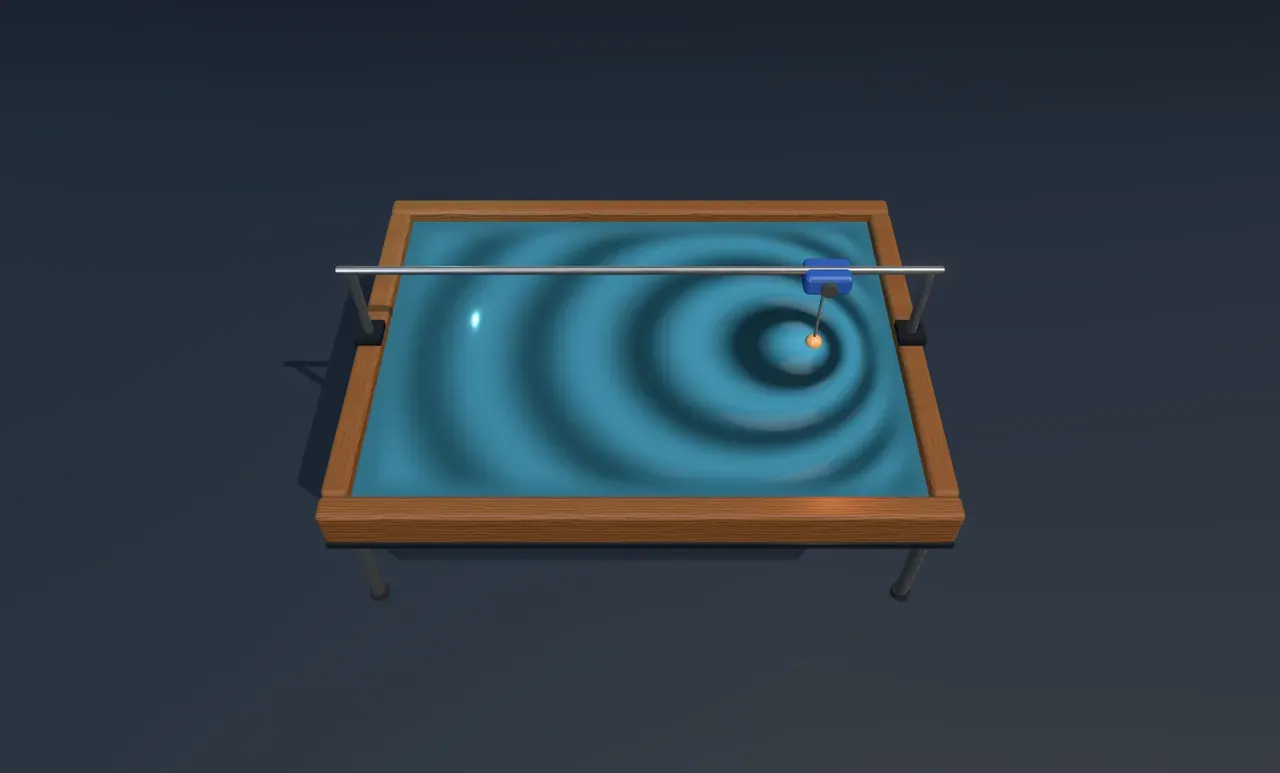
The ripple tank again, and this time the bead is fixed to a cart that can cross the tank. Source speed is measured against the wave speed: means half the wave speed, which here is 25 cm/s. The Frequency is fixed at 6 Hz, and time is slowed down 5 times.
While the bead stands still, the wavelength in every direction is centimetres. Predict what will change when the bead moves, then look.
Step 2 of 5
What you hear ahead of the source
In each cycle, , the bead sends out one crest. In that time the crest before it has moved on , but the bead, moving at speed , has moved on the same way. So in front of it the gap between crests is smaller:
And the wave still travels at , so a listener standing in front of the source receives the crests at a frequency
Behind the source everything is reversed: , and the frequency . This is the Doppler effect. Source speed and Frequency are fixed now.
Step 3 of 5
Ten hertz ahead
The bead’s Frequency is fixed at 6 Hz. Find the source speed at which a listener in front of it receives 10 Hz.
Try it: after checking, slide Source speed up to 1 × wave speed and then to 1.2. At the wave speed all the crests pile up into one front just ahead of the bead, and beyond it they trail behind it in a V: the wave of a sonic boom. No wave reaches the water in front of such a source, and the formula no longer applies.
Step 4 of 5
A passing siren
An ambulance with a siren does exactly what the bead does. The driver moves with the siren, so they hear the frequency it plays. Someone standing on the pavement hears a different frequency, which depends on whether the ambulance is coming towards them or going away.
Step 5 of 5
A real siren
The formula works for sound too. The speed of sound in air is 343 m/s, and a fast ambulance travels at about 30 m/s, so is much smaller than in the tank. The change in pitch is smaller, but you still hear it clearly.
Loading the interactive version…
Loading the interactive version…
Each step sets up the Scene for you, and a control marked “fixed” stays put for that step.
Practice · Predict, then look
The bead is about to start moving at half the wave speed, still tapping 6 times a second. What will happen to the crests?
Practice · Predict, then look
The bead is about to start moving at half the wave speed, still tapping 6 times a second. What will happen to the crests?
Practice · Calculate
The bead taps at 6 Hz and moves at half the wave speed. At what frequency do the crests reach a spot that stands in front of it?
Practice · Calculate
The bead taps at 6 Hz and moves at half the wave speed. At what frequency do the crests reach a spot that stands in front of it?
Practice · Reach the target
The Frequency is fixed at 6 Hz. Change Source speed until a spot in front of the bead receives the crests at 10 Hz, and press Check.
Practice · Reach the target
The Frequency is fixed at 6 Hz. Change Source speed until a spot in front of the bead receives the crests at 10 Hz, and press Check.
Practice · Choose
An ambulance with its siren on drives at a steady speed along the road, passes you and drives away. What do you hear?
Practice · Choose
An ambulance with its siren on drives at a steady speed along the road, passes you and drives away. What do you hear?
Practice · Calculate
A siren plays 700 Hz, and the ambulance drives straight towards you at 30 m/s. The speed of sound is 343 m/s. What frequency do you hear?
Practice · Calculate
A siren plays 700 Hz, and the ambulance drives straight towards you at 30 m/s. The speed of sound is 343 m/s. What frequency do you hear?
Lesson complete. Every practice question here is done.