Two questions about a curve
A car’s speedometer and its trip counter answer two different questions. One says how fast you are going right now; the other says how far you have gone so far. Calculus is the mathematics of those two questions for any changing quantity: how fast it is changing at one instant, a rate, and how much it has added up to, an area.
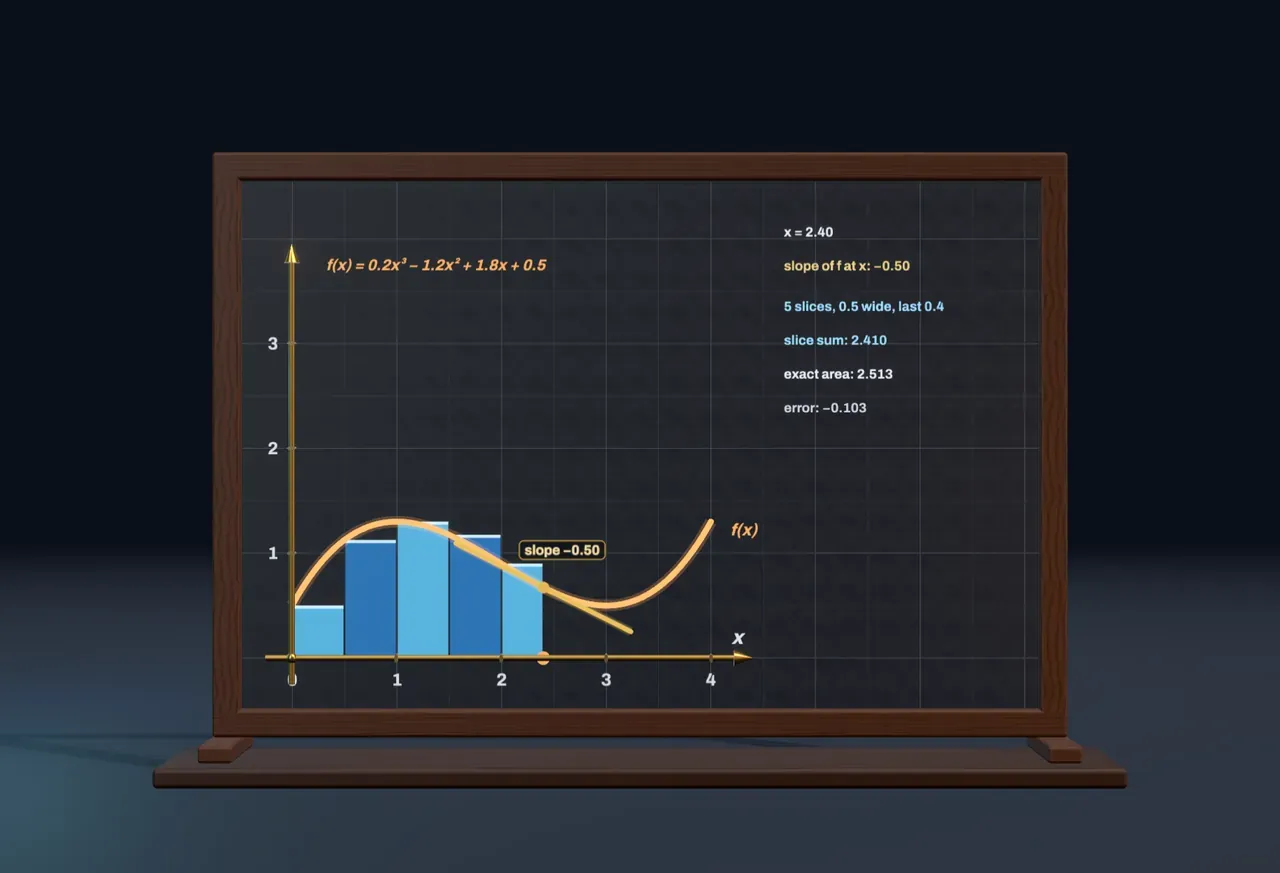
The board shows a curve with a hill at x = 1 and a dip at x = 3. A straight line touches it at the point x, and blue slices fill the area under it from 0 up to that point.
Slope: how steep at one point
A curve has no single steepness, it changes as you go along. To measure it at one point, lay a straight edge on the curve so that it just touches there without cutting across. That line is the tangent, and its steepness, how far it rises for each step to the right, is the curve’s slope at that point, also called the derivative.
Watch the tangent line as you move Point x. Climbing the hill it tilts up and the slope is positive. At the top it lies level: the slope is exactly 0. Going down into the dip it tilts down and the slope is negative, until it lies level again at the bottom. For this curve the slope is 0.6(x − 1)(x − 3), which is zero at exactly those two places.
Area: adding up thin slices
The area under a curved top has no simple formula from school geometry. The trick is to cut it into thin upright slices. Each slice is nearly a rectangle, and a rectangle’s area is width times height. Add up all the rectangles and you have an estimate, called a Riemann sum after Bernhard Riemann, who made the idea rigorous in the 1850s. The idea itself is far older: in the third century BC Archimedes found the area of a curved piece of a parabola by filling it with ever smaller triangles.
Here each slice is as tall as the curve at its left edge. Where the curve is rising, the slices fall short of it; where it falls, they poke above it. The readout adds them up and compares the total with the exact area.
Try it: set Slice width to 1, 0.5 and then 0.1 and watch the error shrink. Then press Hilltop on Point x and slide Thinner slices to Exact area.
Narrower slices, smaller error
With Point x at 4, the slice sum is 3.2 when the slices are 1 wide, 3.4 at 0.5 and 3.56 at 0.1, closing in on the exact area of 3.6. Halving the width halves the error here, because each slice’s mistake is a thin sliver that shrinks with it. Let the width shrink towards zero and the sum settles on one number: that limit is the exact area, the integral.
The exact value does not need endless slices. It comes from a second formula, the antiderivative, A(x) = 0.05x⁴ − 0.4x³ + 0.9x² + 0.5x, which gives the area under the curve from 0 to any x.
Slope and area undo each other
Slide Thinner slices to Exact area and the slices merge into one smooth fill. A pink curve rises above it: A(x), the area collected so far as the point moves right. A second tangent line touches that curve at the same x, with a slope triangle under it, one unit across.
The rise of that triangle is exactly as tall as the mint line from the axis up to the first curve. The rate at which the area grows is the height of the curve: where the curve is tall, each step right adds a lot of area and A climbs steeply; where it dips, A barely rises. This is the fundamental theorem of calculus: finding a slope and finding an area are inverse operations, each undoing the other. It is why the antiderivative gives exact areas, and why the speedometer’s reading is the rate at which the trip counter climbs.
Isaac Newton and Gottfried Wilhelm Leibniz worked this out independently in the second half of the 17th century. Leibniz published first, in 1684, and his notation, dx for a thin slice and the stretched S of ∫ for a sum, is still used today.
What this model leaves out
The curve is one fixed, smooth polynomial that stays above the axis, so every area here is positive; below the axis, area counts as negative. The slices use the curve’s height at their left edge, one of several common choices, and the last slice is cut off at the point x. Slopes, the slice sum and the exact area are printed rounded, but each is computed from the formulas, not measured from the drawing.