A reaction that waits
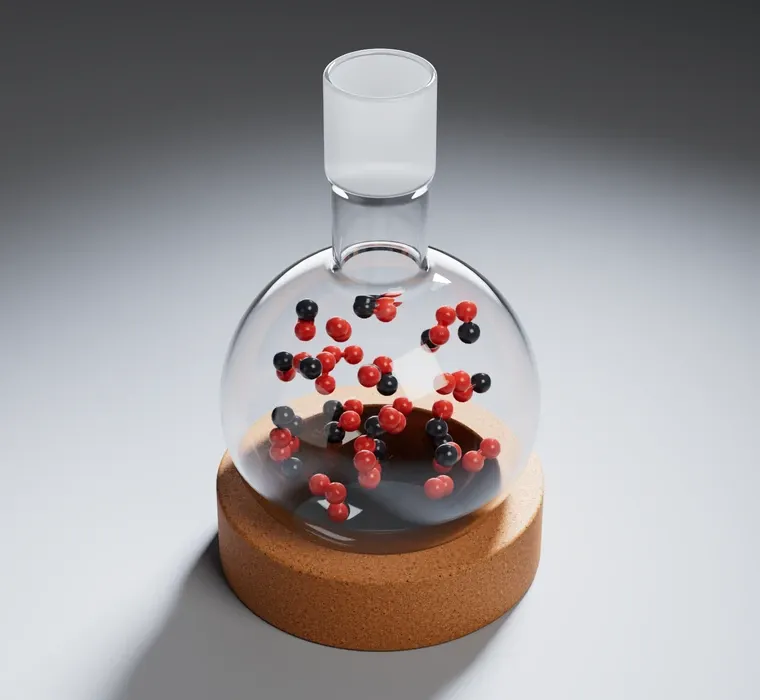
Carbon monoxide is a poisonous gas that every petrol engine makes. Mixed with oxygen it could burn to harmless carbon dioxide and release plenty of energy, yet at ordinary temperatures the two gases can sit together for a very long time and hardly react. The barrier between them is too high: to get started, a collision must begin pulling apart the strong double bond in an oxygen molecule, and almost no collision in the gas is hard enough to do it.
A car’s catalytic converter solves this with a thin coat of precious metals such as platinum on a honeycomb inside the exhaust pipe. The same gases that pass each other unchanged in the air react quickly on the metal.
How the metal helps
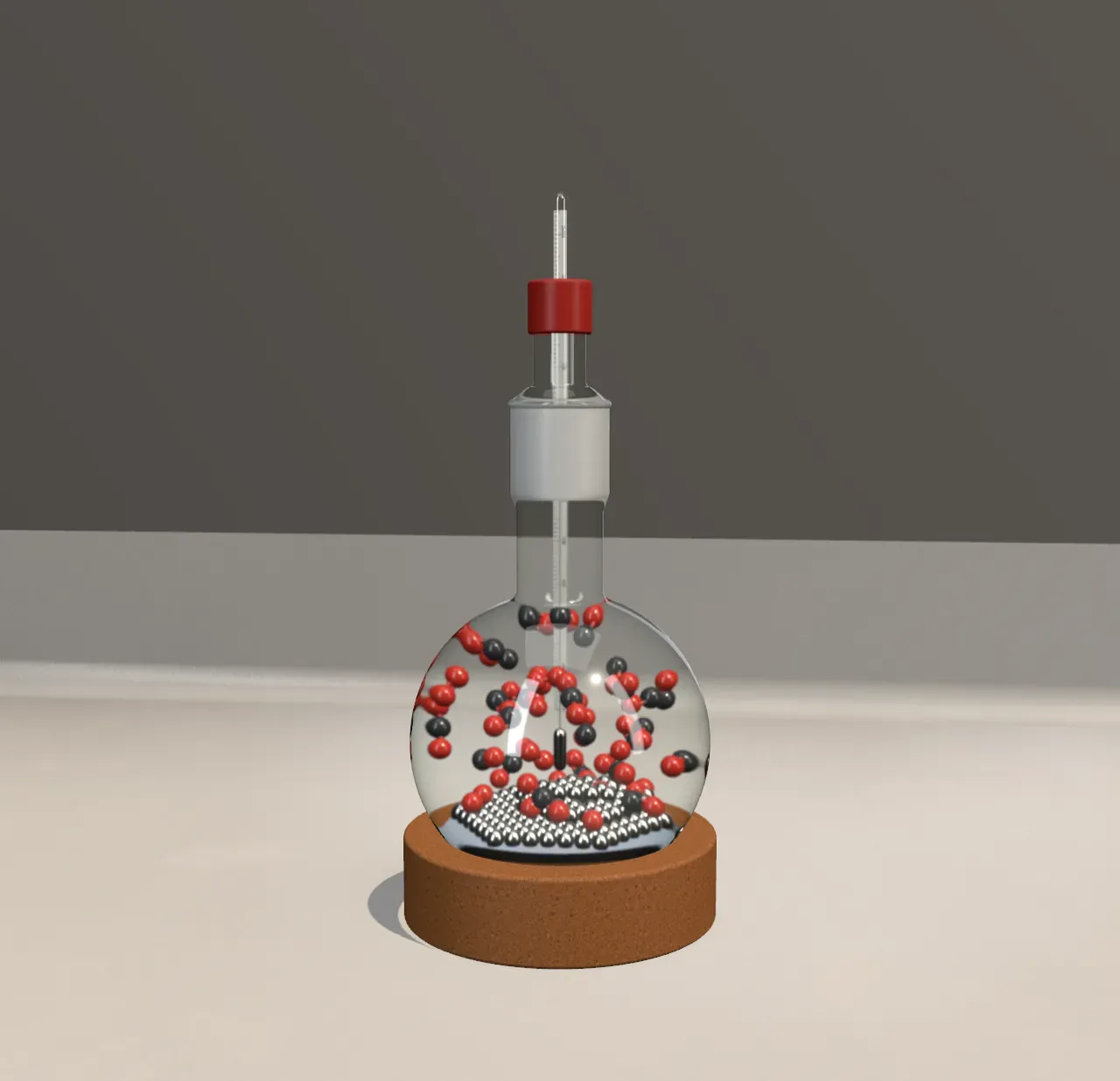
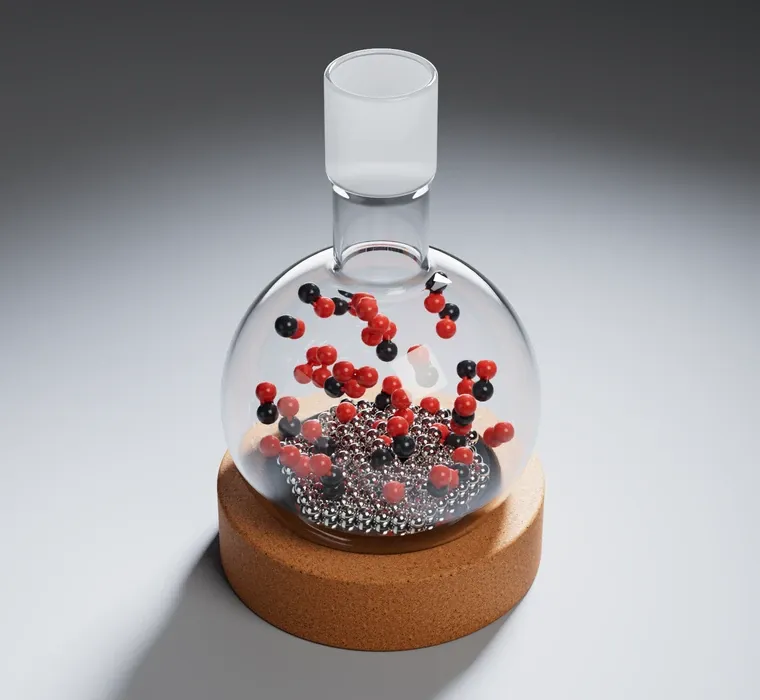
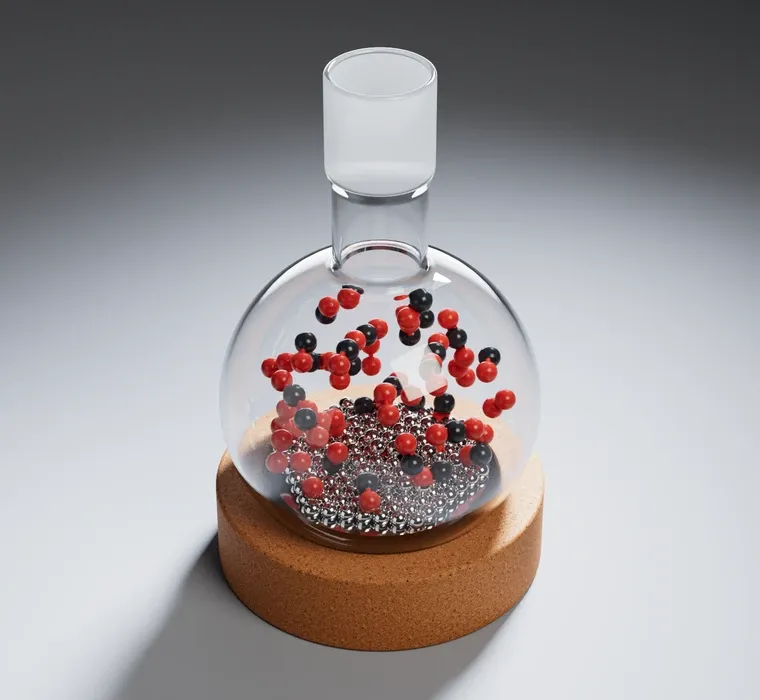
Watch the platinum plate in the flask. Molecules that land on it stick for a while. An oxygen molecule that lands is pulled apart into two separate atoms, because the metal atoms bind each oxygen strongly enough to break the bond between them. A carbon monoxide molecule that wanders across the surface and meets one of those loose oxygen atoms needs only a small push to join it, and a carbon dioxide molecule lifts off.
The reaction has taken a different path, made of easier steps, and the highest hill on that path is much lower. This is what a catalyst does: it provides a route with a lower activation energy. Holding the molecules still on its surface also takes care of aim, so a collision no longer has to arrive the right way round.
Try it: choose Cold start and switch Platinum catalyst off, then on. Then choose Warm engine. Compare the two lines on the energy curve: the share of molecules above the lower barrier is many times larger. Choose On under Highlight energetic molecules to light the molecules with more energy than the barrier.
Never used up
After each reaction the platinum is exactly as it was, ready for the next pair. That is why a few grams of metal in a converter can clean exhaust for years. A catalyst changes how fast a reaction reaches its end, not where that end is: it speeds the reverse reaction just as much, and it cannot make a reaction happen that would not happen on its own given enough time.
Even with a catalyst, temperature still matters. A converter does little until the exhaust has heated it to a few hundred degrees Celsius, which is why a car pollutes most in the first minutes after a cold start.
Catalysts all around
Much of modern chemistry runs on catalysts. In the Haber process, an iron catalyst at roughly 400 to 450 °C and about 200 times atmospheric pressure joins nitrogen from the air with hydrogen to make ammonia. Most of that ammonia becomes fertiliser, and food for roughly half the people alive today depends on it. Living things use catalysts too: enzymes, proteins whose folded shape holds the reacting molecules just right.
What this model leaves out
The barriers in the flask are a few times lower than the real ones, so you do not have to wait. A real catalytic surface has particular sites where molecules bind best, molecules can crowd each other off the surface, and a cold converter is actually blocked by carbon monoxide sitting on the metal. Real converters also turn nitrogen oxides back into nitrogen and burn leftover fuel. The flask is topped up with fresh gas so the rate you see stays steady.