The hump every reaction has to get over, and how a catalyst opens a lower route without giving any energy and without running out: the platinum in a catalytic converter.
Step 1 of 5 · The barrier
Step 1 of 5
The barrier
Carbon monoxide, , is a poisonous gas that comes out of an engine. With oxygen it can become carbon dioxide: . The reaction gives out a lot of energy, and yet in the flask, at 550 K and without a catalyst, almost nothing happens.
The top chart is the spread of energies from the last Lesson; the bottom chart is the reaction’s energy profile: the substances’ energy along the way from reactants to products.
Step 2 of 5
Putting in the platinum
A catalyst is a substance that speeds up a reaction without being used up by it. In a car’s catalytic converter the catalyst is platinum, a precious metal, in a thin layer over a large surface. Here Temperature is fixed at 550 K, the heat of an engine that has warmed up. Predict what Platinum catalyst will do.
Step 3 of 5
A lower hump
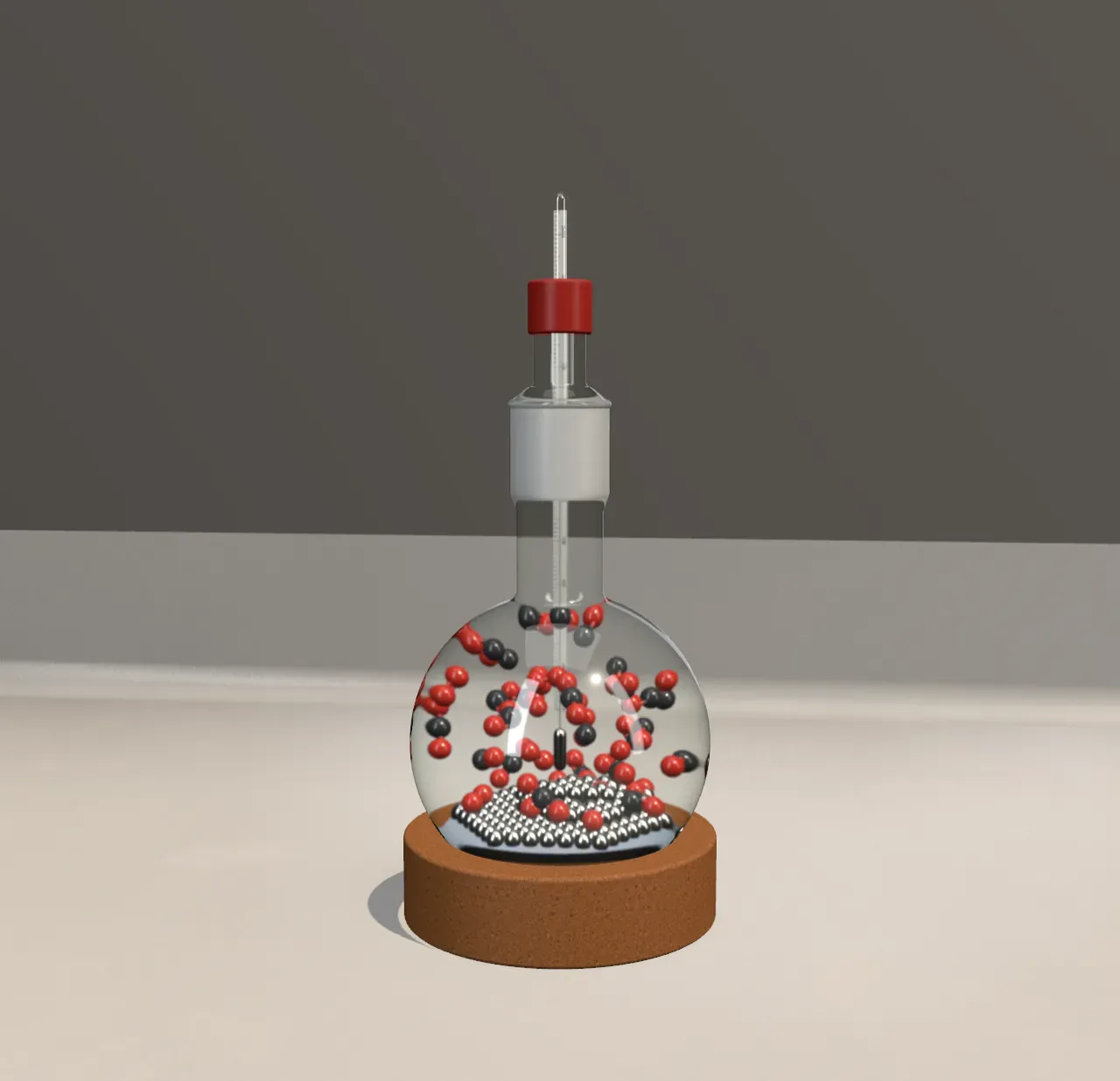
On the platinum the reaction goes another way: molecules bind to the metal and split into atoms, and molecules landing beside them react with them. Each step on this route has a low barrier. On the energy profile this route is drawn as a dashed line.
Step 4 of 5
Heating instead
If the high barrier is the problem, could you just heat more? The last Lesson showed that heating grows the share that clears the barrier. Predict by how much.
Step 5 of 5
It never runs out
A catalyst takes part in the reaction, but does not appear in its overall equation: it comes out as it went in. Watch the plate at the bottom of the flask while the reaction runs.
Loading the interactive version…
Loading the interactive version…
Each step sets up the Scene for you, and a control marked “fixed” stays put for that step.
Practice · Choose
In the second chart, the hump between reactants and products is marked . What is the activation energy?
Practice · Choose
In the second chart, the hump between reactants and products is marked . What is the activation energy?
Practice · Predict, then look
The flask holds carbon monoxide and oxygen at 550 K, without a catalyst: almost nothing reacts. What will happen when you put the Platinum catalyst in?
Practice · Predict, then look
The flask holds carbon monoxide and oxygen at 550 K, without a catalyst: almost nothing reacts. What will happen when you put the Platinum catalyst in?
Practice · Calculate
Read it off the Activation barrier chart: what is the activation energy on the platinum route?
Practice · Calculate
Read it off the Activation barrier chart: what is the activation energy on the platinum route?
Practice · Predict, then look
With the platinum at 550 K, about 9% of the molecules clear the barrier. If you take the catalyst out and heat instead, to the top of the scale, 800 K, will a similar share of molecules clear the barrier?
Practice · Predict, then look
With the platinum at 550 K, about 9% of the molecules clear the barrier. If you take the catalyst out and heat instead, to the top of the scale, 800 K, will a similar share of molecules clear the barrier?
Practice · Choose
A catalytic converter works in a car for ten years and more. What happens to its platinum in each of the reactions it speeds?
Practice · Choose
A catalytic converter works in a car for ten years and more. What happens to its platinum in each of the reactions it speeds?
Lesson complete. Every practice question here is done.