Where the energy in a reaction goes: burning that gives out heat, the power of a flame, the sign of ΔH, and a cold pack that takes heat in from your hand.
Step 1 of 5 · Heat coming out
Step 1 of 5
Heat coming out
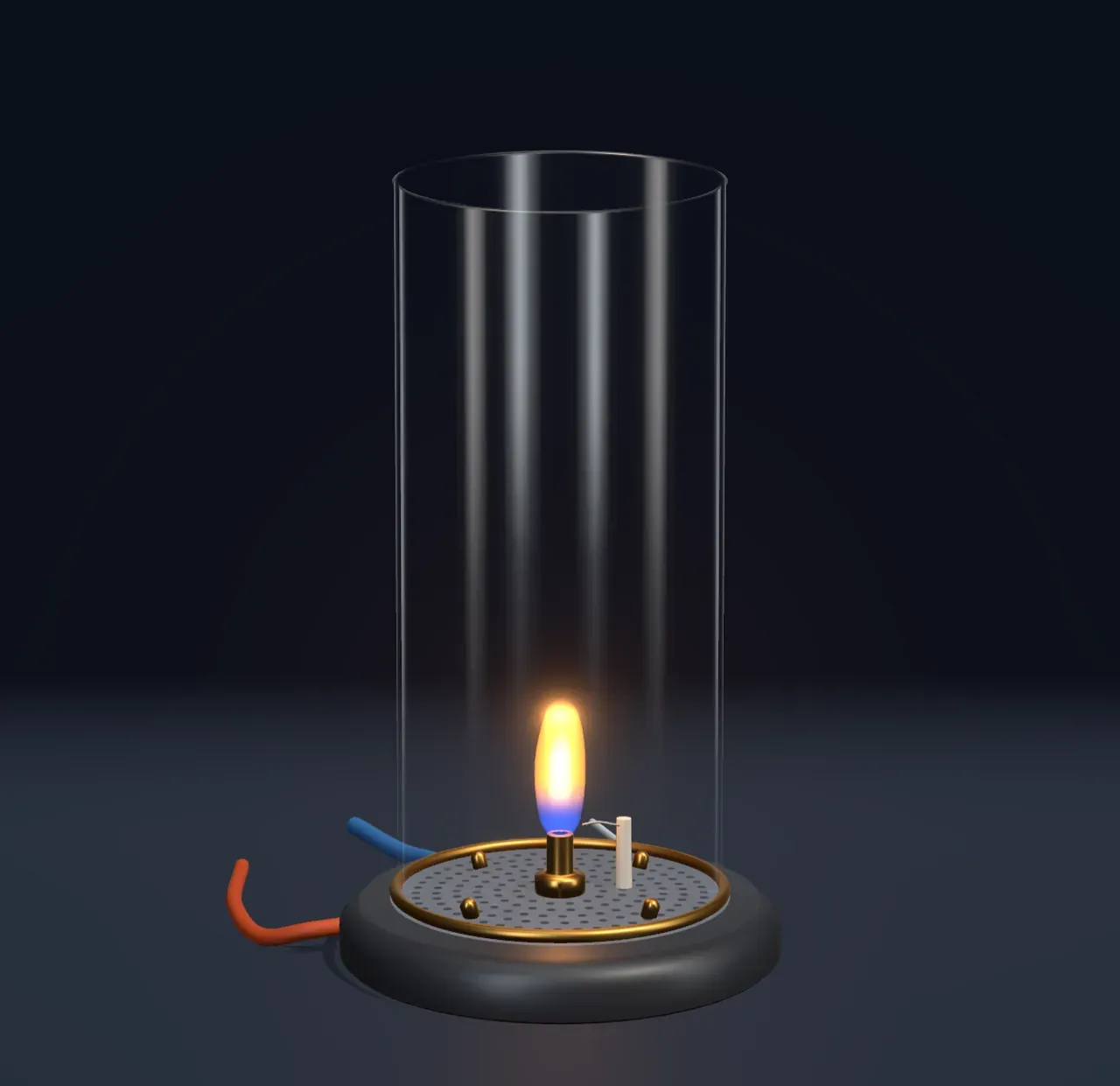
In the glass chimney a jet of methane burns, the gas in a cooker: . The flame warms the glass and the air around it. That energy was not made from nothing: it was stored in the substances, and the reaction released it.
A reaction that hands energy to its surroundings, usually as heat, is called exothermic. A reaction that takes energy from its surroundings is called endothermic.
Step 2 of 5
The flame’s power
Each mole of methane burned gives out 802 kJ. The flame burns methane at a steady rate, so it gives out heat at a steady rate: a power, in joules per second, that is in watts. Here Gas flow, Oxygen in the air and Water mist are fixed.
Step 3 of 5
A bigger flame
Because every mole gives out the same energy, the heat per second goes in proportion to the gas burned per second. Gas flow is now free.
Step 4 of 5
The sign of ΔH
Chemists describe a reaction’s energy by its enthalpy change, : the products’ energy minus the reactants’. On the energy profile of an exothermic reaction the products sit below the reactants, so . In an endothermic reaction they sit higher, and .
Step 5 of 5
Heat going in
Endothermic reactions and processes are less striking, because they neither glow nor warm anything. But you can feel them: they cool what is around them. Photosynthesis takes in the energy of sunlight; limestone, , breaks down to lime only when it is heated in a kiln; and some salts take in heat as they dissolve in water.
Loading the interactive version…
Loading the interactive version…
Each step sets up the Scene for you, and a control marked “fixed” stays put for that step.
Practice · Choose
The flame lights only after the igniter sparks. Is burning methane an exothermic reaction (giving out heat) or an endothermic one (taking it in)?
Practice · Choose
The flame lights only after the igniter sparks. Is burning methane an exothermic reaction (giving out heat) or an endothermic one (taking it in)?
Practice · Calculate
Gas flow is fixed at 4 cm³/s of methane. A mole of gas fills 24,055 cm³ here, and each mole of methane burned gives out 802 kJ. What is the flame’s power, that is, how much heat does it give out each second?
Practice · Calculate
Gas flow is fixed at 4 cm³/s of methane. A mole of gas fills 24,055 cm³ here, and each mole of methane burned gives out 802 kJ. What is the flame’s power, that is, how much heat does it give out each second?
Practice · Reach the target
Change Gas flow so that the flame gives out 200 W, then press Check.
Practice · Reach the target
Change Gas flow so that the flame gives out 200 W, then press Check.
Practice · Calculate
Burning a mole of methane to and water vapour gives out 802 kJ to the surroundings. What is for the reaction , with its sign?
Practice · Calculate
Burning a mole of methane to and water vapour gives out 802 kJ to the surroundings. What is for the reaction , with its sign?
Practice · Choose
An instant cold pack for injuries holds ammonium nitrate, , and water. Squeeze it and the solid dissolves and the pack quickly turns cold. Why?
Practice · Choose
An instant cold pack for injuries holds ammonium nitrate, , and water. Squeeze it and the solid dissolves and the pack quickly turns cold. Why?
Lesson complete. Every practice question here is done.