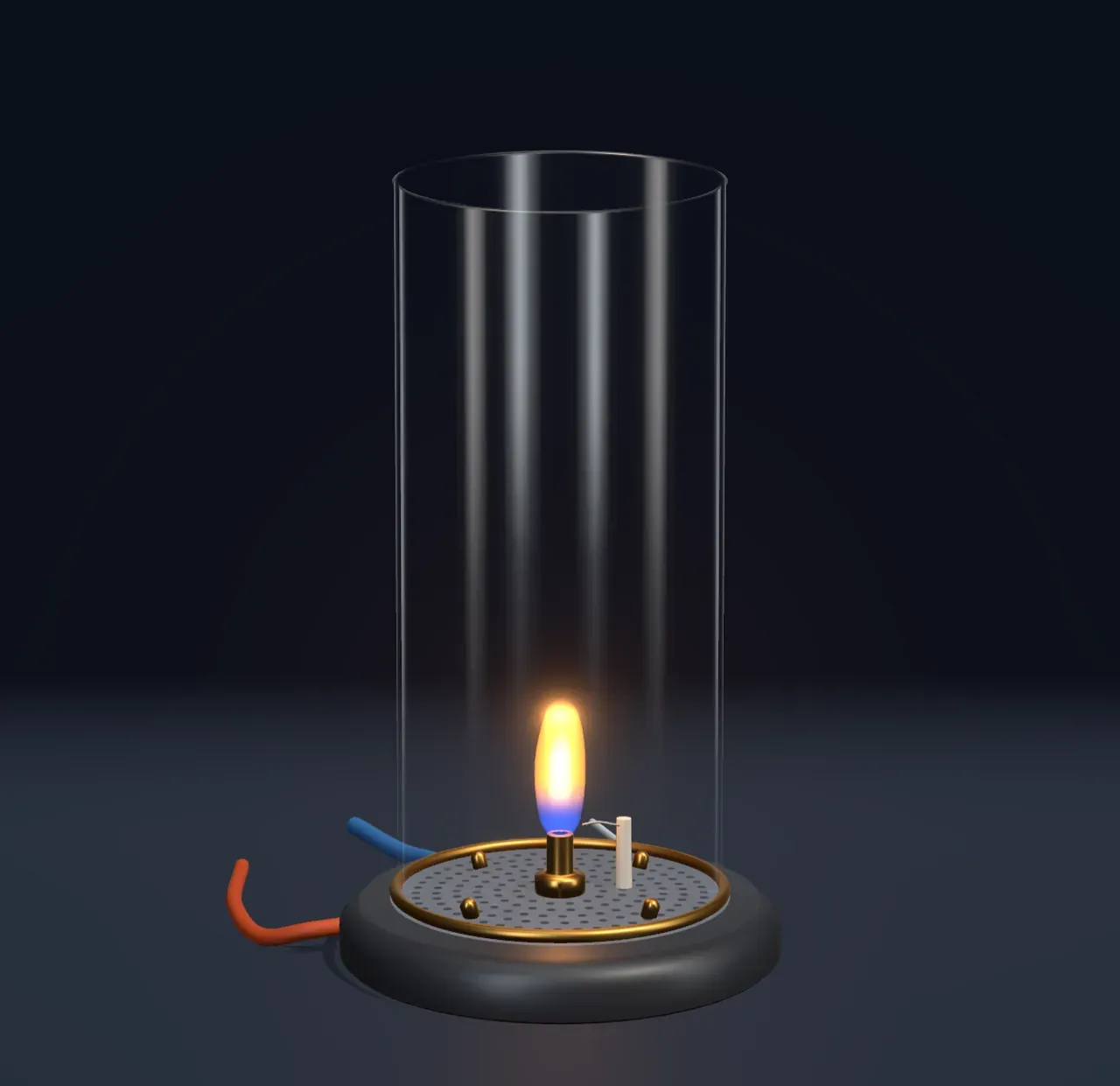
Fire is a chemical reaction
A gas flame looks like a thing, but it is a place where a reaction is happening. Methane, the main part of natural gas, streams out of the jet. Oxygen from the air around it drifts in. Where the two meet in the right proportion they react:
One molecule of methane and two of oxygen become one of carbon dioxide and two of water, and the reaction gives out heat: about 800 kilojoules for every 16 grams of methane, enough to bring more than two litres of cold water to the boil. Combustion is the name for any fast reaction like this, a fuel combining with oxygen and releasing heat and light. Wood, wax, petrol and coal burn in the same way; they just bring more complicated fuel molecules.
The steady flame in the Scene burns 4 cubic centimetres of methane a second and gives out about 130 watts, a little more than a large candle.
The fire triangle
Fire-fighters sum up what a flame needs in a triangle: fuel, oxygen and heat. All three must be there at once. Take any one away and the fire goes out. The diagram beside the experiment draws that triangle and breaks the side that is missing.
Try it: set Gas flow to zero and the fuel side breaks. Bring it back, then slide Oxygen in the air down to 12 %. Bring the oxygen back and slide Water mist up to 10 mg/s. Three different causes, one result.
Each leg is a real way to fight a fire. Closing a gas valve, or clearing brush ahead of a forest fire, takes the fuel. A fire blanket, a lid on a burning pan or a foam that seals a fuel spill keeps the oxygen out. Water takes the heat.
Why it needs heat
Methane and oxygen sit together in the air of a kitchen without reacting at all. Before new bonds can form, some of the old ones in the methane and oxygen molecules have to be broken, and that costs energy first. The energy a collision needs to get the reaction going is called the activation energy. At room temperature almost no collisions have it, so a mixture of gas and air can wait for ever.
A spark or a match gives a small pocket of gas enough energy to start. The reaction then releases far more heat than it took to begin, and that heat starts the next layer of gas, and the next. This is why a flame keeps itself going once it is lit: it supplies its own heat leg. It is also why it needs a lot of it. Below about 1,330 °C the reactions in a hydrocarbon flame run more slowly than heat leaks away, and the flame dies even though fuel and oxygen are still there.
Why it needs enough oxygen
Air is only about a fifth oxygen. Almost all the rest is nitrogen, which does not burn but cannot be kept out of the way: it arrives with the oxygen, and the flame has to heat it. For each molecule of methane burned in air, about seven and a half molecules of nitrogen come along and soak up most of the heat. That is why methane burning in air reaches about 1,950 °C rather than the 2,800 °C or so it reaches in pure oxygen.
Thin the oxygen and there is more nitrogen to heat for the same amount of burning. The flame temperature falls, and somewhere near 13 % oxygen it drops below the limit and the flame goes out, even though plenty of oxygen is left. Real fires in sealed rooms go out the same way, long before all the oxygen is used up.
Try it: slide Oxygen in the air slowly down from 21 %. The flame grows taller as it has to reach further for its oxygen, turns dimmer and bluer, and goes out around 13 %. Now slide it up to 30 %: a short, fierce, white flame.
How water puts a fire out
Water does not burn and it is not short of anything a flame wants, yet a fine mist kills a flame quickly. Each gram of water that reaches the flame has to be warmed to 100 °C, boiled, and then heated as steam to the flame’s temperature, and boiling alone takes 2,260 joules a gram. About eight milligrams of mist a second, sprayed into the air feed, takes away enough heat to drag the steady flame below its limit.
A bigger fire needs more water, because it makes more heat each second for the water to soak up. The amount that just puts the flame out grows with the gas flow.
Try it: slide Water mist up to 10 mg/s and the steady flame dies; the igniter keeps sparking, but nothing holds. Now set Gas flow to 8 cm³/s. The bigger flame lights again and survives the same mist.
Inside the flame
Choose Molecules under Zoom to the molecules to slice through the flame. Methane rises from the jet; oxygen and nitrogen drift in from the sides. Where methane meets oxygen at the flame’s edge, the two flash into carbon dioxide and water, which rise with the hot plume and out of the top. Nitrogen comes close, is heated and jostled, and leaves unchanged. With the flame out, the methane simply rises unburnt through the air, which is why an unlit gas leak is so dangerous.
This kind of flame, where fuel and air meet only at the flame’s edge, is called a diffusion flame. A candle and a campfire burn this way. A gas hob or a Bunsen burner with its air hole open mixes air into the gas before it burns, which gives a different, premixed flame.
Reading a flame’s colour
The blue at the base of a gas flame is light given off by short-lived fragments of molecules in the middle of reacting. The yellow above it is soot: tiny specks of carbon, formed where methane is heated before it finds enough oxygen, glowing because they are hot, like the filament of an old light bulb. They burn away at the flame’s tip. A flame close to its limit makes little soot and looks small and blue; one fed extra oxygen burns hotter and whiter.
When fuel burns without enough oxygen, some carbon ends up as soot and as carbon monoxide instead of carbon dioxide. Carbon monoxide has no colour or smell and stops blood carrying oxygen, which is why heaters and boilers need fresh air and why a yellow, smoky gas flame needs looking at.
The fourth side
Fire-fighters sometimes draw a fire tetrahedron, with a fourth face for the chain of reactions inside the flame. Those reactions are passed along by very reactive fragments of molecules. Some extinguisher powders work mostly by mopping these fragments up, which stops the chain even while fuel, oxygen and heat are still present.
What this model leaves out
The flame temperature here comes from simple bookkeeping: the heat the methane releases, shared out over the carbon dioxide, water vapour and nitrogen it must warm, with average heat capacities chosen so that methane in ordinary air comes out at the usual 1,950 °C. At these temperatures real flames also spend energy splitting some carbon dioxide and water apart, which caps them lower, so the temperatures above 21 % oxygen read high. The limit is a single temperature, 1,600 kelvin (about 1,330 °C), standing for chemistry that really depends on how fast the gases flow and how quickly heat escapes. The flame’s height follows an engineering rule for small steady jet flames; real flames of this size flicker and lean in a draught. The model treats every droplet of mist as reaching the flame and boiling there, and it draws the molecules slowly, hugely enlarged and far too few, in one thin slice through the flame.