Where a flame's heat comes from: breaking bonds takes energy in and making them gives it out, and working out the ΔH of burning from a table of bond energies.
Step 1 of 6 · Breaking and making
Step 1 of 6
Breaking and making
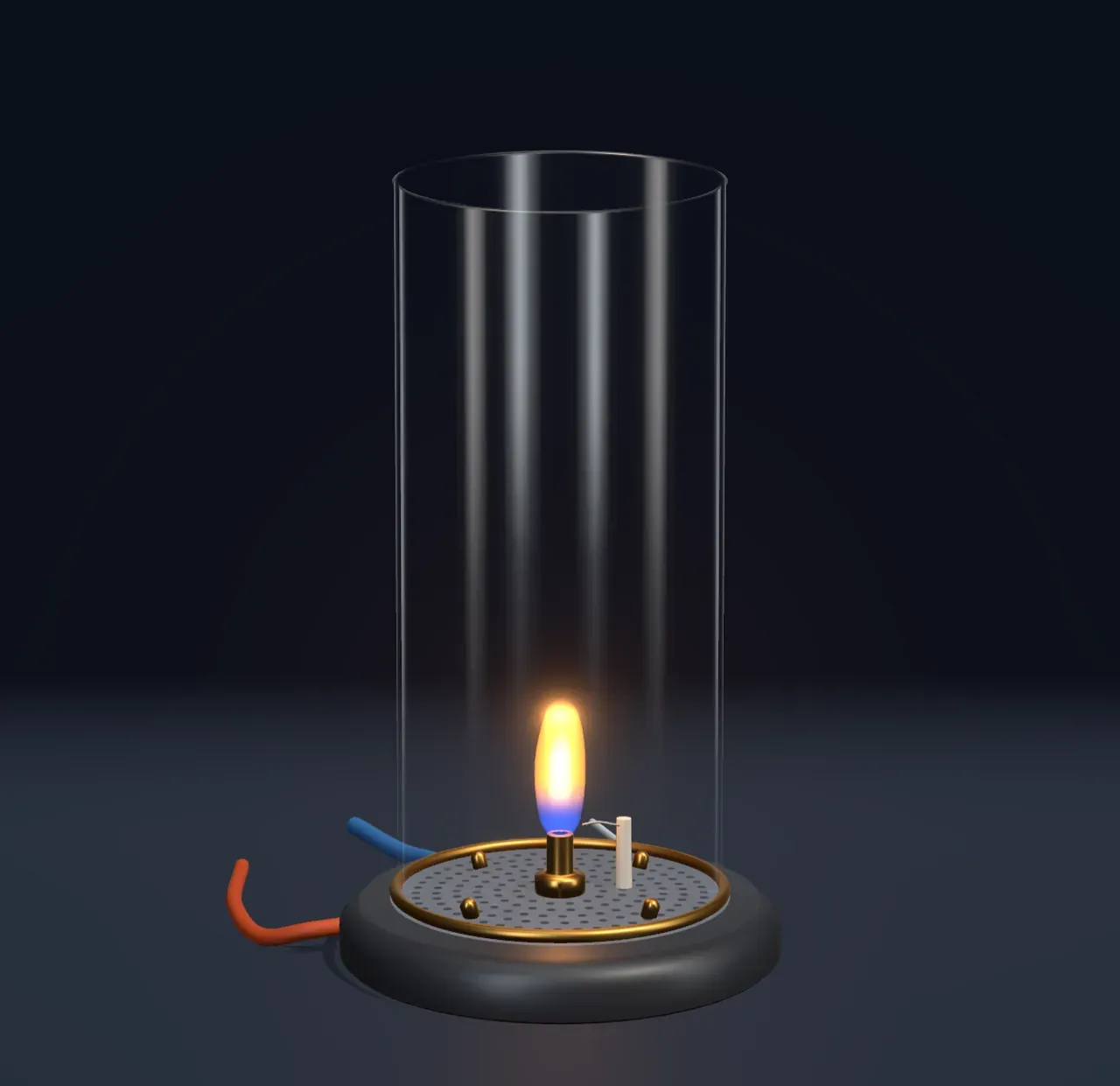
Zoom to the molecules is at Molecules: a slice through the flame that shows the molecules themselves. Methane () and oxygen () go in, and carbon dioxide () and water () come out. For that to happen, every bond in the reactants has to break, and every bond in the products has to form.
Step 2 of 6
The bonds that break
Every chemical bond holds a certain energy: the bond energy is the energy it takes to break a mole of such bonds. A double bond is stronger than a single bond between the same atoms. Count every bond in the reactants: each molecule, times its coefficient.
Step 3 of 6
The bonds that form
When a bond forms, it releases exactly the energy it takes to break it. Now count the bonds in the products.
Step 4 of 6
The difference
The reaction’s is what went in minus what came out:
If the new bonds are stronger than the old ones, more comes out than went in, and is negative: the reaction is exothermic.
Step 5 of 6
Averages
The flame in the Scene gives out 802 kJ per mole of methane, the measured value. Your calculation is close to it, but not exact.
Step 6 of 6
Another reaction
The same method works for any reaction in the gas, even when there is no flame to compare with.
Loading the interactive version…
Loading the interactive version…
Each step sets up the Scene for you, and a control marked “fixed” stays put for that step.
Practice · Choose
Zoom to the molecules is at Molecules: in the flame bonds break in methane and oxygen, and new bonds form in and water. What is true about the energy?
Practice · Choose
Zoom to the molecules is at Molecules: in the flame bonds break in methane and oxygen, and new bonds form in and water. What is true about the energy?
Practice · Calculate
Average bond energies, in kJ/mol: 413, 498. How much energy does it take to break all the bonds in the reactants of ?
Practice · Calculate
Average bond energies, in kJ/mol: 413, 498. How much energy does it take to break all the bonds in the reactants of ?
Practice · Calculate
has two bonds, 805 kJ/mol each, and each water molecule has two bonds, 464 kJ/mol each. How much energy is released when all the bonds in the products, , form?
Practice · Calculate
has two bonds, 805 kJ/mol each, and each water molecule has two bonds, 464 kJ/mol each. How much energy is released when all the bonds in the products, , form?
Practice · Calculate
From the last two answers: 2648 kJ go in to break bonds, and 3466 kJ come out from making them. What is for burning methane by bond energies, with its sign?
Practice · Calculate
From the last two answers: 2648 kJ go in to break bonds, and 3466 kJ come out from making them. What is for burning methane by bond energies, with its sign?
Practice · Choose
Bond energies gave , but a measurement of burning methane gives . Where does the difference come from?
Practice · Choose
Bond energies gave , but a measurement of burning methane gives . Where does the difference come from?
Practice · Calculate
Hydrogen and chlorine react: . Bond energies, in kJ/mol: 436, 243, 432. What is the reaction’s , with its sign?
Practice · Calculate
Hydrogen and chlorine react: . Bond energies, in kJ/mol: 436, 243, 432. What is the reaction’s , with its sign?
Lesson complete. Every practice question here is done.