Atoms change partners
A match flares, an iron nail rusts, milk turns sour. Each is a chemical reaction: bonds between atoms break and new bonds form, so the atoms end up arranged into different substances. No atom is made or destroyed along the way.
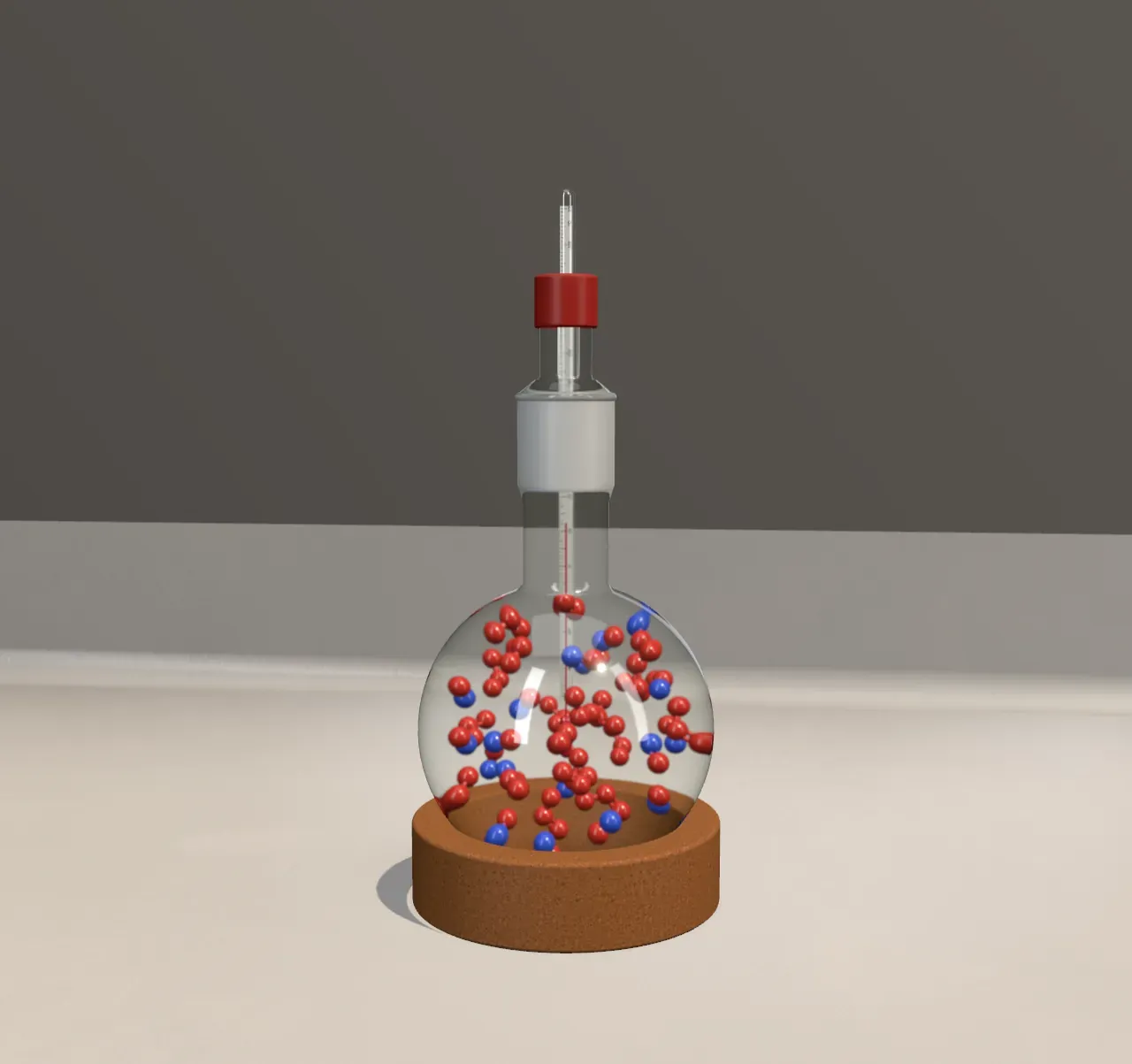
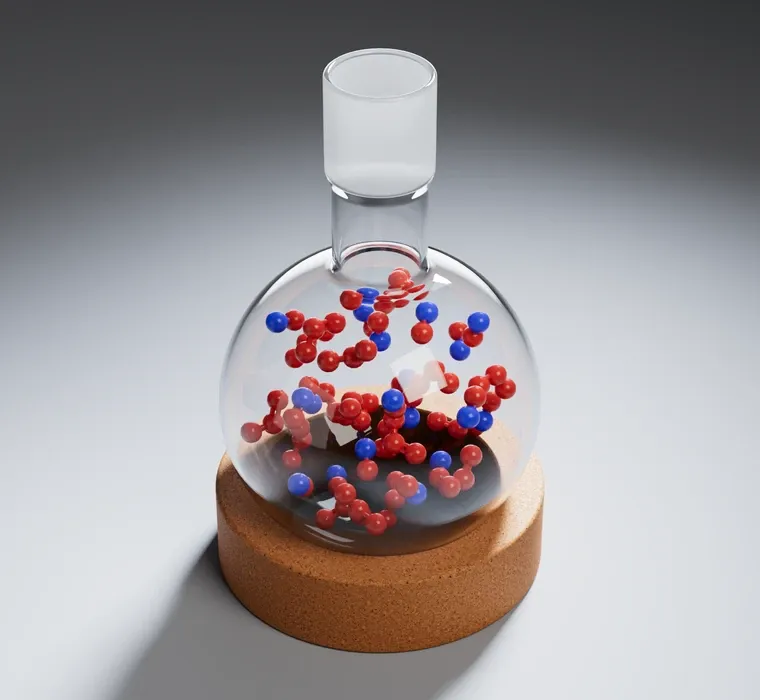
The flask holds a reaction that happens in the air of every busy city. Nitric oxide (NO), which car engines make, meets ozone (O₃). One oxygen atom moves from the ozone to the nitric oxide, leaving nitrogen dioxide (NO₂) and an ordinary oxygen molecule (O₂). Count the atoms on each side and they match: one nitrogen and four oxygens before, one nitrogen and four oxygens after. It is one reason ozone levels are often lower right beside busy roads than further downwind, and nitrogen dioxide is the gas that gives city smog its brownish tinge.
Most collisions are just bounces
Molecules can only react when they meet. In a gas at room temperature they fly at around 500 metres per second and collide all the time, yet almost every collision is a bounce. Two things have to go right.
The collision must carry enough energy. Breaking into an existing bond costs energy before the new bonds give any back, like pushing a cart over a hump before it can roll down the other side. The height of that hump is the activation energy. The molecules must also meet the right way round. Here the nitrogen end of NO has to strike an oxygen at the end of the ozone; a hit on the wrong side bounces off, however hard it is.
Warmth lifts more molecules over the hump
Temperature measures the average energy of the molecules, but no molecule is average. At any moment a few are slow, most are middling and a few are fast. Warming the gas shifts the whole spread towards higher energies, and the share of collisions above the activation energy grows much faster than the temperature does.
For this reaction, measurements show the rate about six times higher at room temperature than at −53 °C, the cold of the lower stratosphere. Reactions with taller humps are far more sensitive. A common rule of thumb is that many reactions near room temperature roughly double their speed for every 10 °C, which is part of why food keeps longer in the fridge.
Try it: set Temperature to 220 K, the cold of the stratosphere, and count the flashes, then slide it up to 440 K. Choose On under Highlight energetic molecules: the glowing molecules have more energy than the barrier, and small blue sparks are hard hits that came in the wrong way round. The shaded tail of the energy curve grows as the gas warms.
Crowding speeds it up too
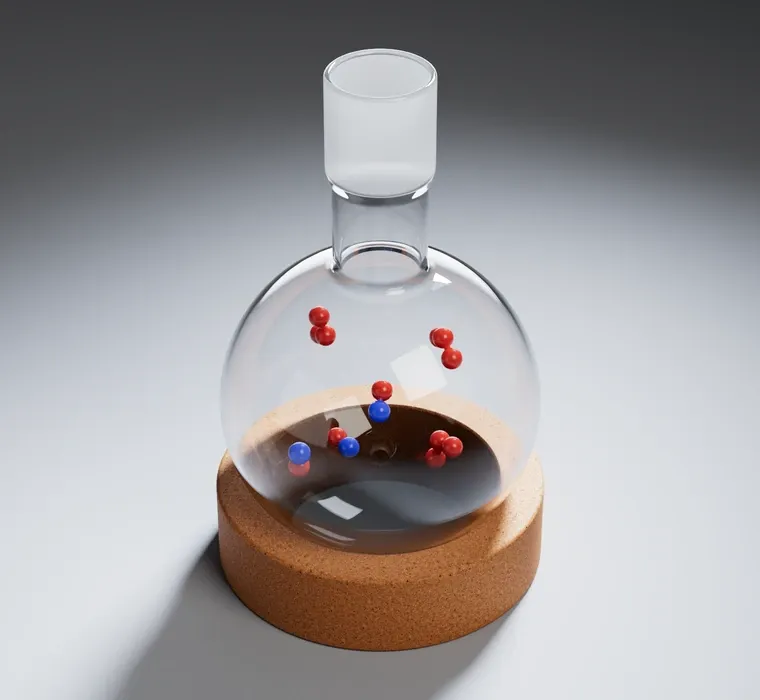
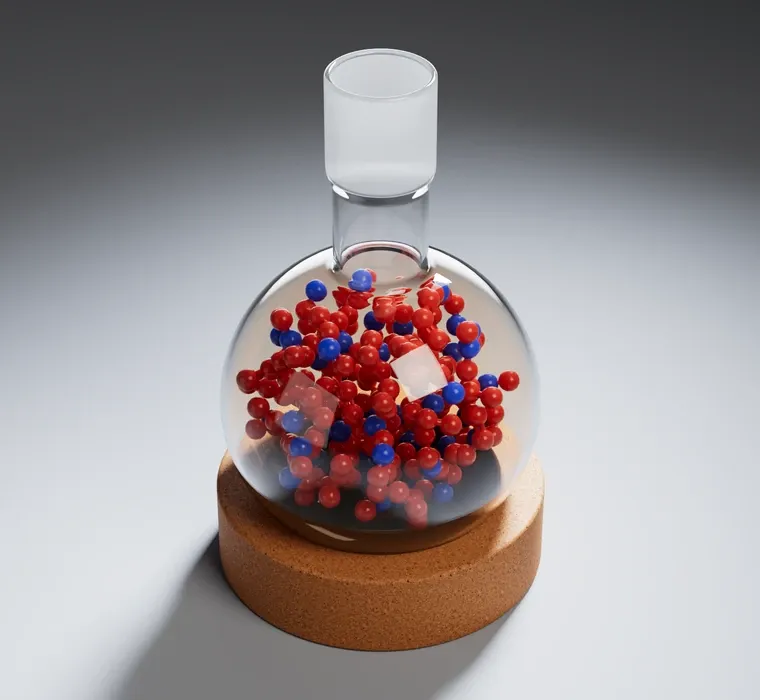
More molecules in the same space means more meetings. The rate depends on both concentrations together, so doubling the amount of NO and ozone makes their collisions four times as common. Set Concentration to 20 % and the flashes become rare; set it to 100 % and they come quickly. The same idea explains why a fire burns fiercely in pure oxygen.
What this model leaves out
Real molecules in air are about ten of their own widths apart, and they collide billions of times a second; the flask packs them close and slows everything down so you can follow single collisions. The model asks only whether the reactive ends face each other, a simplified stand-in for the real geometry. Each reaction also releases about 200 kJ/mol of heat that would warm a real gas, but the flask walls here hold the temperature steady. Finally, fresh reactants quietly replace the products, so the flask shows the starting rate for as long as you watch, rather than slowing down as the reactants run out.