Why only some collisions lead to a reaction, why twice the concentration makes it four times faster, and why a hundred degrees speed it up far more than the molecules' speed suggests.
Step 1 of 6 · Molecules have to meet
Step 1 of 6
Molecules have to meet
Some reactions are over in a split second, like an explosion, and some take years, like rusting. The rate of reaction is how much reactant turns into product each second. To see what sets it, look at the molecules.
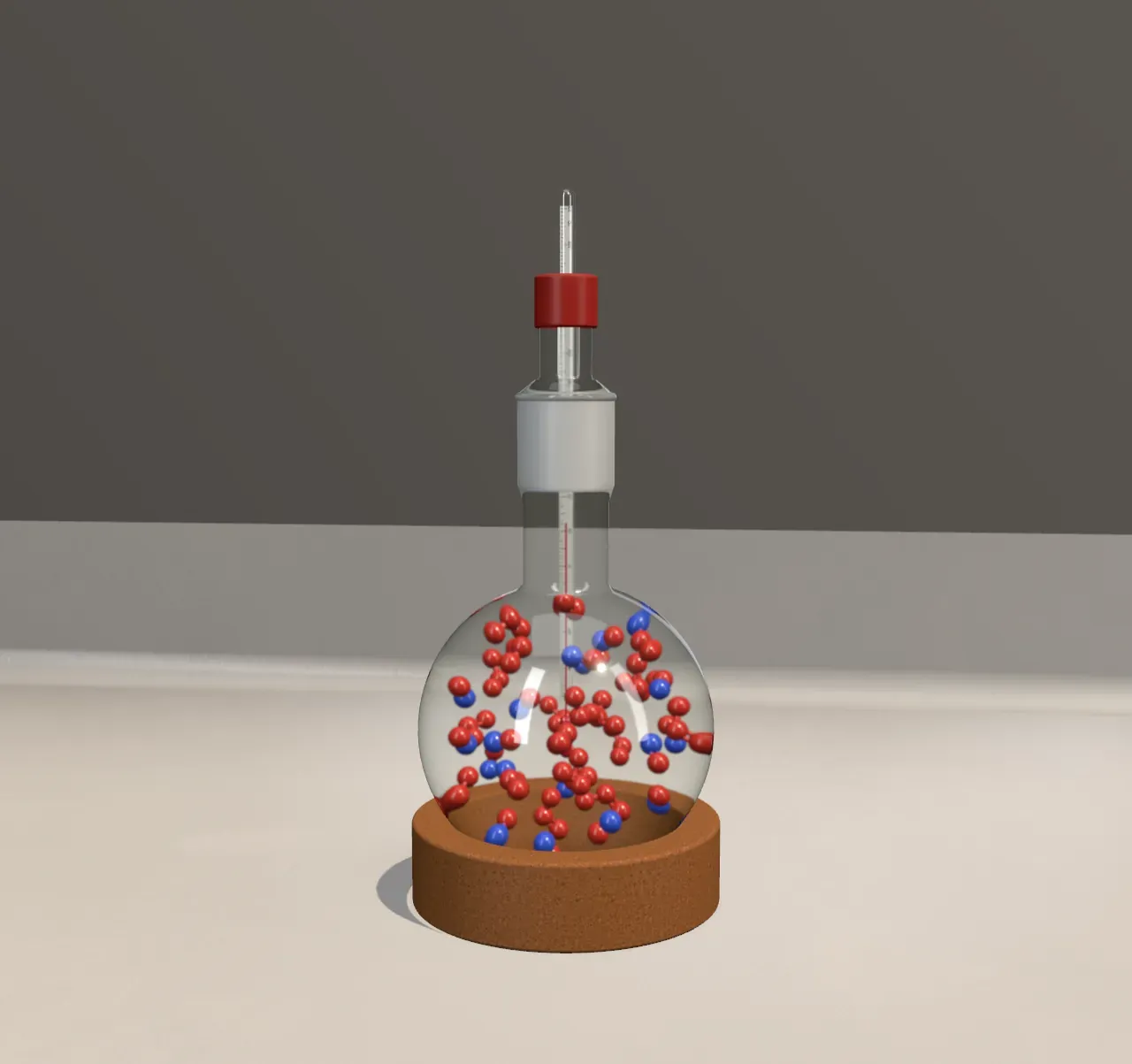
The flask holds molecules of nitrogen monoxide, , and of ozone, , which react by . That is how nitrogen oxides destroy ozone in the stratosphere. Each flash is one reaction. Watch how many collisions there are, and how many of them end in a flash.
Step 2 of 6
A more crowded flask
Concentration sets how many reacting molecules the flask holds. The more molecules there are, the more often they meet. But by how much?
Here Temperature is fixed at 298 K, room temperature.
Step 3 of 6
Thinning it out
The rate depends on both reactants together, so it goes as the square of Concentration: , and both concentrations move with the slider. Use that the other way round.
Step 4 of 6
Turning up the heat
Heating speeds up almost every reaction. A molecule’s mean speed grows as the square root of the temperature in kelvin, , so from 298 K to 398 K the molecules are only faster. Concentration is now fixed. Predict before you heat.
Step 5 of 6
The energetic few
Not every molecule has the same energy: at any temperature there are a few very slow ones, many middling ones and a few very fast ones. The chart shows that spread, and a line marks the activation energy, , the least energy a collision needs to react. The shaded area is the molecules beyond the line. Highlight energetic molecules is now On, so those molecules glow in the flask.
Step 6 of 6
Why heating works
When you heat, the whole curve shifts right and flattens. The line stays where it is. Compare the chart at 398 K with the chart at 298 K.
Loading the interactive version…
Loading the interactive version…
Each step sets up the Scene for you, and a control marked “fixed” stays put for that step.
Practice · Choose
The flask holds molecules and ozone molecules, . What has to happen for a pair of them to react to and ?
Practice · Choose
The flask holds molecules and ozone molecules, . What has to happen for a pair of them to react to and ?
Practice · Predict, then look
Concentration stands at 30%, and Temperature is fixed. What will happen to the rate when Concentration rises to 60%, that is, with twice as many molecules and twice as many molecules?
Practice · Predict, then look
Concentration stands at 30%, and Temperature is fixed. What will happen to the rate when Concentration rises to 60%, that is, with twice as many molecules and twice as many molecules?
Practice · Reach the target
Concentration stands at 100%, and the flask is full of reactants. Change Concentration so that the reaction runs at a quarter of the rate it has now, then press Check.
Practice · Reach the target
Concentration stands at 100%, and the flask is full of reactants. Change Concentration so that the reaction runs at a quarter of the rate it has now, then press Check.
Practice · Predict, then look
You heat the flask from 298 K to 398 K: 1.34 times in kelvin. How many times faster will the reaction be?
Practice · Predict, then look
You heat the flask from 298 K to 398 K: 1.34 times in kelvin. How many times faster will the reaction be?
Practice · Reach the target
The chart shows how many of the molecules carry more than the activation energy, 12.5 kJ/mol. Change Temperature until 5% of the molecules clear the barrier, then press Check.
Practice · Reach the target
The chart shows how many of the molecules carry more than the activation energy, 12.5 kJ/mol. Change Temperature until 5% of the molecules clear the barrier, then press Check.
Practice · Choose
From 298 K to 398 K the molecules are only faster, but the reaction is three times faster. What is the main reason?
Practice · Choose
From 298 K to 398 K the molecules are only faster, but the reaction is three times faster. What is the main reason?
Lesson complete. Every practice question here is done.