A pair of scissors that reads
Every cell in your body carries about 3 billion letters of DNA in each copy of its genome. To change one gene on purpose you need a tool that can find a single stretch of perhaps 20 letters in all of that, cut there and nowhere else, and then let the cell rewrite it.
CRISPR gene editing does this with a protein borrowed from bacteria, Cas9, and a short piece of RNA that tells it where to go. In 2012 Emmanuelle Charpentier and Jennifer Doudna showed that Cas9 could be pointed at any sequence just by changing the RNA; the work earned them the 2020 Nobel Prize in Chemistry.
Borrowed from a bacterial immune system
Bacteria are attacked by viruses called phages. Many keep a record of past attackers: snippets of viral DNA stored between short repeated sequences in their own genome. Those repeats gave the system its name, clustered regularly interspaced short palindromic repeats, or CRISPR.
The bacterium copies each stored snippet into RNA and loads it into Cas9. If the same virus returns, Cas9 recognises the matching viral DNA and cuts it. For gene editing, researchers write their own 20-letter snippet, the guide RNA, to match the gene they want to change.
Finding the target
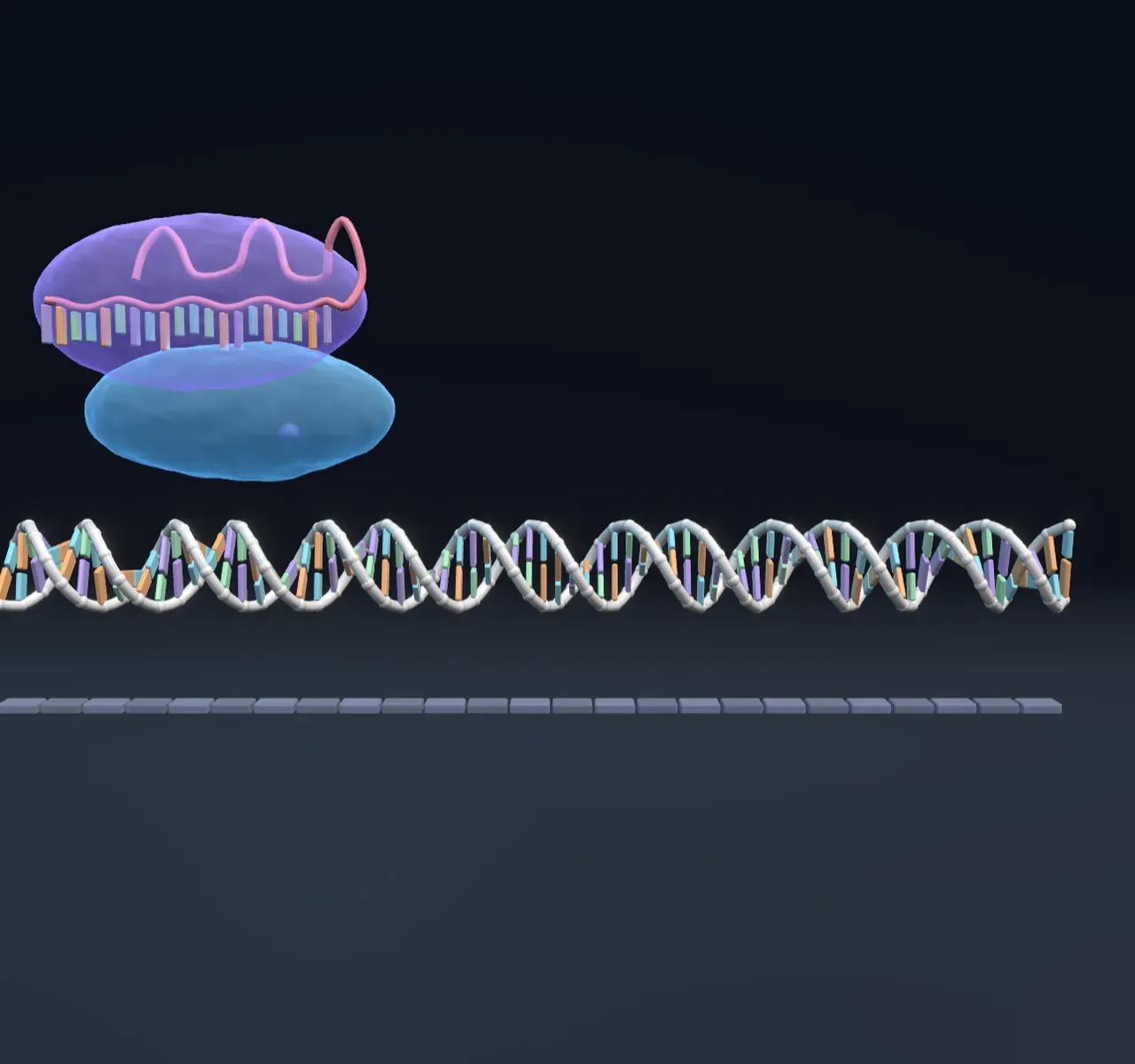
Cas9 cannot read DNA through its zipped-up double helix. Instead it first looks for a short signal on the outside, the PAM: for the common Cas9 from Streptococcus pyogenes, any letter followed by two Gs (written NGG). Only where it finds one does it pry the two strands apart, starting next to the PAM, and offer its guide to the strand underneath.
The guide pairs letter by letter, A with T and G with C, the same rule that holds the double helix together. If a letter fails to pair near the PAM, the opening stops, the DNA zips shut, and Cas9 moves on. Only when all 20 letters pair does Cas9 change shape and lock on. Checking the PAM first saves Cas9 from unzipping the DNA everywhere, and it protects the bacterium: its own stored snippets have no PAM beside them, so Cas9 never cuts them.
Try it: set Guide RNA to One letter off, near the PAM and drag Run the edit slowly through the middle. The red letter stops the unzipping after three pairs, and Cas9 drifts away without cutting.
Twenty letters is enough to be nearly unique: there are about a trillion different 20-letter sequences, and a human genome holds a few billion. But the check is not perfect. Letters at the far end from the PAM matter less, so a guide with one mismatch there can still lock on. That is how CRISPR makes off-target cuts in genes nobody meant to touch. Pick One letter off, far end to see one.
The cut, and the repair
Once locked on, Cas9 cuts both strands of the DNA, each with its own blade, three letters from the PAM. A cut that runs right through the double helix is dangerous to a cell, so it repairs it quickly, in one of two ways.
The fast way is to join the ends straight back together. It is quick but sloppy, and often adds or removes a letter or two. Because a gene is read three letters at a time, in codons, one extra letter shifts every codon after it out of step. The garbled message soon hits a stop codon, and the protein is never finished: the gene has been switched off, or knocked out.
The careful way is to copy a template. If the researchers supply a piece of DNA whose ends match the DNA either side of the break, the cell can copy it across the gap, including any new letters in its middle. This writes in exactly the change they designed. It works mainly in dividing cells and less often than joining.
Try it: drag Run the edit to Gene repaired with Repair set to Join the ends, then switch to Copy a template, and compare the codon tiles below the DNA.
Editing people
The first CRISPR medicine, approved in the UK and US from the end of 2023, treats sickle cell disease and beta thalassaemia. Doctors take blood stem cells from a patient, use Cas9 to cut a stretch of DNA that, after birth, shuts down the baby form of haemoglobin, and return the cells. The sloppily joined ends break that stretch, and the new red blood cells make the baby form, which does not sickle.
Newer tools build on the same guide. Base editors and prime editors use a disabled Cas9 that nicks or does not cut the DNA at all, and change letters without making a full break. Editing an embryo would change every cell of a person and pass to their children; when a researcher did this to twin girls in 2018, he was widely condemned and jailed, and most countries forbid it.
What this model leaves out
The gene here is short and made up, and the DNA lies straight and bare; in a cell it is coiled around proteins, which Cas9 must reach. Cas9 is drawn as two smooth lobes and its guide RNA as a simple fold, not their real shapes. The rule for which mismatches are tolerated is a sharp cut-off here, where in reality it is a gradual one that also depends on which letters are involved. Joining the ends really gives a mix of results, not always one added letter. And the Scene shows one molecule doing one edit; in practice millions of cells are edited at once, and only some of them end up with the change.