How Cas9 finds one site in a genome, why a wrong letter near the PAM stops it and one at the far end does not, and how the cell's repair knocks a gene out or writes new letters into it.
Step 1 of 6 · Searching for one site
Step 1 of 6
Searching for one site
CRISPR began as an immune system in bacteria: a bacterium that survives a virus keeps a piece of its DNA, and next time a protein called Cas9 uses that piece to find the virus and cut it. In Jennifer Doudna and Emmanuelle Charpentier showed that Cas9 can be given any piece we like, and so cut any gene we like. They won the Nobel Prize in Chemistry for it in .
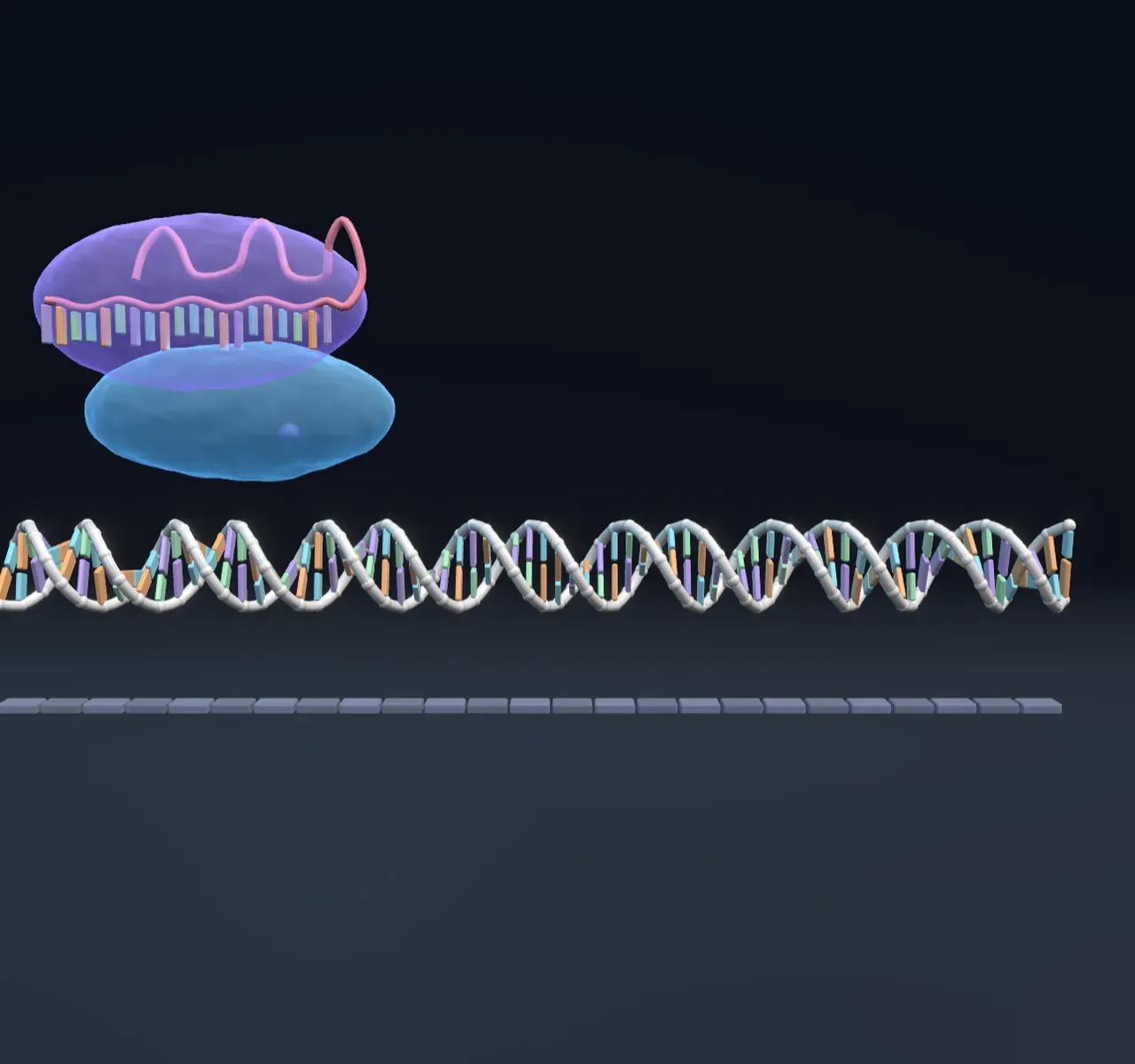
Cas9 carries a guide RNA of letters, written like the site to be cut. It does not scan the whole genome letter by letter: it slides along the DNA and stops only at a PAM, any letter followed by GG. Only there does it open the DNA and check whether the guide matches.
Step 2 of 6
The far end
At a PAM, Cas9 opens the helix and pairs the guide RNA against one strand, letter by letter, from the end beside the PAM to the far end. If all twenty letters pair, Cas9 locks on, and two blades cut both strands, three letters from the PAM.
But what happens when the guide almost matches? Guide RNA and Run the edit are fixed until you choose an answer.
Step 3 of 6
Near the PAM
The first letters beside the PAM, the seed, are the ones Cas9 checks first, so they decide whether the opening goes on. A wrong letter there stops it right at the start.
Step 4 of 6
Joining the ends
After the cut Cas9 lets go, and a break through both strands is left in the DNA. A break like that is dangerous to the cell, and it repairs it fast. The quick way is joining the ends, but it is not exact: often an extra letter slips in, or a letter is lost.
An extra letter is a frameshift, as in the last Lesson. On the strip of codons under the DNA, watch what happens to the codons after the break.
Step 5 of 6
Copying a template
The second way is exact: when the cell holds a piece of DNA whose ends match both sides of the break, it copies it into the break. Researchers supply a template like that, with the letters they want to write in its middle. That way a mutation can be corrected, or something new added to a gene.
Step 6 of 6
Who repairs
Move Run the edit back and forth around the cut, and follow Cas9 and the template. In the first CRISPR treatment was approved, for sickle-cell anaemia: the patient’s bone-marrow stem cells are edited outside the body and put back.
Loading the interactive version…
Loading the interactive version…
Each step sets up the Scene for you, and a control marked “fixed” stays put for that step.
Practice · Calculate
Cas9 does not read all the DNA. It slides along it and stops only at a PAM, any letter followed by GG, and checks its guide RNA there. Slide Run the edit slowly. At how many places along the stretch in the Scene can Cas9 stop?
Practice · Calculate
Cas9 does not read all the DNA. It slides along it and stops only at a PAM, any letter followed by GG, and checks its guide RNA there. Slide Run the edit slowly. At how many places along the stretch in the Scene can Cas9 stop?
Practice · Predict, then look
Now the guide RNA has one wrong letter, at the end far from the PAM. of its letters match the target. Will Cas9 cut the gene?
Practice · Predict, then look
Now the guide RNA has one wrong letter, at the end far from the PAM. of its letters match the target. Will Cas9 cut the gene?
Practice · Predict, then look
And now the wrong letter in the guide RNA sits near the PAM, three letters from it. Will Cas9 cut?
Practice · Predict, then look
And now the wrong letter in the guide RNA sits near the PAM, three letters from it. Will Cas9 cut?
Practice · Calculate
The guide matches, Cas9 cuts, and the cell joins the ends and slips in one extra letter, a T. Before the edit the stretch reads as codons with no stop. The cut falls after codon , and on the codon strip the stop codon is the fourth after the break. How many amino acids are coded now before it stops?
Practice · Calculate
This time the researchers give the cell a template, and it copies six new letters from it into the break: CAC CAT. How many codons are read along the stretch now, with no stop codon?
Practice · Calculate
This time the researchers give the cell a template, and it copies six new letters from it into the break: CAC CAT. How many codons are read along the stretch now, with no stop codon?
Practice · Choose
Who writes the new letters into the gene?
Practice · Choose
Who writes the new letters into the gene?
Lesson complete. Every practice question here is done.