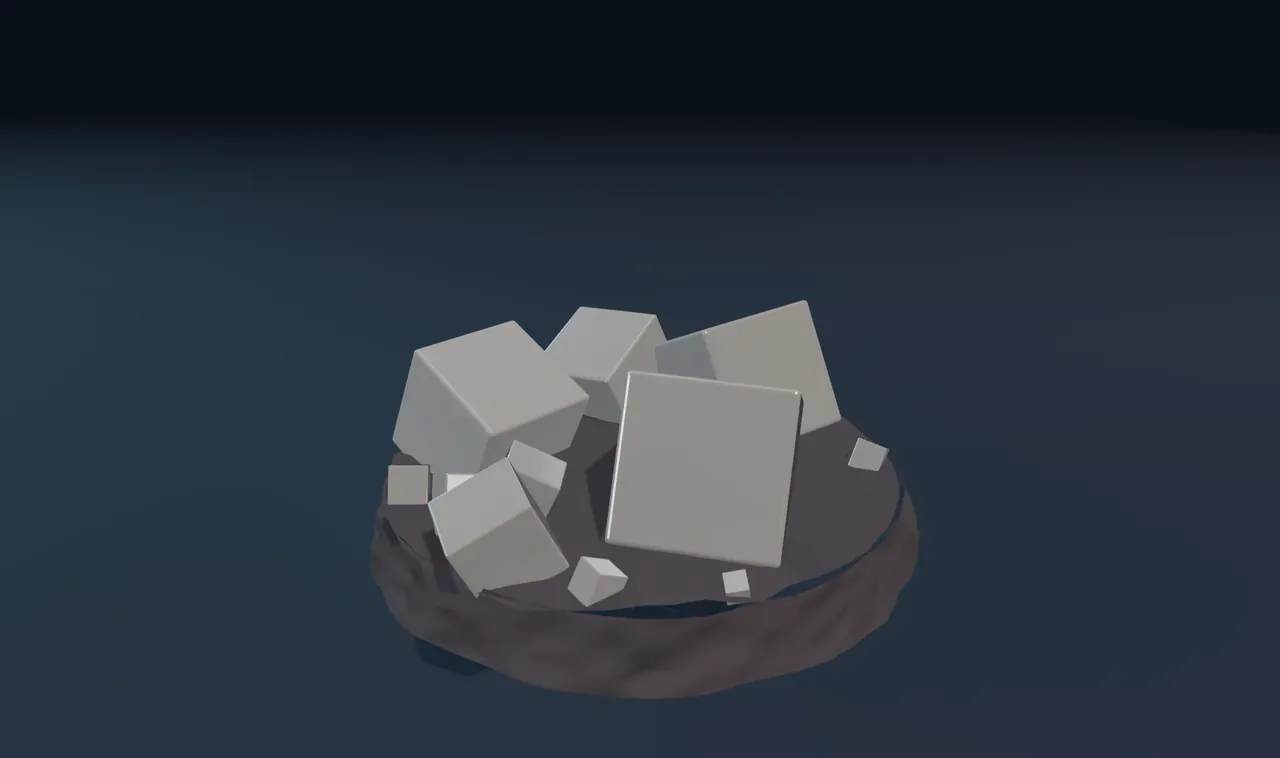
Order you can see
Pour some table salt onto dark paper and look closely, with a magnifying glass if you have one. Most grains are little cubes with flat faces and sharp corners. Nobody cut them that way. Snowflakes have six arms, quartz grows as six-sided columns with pointed tips, and a split geode is lined with glittering points. A crystal is a solid whose shape comes from inside: its atoms are stacked in a pattern that repeats, identically, in every direction.
One small box, repeated
Choose Atoms under Zoom to the atoms. In salt, sodium and chloride ions alternate along every row, every column and every layer, each sodium surrounded by six chlorides and each chloride by six sodiums. The smallest block that builds the whole crystal by copying itself is the unit cell. For salt it is a cube 0.564 nanometres along each edge, so a grain one millimetre across is nearly two million cells wide.
The shape of the cell shows up in the shape of the crystal. Salt’s cell is a cube, and the flat faces of a grain are planes of ions lying exactly along that cube. Ice is built from water molecules linked by hydrogen bonds into puckered hexagonal rings, which is why every snowflake has six-fold symmetry. Quartz winds its silicon and oxygen atoms in spirals around three-fold axes, and grows six-sided columns.
Switch on Show unit cell and compare the outlined cell for Salt, Ice and Quartz with the shape of their crystals.
Seeds and growth
A crystal starts as a seed: a few atoms that happen to settle into the right arrangement. Below its freezing point a liquid is ready to crystallise, but a seed that is too small simply falls apart again. The colder the liquid gets below its freezing point, the smaller a seed needs to be to survive, and the faster new ones appear. Meanwhile every seed that does survive grows, adding layer after layer of atoms to its faces.
How big the finished crystals are depends on which wins. Cool a melt slowly and the first few seeds have time to grow through all the liquid before many more appear: a few large crystals. Cool it fast and the liquid sinks far below its freezing point while it is still mostly liquid, seeds appear everywhere at once, and they crowd each other out before any grows large.
Try it: move Cooling rate from 1 to 100 × slowest and count the crystals. The same amount of material ends up in a few big ones or a crowd of small ones.
Crystals everywhere
Rocks record this. Granite cooled deep underground over thousands of years or more, and its crystals are big enough to see. Basalt is lava that cooled at the surface within days to years; its crystals are mostly too small to pick out. Obsidian cooled so fast that hardly any crystals formed at all: it is a glass. Geodes fill slowly from mineral-rich water, so their quartz has time to grow into long points. Metals are crystals too. A steel beam or a copper wire is a mosaic of tiny crystal grains, and metalworkers control their size by how quickly the metal cools.
What this model leaves out
The crystals here grow on a flat rock, and their sizes come from a simple nucleation-and-growth calculation that is honest about the trend, not about real times or temperatures. Real grains fill space and meet along irregular boundaries rather than as perfect cubes and columns. Salt usually crystallises as water evaporates rather than as a melt cools, but the same competition between new seeds and growing crystals decides its size. Real ice arranges its hydrogens in a disordered way that still obeys the same rules, rather than the single tidy pattern drawn here.