Why a grain of salt is a cube and a snowflake has six sides: a unit cell that repeats, and the shape it gives the crystal. Seeds and growth, and why slow cooling grows big crystals and fast cooling a crowd of tiny ones.
Step 1 of 7 · One small box
Step 1 of 7
One small box
Pour some table salt onto dark paper and look closely: most grains are little cubes, with flat faces and sharp corners. Nobody cut them that way. A crystal is a solid whose shape comes from inside: its particles are arranged in a pattern that repeats, exactly, in every direction.
In the Scene Zoom to the atoms is at Atoms, and Show unit cell outlines the smallest box that builds the whole crystal when copied again and again: the unit cell. For salt it is a cube 0.564 nm along each edge. How many such cells fit across a grain of salt one millimetre wide?
Step 2 of 7
Six-sided snowflakes
The shape of the cell shows in the shape of the crystal. Salt’s cell is a cube, and a grain’s flat faces are planes of ions lying exactly along that cube. The Scene now shows Ice. Switch between Salt, Ice and Quartz, and compare the outlined cell with the crystal’s shape: choose Crystals under Zoom to the atoms to see the whole crystal.
Step 3 of 7
Neighbours in ice
In ice the water molecules are joined by hydrogen bonds, dashed in sky blue. They form puckered hexagonal rings, hence six-sided plates and snowflakes. Pick one water molecule in the middle of the crystal and count how many molecules it is hydrogen-bonded to.
Step 4 of 7
Slow cooling
A crystal starts from a seed: a few particles that happen to settle into the right pattern. Below its freezing point a liquid is ready to crystallise, but a seed that is too small falls apart again. The colder the liquid gets below its freezing point, the faster new seeds appear, and meanwhile every seed that survives grows, layer by layer.
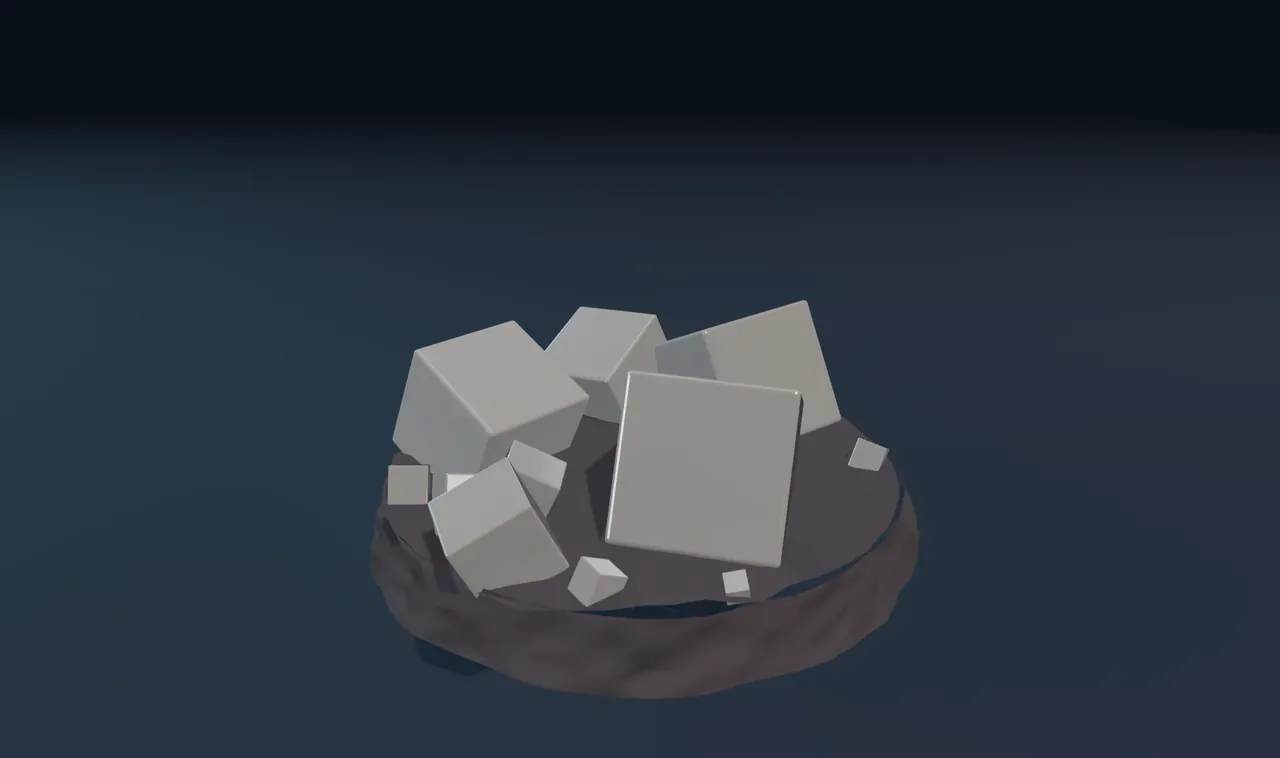
In the Scene Cooling rate is at 1, the slowest, and salt crystals have grown on a rock. Count how many crystals there are.
Step 5 of 7
Fast cooling
How big the crystals end up depends on the race between new seeds and growing crystals. Predict what happens when you move Cooling rate up to 100, a hundred times faster.
Step 6 of 7
Rocks remember
Rocks keep a record of this. Granite cooled deep underground over thousands of years or more, and its crystals are big enough to see. Basalt is lava that cooled at the surface within days to years, and its crystals are too small to pick out. In geodes, mineral-rich water fills a hollow slowly, so their quartz has time to grow into long columns. Metals are crystals too: a steel beam is a mosaic of tiny grains, and their size is set by how fast it cools.
Step 7 of 7
Ions that touch
The size of the unit cell is measured with X-rays. It can also be worked out from the size of the ions.
Loading the interactive version…
Loading the interactive version…
Each step sets up the Scene for you, and a control marked “fixed” stays put for that step.
Practice · Calculate
Salt’s unit cell is a cube 0.564 nm along each edge. How many such cells are there across a grain of salt 1 mm wide?
Practice · Calculate
Salt’s unit cell is a cube 0.564 nm along each edge. How many such cells are there across a grain of salt 1 mm wide?
Practice · Choose
Why does every snowflake have six arms?
Practice · Choose
Why does every snowflake have six arms?
Practice · Calculate
How many water molecules is each water molecule in ice hydrogen-bonded to?
Practice · Calculate
How many water molecules is each water molecule in ice hydrogen-bonded to?
Practice · Calculate
With Cooling rate at 1, the slowest, how many crystals have grown on the rock?
Practice · Calculate
With Cooling rate at 1, the slowest, how many crystals have grown on the rock?
Practice · Predict, then look
Move Cooling rate from 1 up to 100. What happens to the crystals?
Practice · Predict, then look
Move Cooling rate from 1 up to 100. What happens to the crystals?
Practice · Choose
Obsidian, a volcanic glass, has almost no crystals at all. How did it form?
Practice · Choose
Obsidian, a volcanic glass, has almost no crystals at all. How did it form?
Practice · Calculate
Crystal: Salt. Along each edge of the unit cell, sodium and chloride ions touch in turn: , , . The radius of is 102 pm, and of 181 pm. How long is the unit cell’s edge?
Practice · Calculate
Crystal: Salt. Along each edge of the unit cell, sodium and chloride ions touch in turn: , , . The radius of is 102 pm, and of 181 pm. How long is the unit cell’s edge?
Lesson complete. Every practice question here is done.