Water you cannot drink
Almost all the water on Earth is in the sea, and every litre of it carries about 35 grams of dissolved salt, mostly sodium and chloride ions. That is several times saltier than your body can cope with: drink it and your kidneys spend more water getting rid of the salt than you swallowed.
Taking the salt out is called desalination. The old way is to boil seawater and collect the steam, which leaves the salt behind but costs a great deal of heat. Most new plants instead push seawater through a membrane that lets water molecules pass and stops the salt. The surprise is how hard you have to push.
First, water flows the wrong way
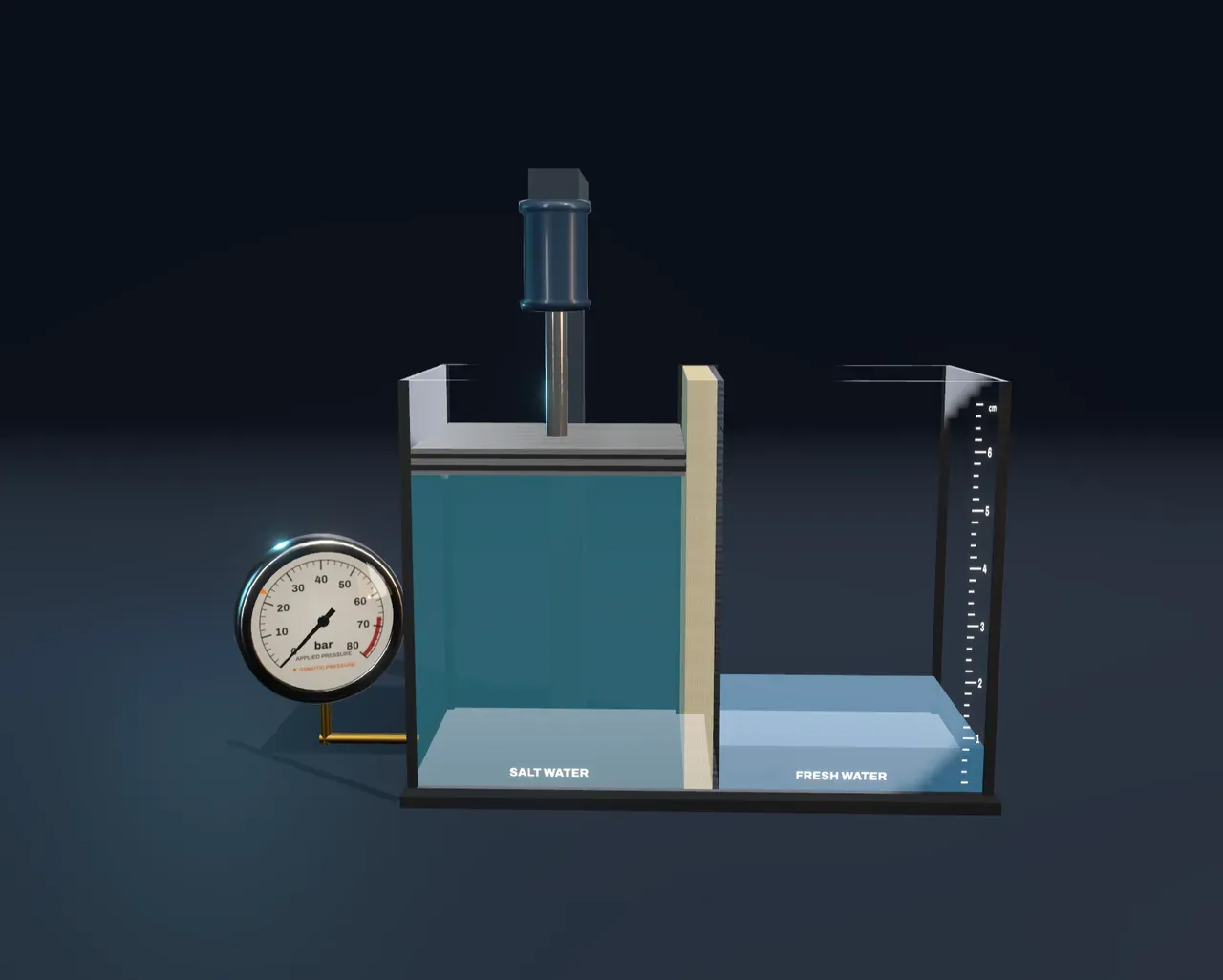
Look at the Scene with no push at all. Salt water sits on the left, fresh water on the right, and the membrane between them. Nothing forces anything, yet the fresh side drains and the salt water rises, lifting the piston.
This is osmosis. Water molecules cross the membrane in both directions all the time, but on the salty side some of the space beside the membrane is taken by ions, which also hold water molecules close to them. Fewer water molecules cross from the salty side than arrive from the fresh side, so water moves, on balance, into the salt water. Left alone, the sea would pull fresh water out of the tank rather than give any up.
Osmotic pressure: the push to beat
You can stop that flow by pressing on the salt water. The pressure that just stops it is the solution’s osmotic pressure. It grows with how many dissolved particles there are: each gram of sea salt in a litre adds about 0.8 bar, so seawater’s osmotic pressure is about 27 bar, the pressure at the bottom of 270 metres of water. Blood is almost 8 bar, brackish groundwater only a few.
Try it: choose Balance on Push on the salt water and the levels hold still. Drop the push a little and water seeps in; raise it a little and the flow reverses. Then set Salt in the water to Brine and find the new balance point on the gauge.
The gauge shows the push with its black needle and the osmotic pressure of the water under the piston with its orange mark. Flow goes whichever way the larger one points.
Reverse osmosis
Push harder than the osmotic pressure and the flow turns round: water is squeezed out of the salt water, through the membrane and into the fresh side, while the ions stay behind. This is reverse osmosis, and it is how most of the world’s desalinated water is made today.
Watch what happens to the water left under the piston. It loses water but keeps all its salt, so it grows saltier and its osmotic pressure rises; the orange mark climbs towards the needle. When they meet, the flow stops. That leftover salt water is brine. At 60 bar, about half of the seawater can come out fresh before the brine pushes back as hard as the pump. Real plants stop at about that point too, then pipe the brine back to sea, where it must be spread out so it does not settle on the seabed.
Try it: choose Seawater plant, choose On under Show the molecules, and watch water molecules wriggle through the polymer while the ions, wrapped in their cages of water, bounce off with a spark.
Why the membrane works
A reverse-osmosis membrane has no holes you could see even with a good microscope. Its working layer is a film of cross-linked polyamide about a ten-thousandth of a millimetre thick, laid on a spongy plastic support. Water molecules dissolve into the polymer and wander through the tiny gaps between its chains. A sodium or chloride ion in water travels with a shell of water molecules clinging to its charge, which makes it too big and too strongly bound to follow. Good membranes hold back more than 99.5 per cent of the salt.
Inside a desalination plant
A seawater plant filters its intake to remove sand, algae and anything that would clog the membrane, then pumps it to about 60 to 70 bar. The membranes are rolled into spiral cartridges, and the seawater flows along their surface rather than into a dead end, sweeping the brine away so salt does not pile up on the film. The brine is still at high pressure when it leaves, so devices called pressure exchangers hand most of that pressure back to the incoming seawater.
Making 1,000 litres of fresh water this way takes about 3 to 4 kilowatt-hours of electricity, a few days of a household fridge. Physics sets a floor of roughly 1 kilowatt-hour at this recovery, because you must at least do the work of pushing water out against the osmotic pressure. Countries short of rivers and rain, from Israel to Saudi Arabia, now get much of their drinking water this way.
What this model leaves out
The test cell is a closed batch with a piston, not the continuous flow of a real plant, and it ignores the few centimetres of water height on each side, which are tiny next to tens of bar. The osmotic pressure is a straight-line rule of thumb at 25 °C; at high salinity it rises a little faster, and it grows with temperature. The membrane here holds back all of the salt and lets water through at a rate simply proportional to the push left over, while a real membrane leaks a little salt, slows as salt collects on its surface, and can be fouled by living things in the sea.