Why it takes so much pressure to make seawater drinkable: osmosis, osmotic pressure, reverse osmosis and the brine that pushes back, and a membrane that lets water through and stops ions.
Step 1 of 5 · Water flows the wrong way
Step 1 of 5
Water flows the wrong way
Almost all the water on Earth is in the sea, and every litre of it carries about 35 grams of dissolved salt, mostly sodium and chloride ions. In the Unit on solutions we learned that salt comes apart into ions in water, each ion wrapped in water molecules. Desalination is taking that salt out. Most new plants push seawater through a membrane that lets water molecules pass and stops the salt.
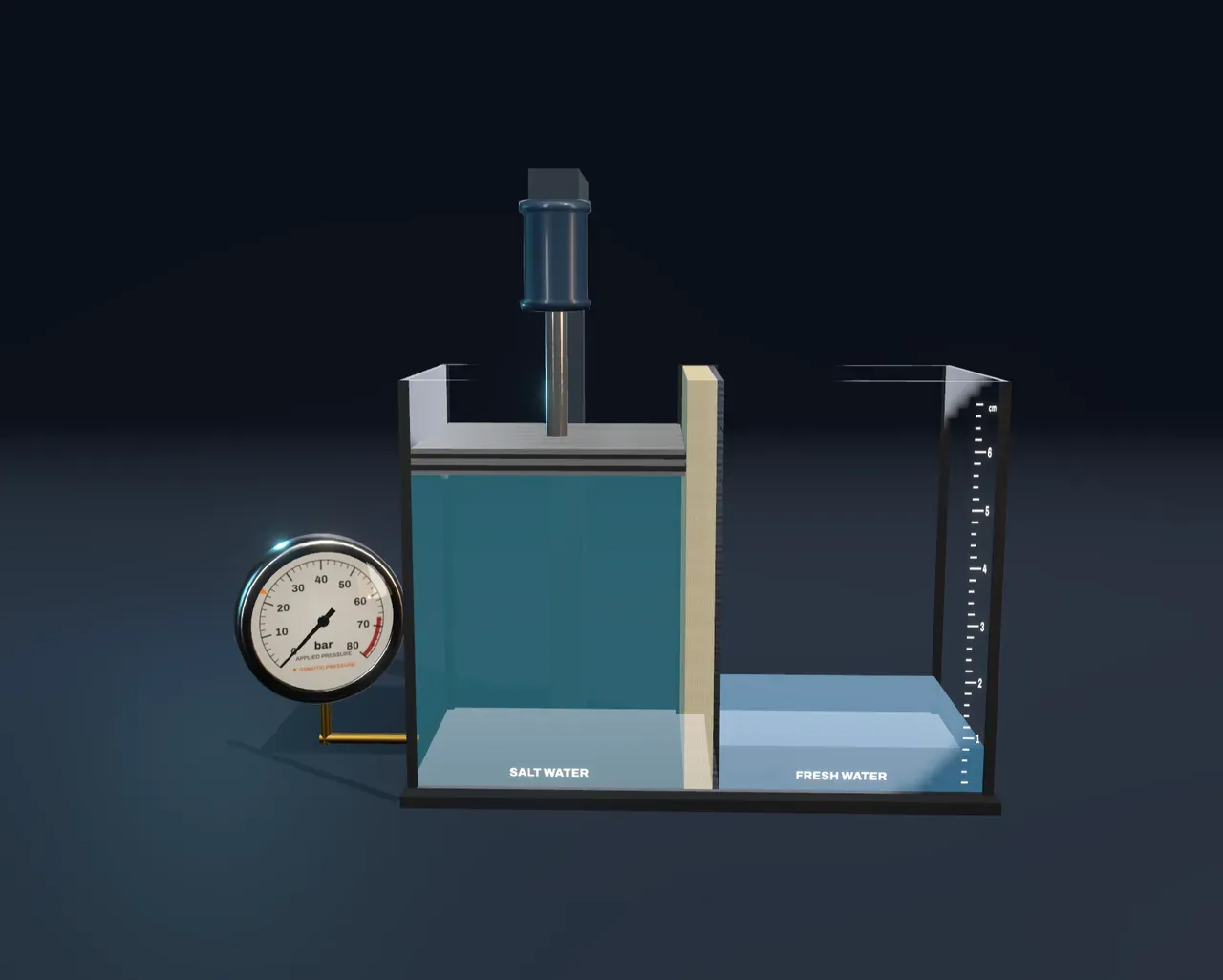
The Scene shows salt water on the left, fresh water on the right, and a membrane between them. Right now a piston presses on the salt water at Balance, and the levels hold still. Predict what happens when you drop Push on the salt water to None.
Step 2 of 5
Osmotic pressure
The flow from the fresh water into the salt water is called osmosis. Water molecules cross the membrane in both directions all the time, but on the salty side some of the space beside the membrane is taken by ions, which also hold water molecules close to them. Fewer molecules cross from the salty side than arrive from the fresh side, so on balance the water moves into the salt water.
Pressing on the salt water can stop the flow. The pressure that just stops it is the solution’s osmotic pressure. Find it with Push on the salt water.
Step 3 of 5
Saltier water
Osmotic pressure grows with the number of dissolved particles: each gram of salt in a litre adds about 0.78 bar. The Scene now holds Brine, 70 g/L, twice as salty as seawater. What push stops the flow now?
Step 4 of 5
Reverse osmosis
Push harder than the osmotic pressure and the flow turns round: water is squeezed out of the salt water, through the membrane and into the fresh side, while the ions stay behind. This is reverse osmosis, and it is how most of the world’s desalinated water is made today, Israel’s included.
The Scene is at Seawater plant, 60 bar. The water left under the piston loses water but keeps all its salt, so it grows saltier and its osmotic pressure rises. When it matches the pump’s push, the flow stops. What share of the seawater comes out fresh by then?
Step 5 of 5
The membrane
Show the molecules is On. A reverse-osmosis membrane has no holes you could see even with a good microscope. Its working layer is a film of polyamide, a polymer whose chains are bonded to each other, about a ten-thousandth of a millimetre thick. Watch how the water molecules wriggle through the polymer, and what happens to the ions.
Loading the interactive version…
Loading the interactive version…
Each step sets up the Scene for you, and a control marked “fixed” stays put for that step.
Practice · Predict, then look
Drop Push on the salt water to None. What happens?
Practice · Predict, then look
Drop Push on the salt water to None. What happens?
Practice · Reach the target
Find the Push on the salt water that stops the flow, so the levels stay still, then press Check.
Practice · Reach the target
Find the Push on the salt water that stops the flow, so the levels stay still, then press Check.
Practice · Calculate
Brine holds 70 grams of salt per litre, and each gram per litre adds about 0.78 bar. What is its osmotic pressure, in bar?
Practice · Calculate
Brine holds 70 grams of salt per litre, and each gram per litre adds about 0.78 bar. What is its osmotic pressure, in bar?
Practice · Calculate
The pump pushes at 60 bar on seawater, 35 g/L. What share of the seawater comes out fresh before the flow stops? Give it as a fraction, such as 0.3.
Practice · Calculate
The pump pushes at 60 bar on seawater, 35 g/L. What share of the seawater comes out fresh before the flow stops? Give it as a fraction, such as 0.3.
Practice · Choose
Why do water molecules get through the membrane, but not sodium and chloride ions?
Practice · Choose
Why do water molecules get through the membrane, but not sodium and chloride ions?
Lesson complete. Every practice question here is done.