Bending round the edges
Talk to a friend in the next room with the door open and they hear you perfectly well, even though they cannot see you. Sound gets through the doorway and spreads out into the room beyond. Light comes through the same doorway in a straight beam and leaves a sharp shadow either side. Both are waves. The difference lies in their size compared with the gap.
When a wave passes through an opening or round an edge, it spreads into the space behind. That spreading is diffraction, a name given by the Italian scientist Francesco Grimaldi, who noticed in the 1600s that shadows of very thin objects have faint coloured fringes rather than sharp edges.
Narrow gaps make round waves
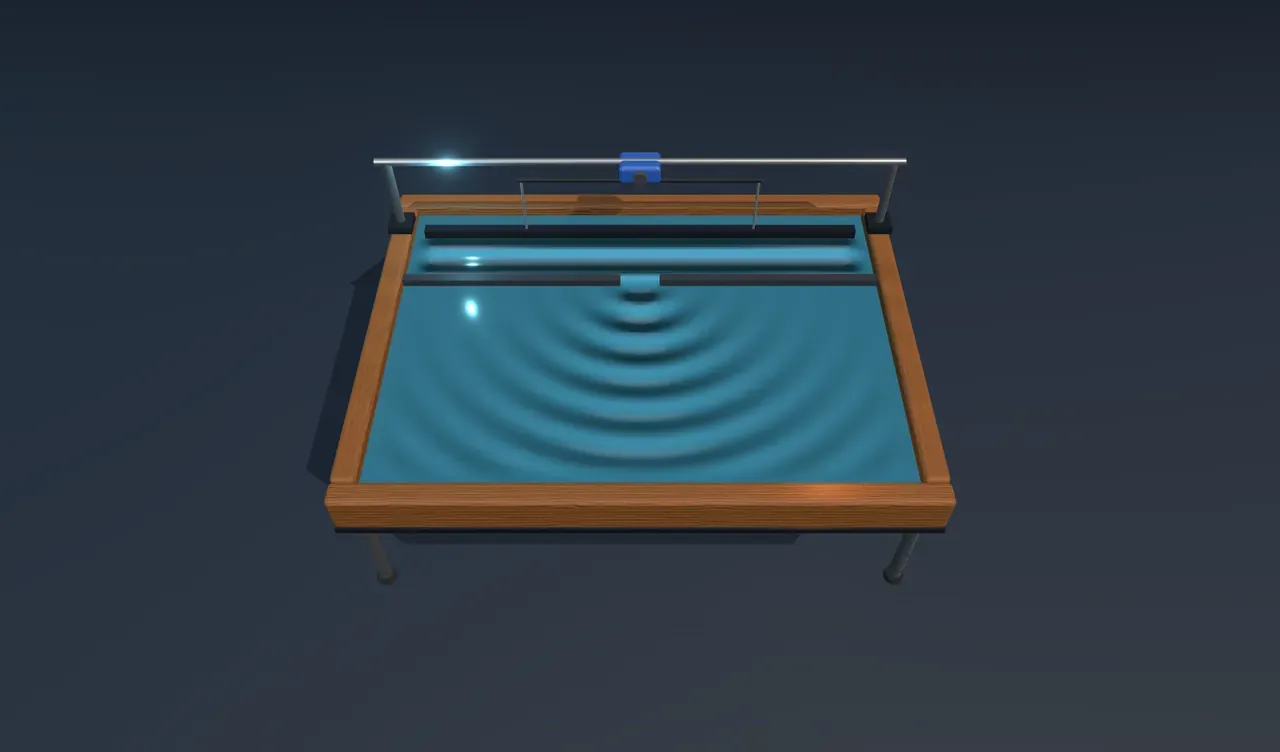
In the scene, a straight bar dips into the water and sends out straight waves, all 2.5 centimetres from crest to crest. They meet a wall with a single gap.
Make the gap about as wide as one wavelength, or narrower. What comes out the other side is a set of half-circles, as though the gap itself were a new source tapping the water. The wave reaches every corner of the tank behind the wall.
Now widen it to many wavelengths. The wave goes through as a straight beam the width of the gap, with calm water in the wall’s shadow on either side. It still spreads slightly at its edges, but much less.
Try it: slide Opening width to 1.5 cm, then 10 cm. Choose On under Show the calm water to see where the wave cannot reach.
Why the gap width matters
A useful way to think about it, first suggested by Christiaan Huygens in the 1600s, treats every point across the opening as a tiny source sending out its own ripples. Straight ahead, all those ripples arrive in step and add up. Off to the side, ripples from different parts of the gap have travelled different distances. In a wide gap there are always pairs that arrive half a wavelength apart and cancel, except in a narrow band straight ahead, so the beam stays straight. In a gap no wider than a wavelength, no two parts are far enough apart to cancel, so the wave spreads in every direction.
So whether a wave spreads depends on the ratio of gap to wavelength. Sound has wavelengths from a couple of centimetres to over ten metres, about the size of doors and walls, so it spreads around them easily. Visible light has wavelengths below a thousandth of a millimetre, far smaller than a doorway, so it travels in straight lines and casts sharp shadows.
Two slits
Choose Two slits. Each slit spreads its own half-circles, and where the two sets cross they interfere: crests meet crests in bright bands and crests meet troughs along calm lines in between. Thomas Young used this pattern with light in the early 1800s to show that light is a wave. The same idea, with thousands of slits, makes the rainbow sheen on a CD and the gratings astronomers use to split starlight into colours.
What the model leaves out
Each opening is represented by a row of small sources, which matches the real wave well beyond the wall but only roughly right at the gap. Real walls reflect part of each wave back towards the bar; here the wall and the tank’s edges absorb everything. Real ripples this short are also slightly affected by surface tension, so their speed depends a little on their wavelength. The wave heights are exaggerated and the motion is slowed.