A wave passing through an opening spreads more the narrower the opening is compared with its wavelength; why you hear round a corner but cannot see, and the fringes of two slits, in water and in light.
Step 1 of 4 · A narrow gap
Step 1 of 4
A narrow gap
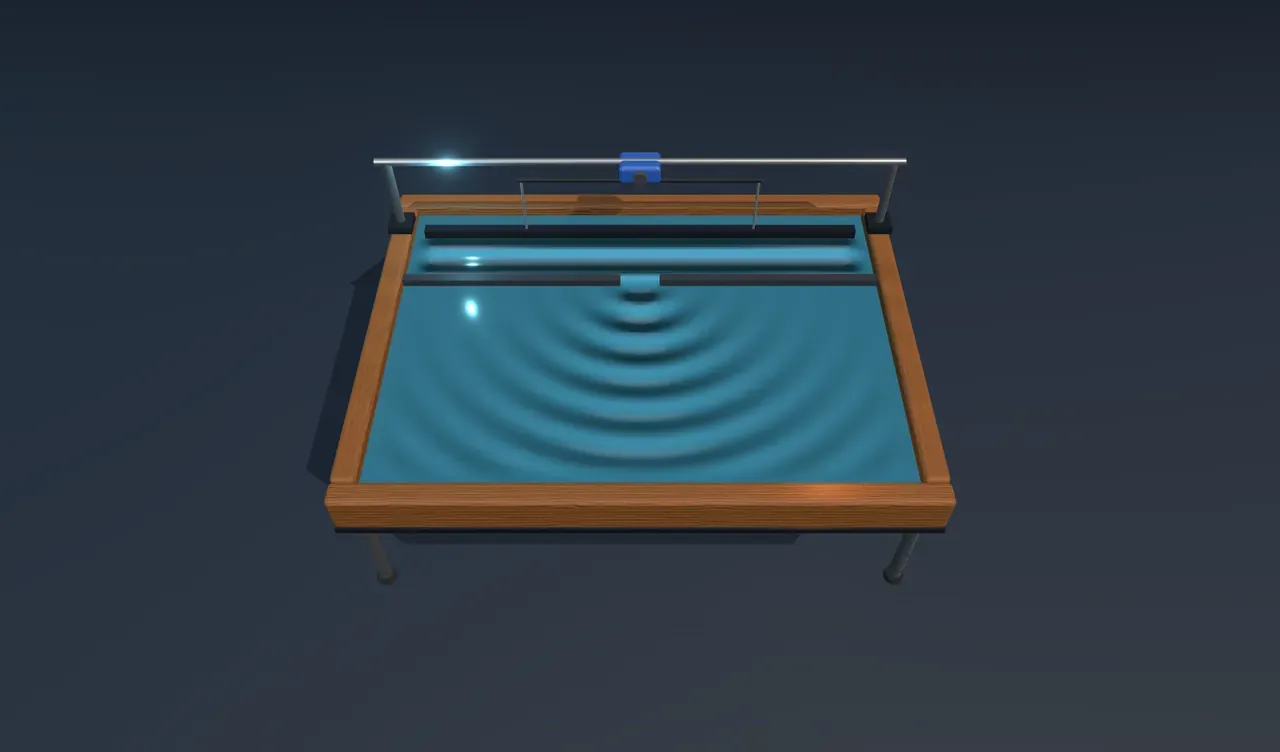
In the water tank a straight bar sends out straight waves, at a frequency of 10 Hz and a speed of 25 cm/s. Their wavelength is therefore . The waves meet a wall with one opening, 10 cm wide, and pass through it as a straight beam, with almost calm water in the wall’s shadow on either side.
When a wave passes through an opening or past an edge, it spreads a little into the space behind it. That spreading is diffraction. Predict what will happen when the opening is narrower than one wavelength, then watch the Scene narrow it.
Step 2 of 4
Sound and light
Every point across the opening sends out ripples of its own. In a wide opening, ripples from different parts of the opening cancel each other out to the sides, leaving a straight beam. In an opening no wider than the wavelength, no two parts are far enough apart to cancel, and the wave spreads in every direction. So what matters is the ratio of the opening’s width to the wavelength.
Try it: slide Opening width to 1.5 cm, 2.5 cm (one wavelength) and 10 cm, and choose On under Show the calm water to see where the wave does not reach.
Step 3 of 4
Two slits
Now the wall has two slits, 10 cm apart. Each slit spreads half-circles of its own, and they interfere: in a direction the path from one slit is longer than the path from the other by , where is the distance between the slits. When that difference is a whole wavelength, crest meets crest and the wave is strong; when it is half a wavelength, crest meets trough and the water is calm. Show the calm water colours the calm lines.
Step 4 of 4
Young’s experiment
In 1801 Thomas Young did the same experiment with light, and the bright and dark fringes on the wall persuaded physicists that light is a wave. The bright fringes lie at the angles where . At small angles , where is the distance from the middle on a wall a distance away, so:
Visible light has a wavelength of a few hundred nanometres, so to see the fringes the slits have to be very close together, tenths of a millimetre apart.
Loading the interactive version…
Loading the interactive version…
Each step sets up the Scene for you, and a control marked “fixed” stays put for that step.
Practice · Predict, then look
The opening is 10 cm wide, four wavelengths, and the wave passes through it as a straight beam. What will happen when the opening is narrowed to 1.5 cm, less than one wavelength?
Practice · Predict, then look
The opening is 10 cm wide, four wavelengths, and the wave passes through it as a straight beam. What will happen when the opening is narrowed to 1.5 cm, less than one wavelength?
Practice · Choose
Through an open door you hear a friend standing round the corner in the next room, but you cannot see them. Why?
Practice · Choose
Through an open door you hear a friend standing round the corner in the next room, but you cannot see them. Why?
Practice · Calculate
The two slits are 10 cm apart, centre to centre, and the waves are 2.5 cm long. Far from the slits, at what angle from straight ahead is the first calm line?
Practice · Calculate
The two slits are 10 cm apart, centre to centre, and the waves are 2.5 cm long. Far from the slits, at what angle from straight ahead is the first calm line?
Practice · Calculate
Red laser light, of wavelength 650 nm, passes through two slits 0.25 mm apart and lights a wall 2 m away. How far apart are two neighbouring bright fringes on the wall?
Practice · Calculate
Red laser light, of wavelength 650 nm, passes through two slits 0.25 mm apart and lights a wall 2 m away. How far apart are two neighbouring bright fringes on the wall?
Lesson complete. Every practice question here is done.