Light is a transverse wave, and a polarising filter picks the direction it shakes in: half of unpolarised light, Malus's law, a third filter that brings light back, and polarising sunglasses.
Step 1 of 5 · The first filter
Step 1 of 5
The first filter
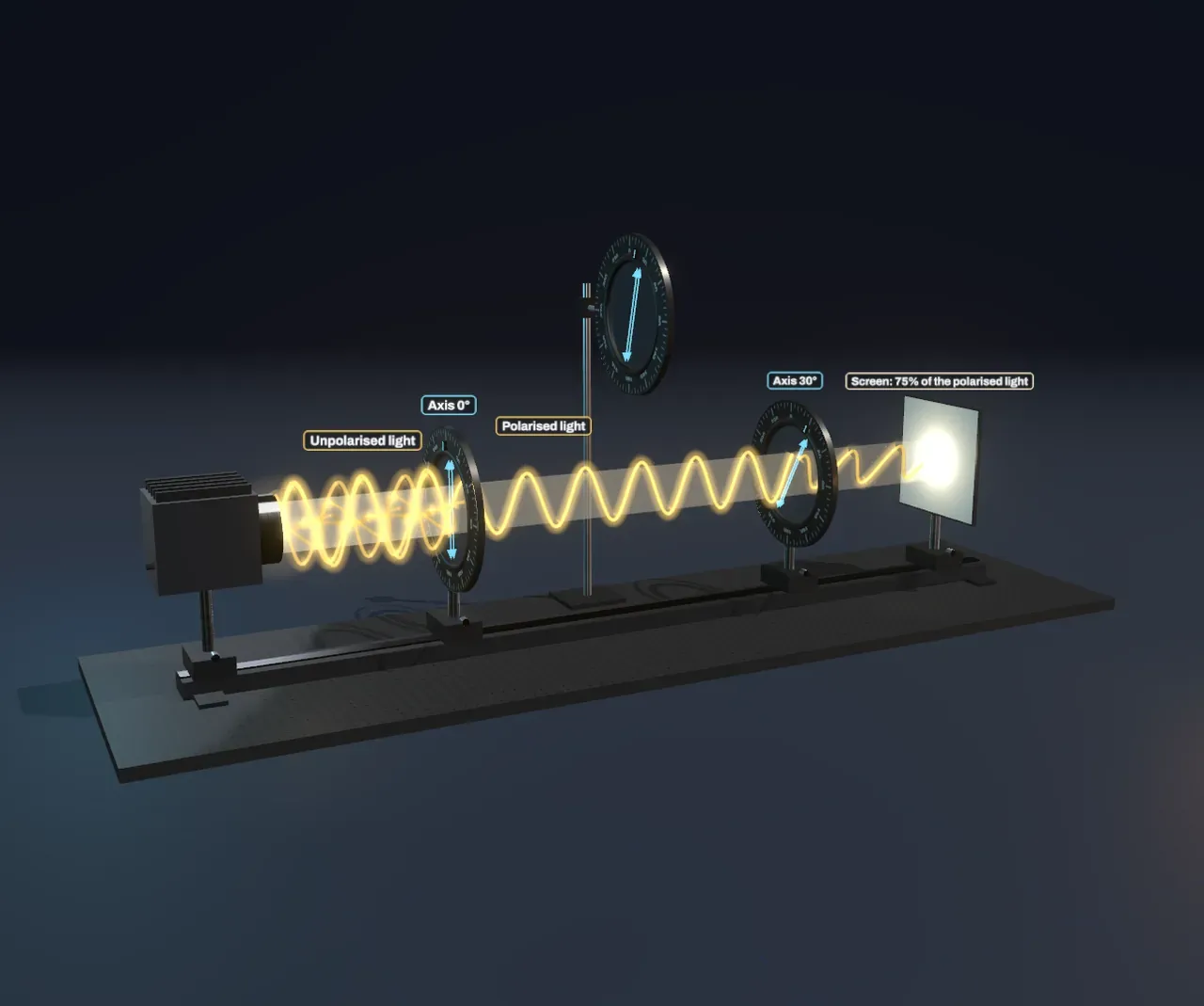
Light is a wave of electric and magnetic fields, and its electric field always shakes across the direction the light travels: a transverse wave, like a wave on a rope. The direction the field shakes in is the light’s polarisation. In light from a lamp or the Sun that direction changes at random, very fast: the light is unpolarised. In the Scene, the yellow waves at different angles between the lamp and the first filter stand for that jumble.
A polarising filter passes only the part of the shaking along its transmission axis, and absorbs the rest. The light leaving it is polarised: it shakes in a single plane, along the axis. A sound wave, which shakes along the direction it travels, cannot be polarised.
Step 2 of 5
Malus’s law
The light reaching the second filter is already polarised, along the first filter’s axis. If the second filter’s axis is turned by an angle , only the part of the field along it gets through: the field times . Brightness goes as the square of the field, so the share of the polarised light passes. This is Malus’s law:
is the light that left the first filter. The chart beside the Scene shows : the share of the polarised light that reaches the screen.
Step 3 of 5
A third filter
When the filters are crossed, at , and the screen is dark: the first filter left only an upright shaking, and the last passes only a sideways one. Predict what will happen when a third filter, turned to , slides in between them, then watch the Scene slide it in.
Step 4 of 5
Three quarters
The third filter is back up, and there are two filters again. This time the other way round: the amount of light is given, and you look for the angle. Work it out first, then turn Angle between filters.
Step 5 of 5
Glare
Light reflected from water, a wet road or a window is mostly polarised sideways. The light of a blue sky is partly polarised too. What do polarising sunglasses do with this?
Try it: with the filters crossed, at , imagine the light past the first filter is the glare, polarised one way, and the last filter is the sunglasses, at right angles to it.
Loading the interactive version…
Loading the interactive version…
Each step sets up the Scene for you, and a control marked “fixed” stays put for that step.
Practice · Choose
The lamp’s light is unpolarised. What share of it gets through the first polarising filter?
Practice · Choose
The lamp’s light is unpolarised. What share of it gets through the first polarising filter?
Practice · Calculate
The last filter is turned from the first. What percentage of the lamp’s light reaches the screen?
Practice · Calculate
The last filter is turned from the first. What percentage of the lamp’s light reaches the screen?
Practice · Predict, then look
The filters are crossed, at , and the screen is dark. A third filter, turned to , slides in between them. What will happen to the screen?
Practice · Predict, then look
The filters are crossed, at , and the screen is dark. A third filter, turned to , slides in between them. What will happen to the screen?
Practice · Reach the target
Turn Angle between filters so that exactly three quarters of the polarised light reaches the screen, then press Check. Try to work out the angle before you move anything.
Practice · Reach the target
Turn Angle between filters so that exactly three quarters of the polarised light reaches the screen, then press Check. Try to work out the angle before you move anything.
Practice · Choose
Polarising sunglasses cut the glare from a wet road, and colours look the same through them. What do they do?
Practice · Choose
Polarising sunglasses cut the glare from a wet road, and colours look the same through them. What do they do?
Lesson complete. Every practice question here is done.