Radio, light and X-rays are the same wave at different lengths: one speed in a vacuum, frequency from wavelength, brightness against colour, and the energy of a single photon.
Step 1 of 5 · One family
Step 1 of 5
One family
Radio waves, microwaves, infrared, visible light, ultraviolet, X-rays and gamma rays are all electromagnetic waves: an electric field and a magnetic field shaking at right angles to each other and to the direction of travel. They need no medium, so they cross empty space. Together they make up the electromagnetic spectrum, arranged by wavelength.
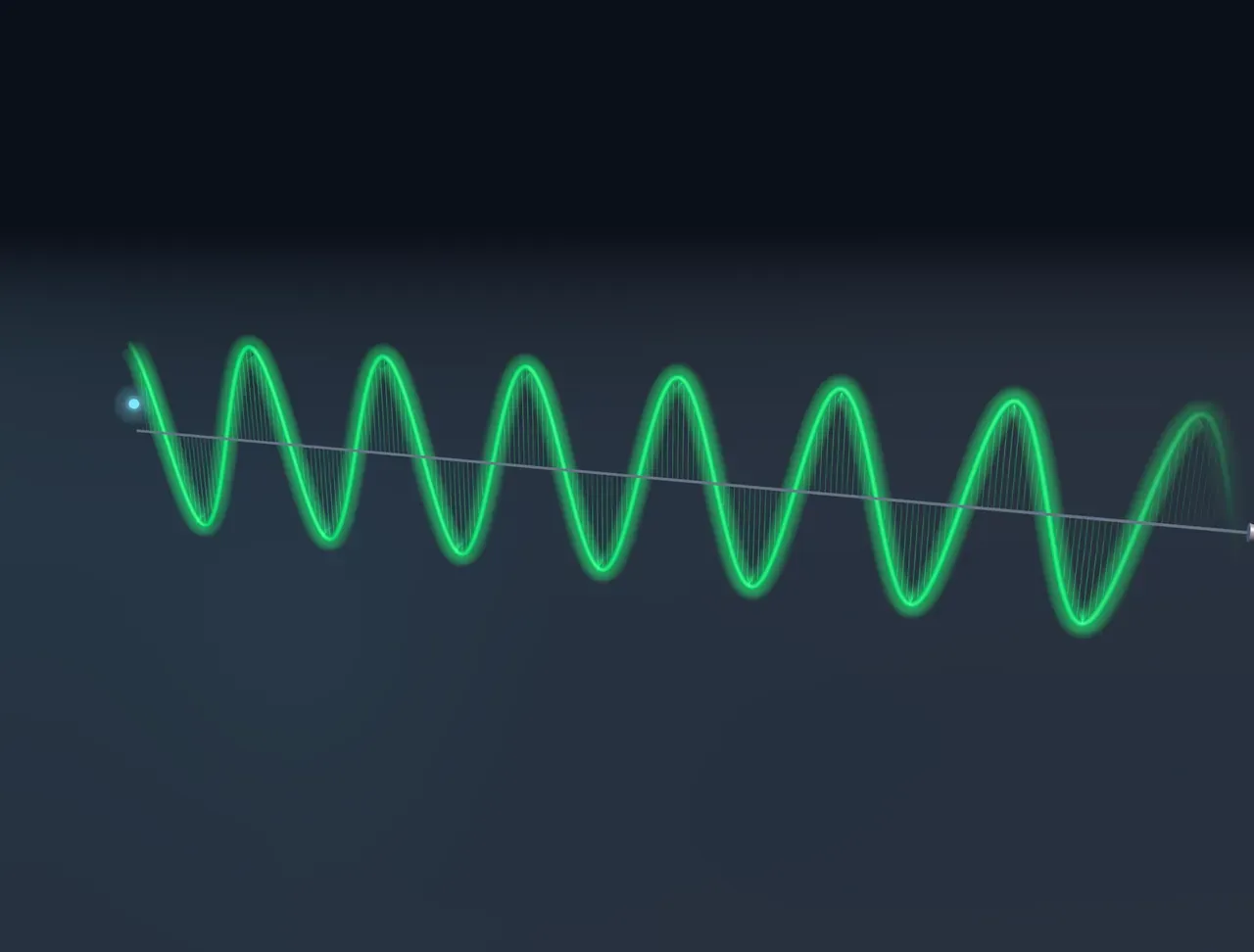
The Wavelength (powers of ten) control moves on a logarithmic scale: the value means metres, and the value means metres. Slide from Radio to X-ray.
Step 2 of 5
Frequency
Every wave obeys . For an electromagnetic wave in a vacuum the speed is always , the speed of light, about , so:
A wave ten times shorter shakes ten times faster. Light’s frequencies are so high that they are handy to measure in terahertz: 1 THz = 10¹² Hz. The wave in the Scene is now fixed at a length of metres.
Step 3 of 5
Brightness and colour
Within the visible band, from about 400 nm to about 700 nm, the colour you see is set by the wavelength: red at the long end and violet at the short end. The Brightness control has nothing to do with the wavelength. Predict what it does change, then watch the Scene turn it up.
Step 4 of 5
The energy of a photon
Light comes in packets, photons, and each photon carries an energy that depends only on its frequency:
is Planck’s constant, . These energies are tiny, so they are also measured in electronvolts: 1 eV ≈ 1.60 × 10⁻¹⁹ J, the energy an electron gains crossing a potential difference of one volt.
Step 5 of 5
Energy per photon
Brightness is how many photons arrive each second; the frequency sets how much energy each one carries. When light strikes a molecule, it is absorbed one photon at a time. Slide from the X-rays back to radio, and notice how many powers of ten the wavelength changes by.
Loading the interactive version…
Loading the interactive version…
Each step sets up the Scene for you, and a control marked “fixed” stays put for that step.
Practice · Choose
A radio wave, visible light and X-rays set out together from a distant star. Which reaches Earth first, through empty space?
Practice · Choose
A radio wave, visible light and X-rays set out together from a distant star. Which reaches Earth first, through empty space?
Practice · Calculate
The wavelength in the Scene is metres, about 501 nm: green light. What is its frequency? Use .
Practice · Calculate
The wavelength in the Scene is metres, about 501 nm: green light. What is its frequency? Use .
Practice · Predict, then look
The screen shows red light, at a Brightness of . What will change in the wave when the brightness is turned up to ?
Practice · Predict, then look
The screen shows red light, at a Brightness of . What will change in the wave when the brightness is turned up to ?
Practice · Calculate
Violet light, of wavelength metres, about 398 nm. How much energy does one of its photons carry? Use and , and answer in joules or electronvolts.
Practice · Calculate
Violet light, of wavelength metres, about 398 nm. How much energy does one of its photons carry? Use and , and answer in joules or electronvolts.
Practice · Choose
A radio mast transmits thousands of watts, far more energy each second than a dentist’s X-ray machine. Yet X-rays can break molecules in cells, and radio waves cannot. Why?
Practice · Choose
A radio mast transmits thousands of watts, far more energy each second than a dentist’s X-ray machine. Yet X-rays can break molecules in cells, and radio waves cannot. Why?
Lesson complete. Every practice question here is done.