Light shakes sideways
Light is a wave of electric and magnetic fields. The electric field at any point along a beam swings back and forth, and it always swings across the beam, never along it. A wave like that is called transverse. A rope flicked up and down sends a transverse wave along it too.
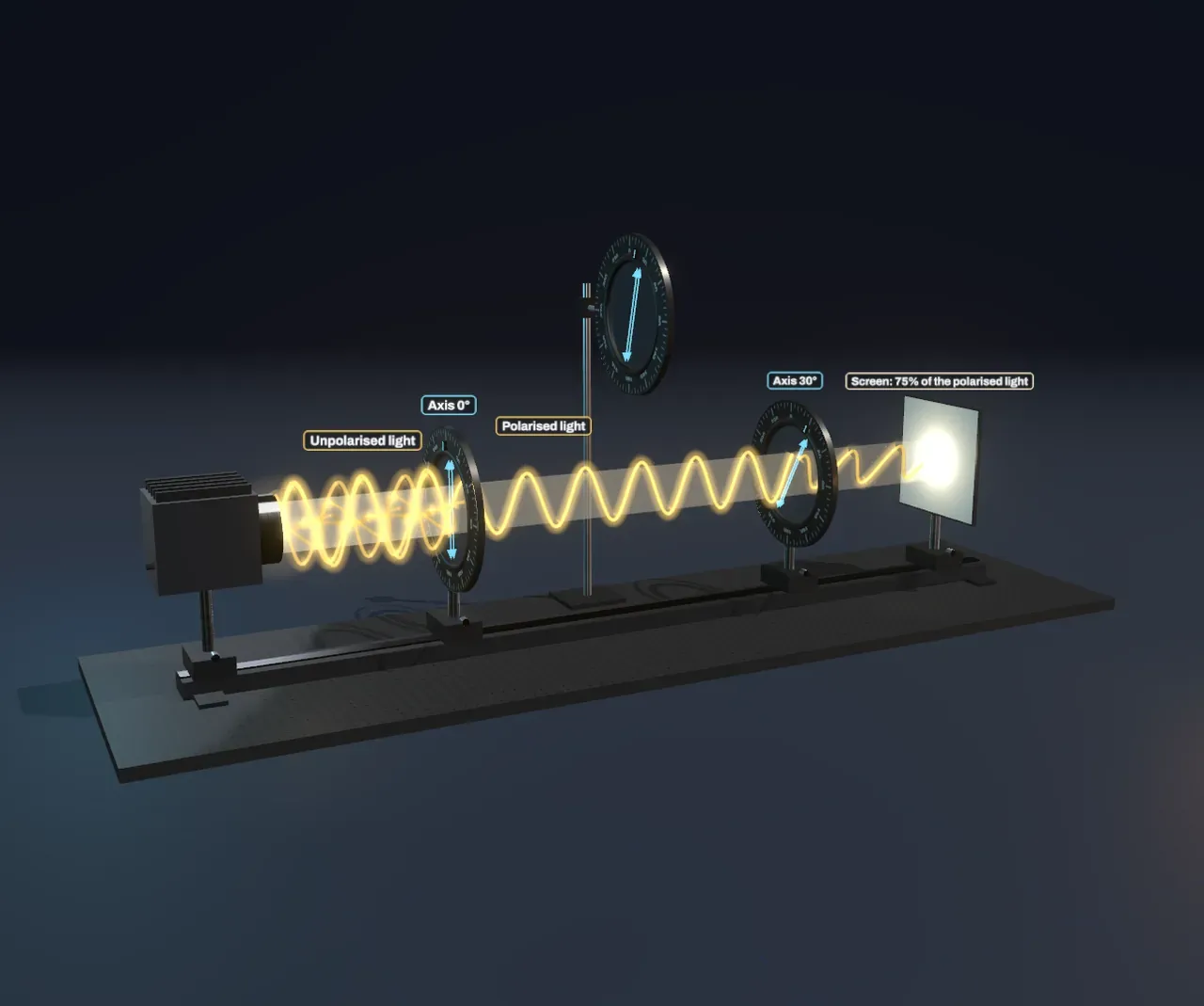
Across the beam there are many directions to choose from: up and down, side to side, or any slant between. The direction the electric field swings is the light’s polarisation. Light from a lamp, a candle or the Sun is unpolarised: it comes from countless atoms each sending out its own short burst, so the direction of swing changes at random, far faster than any eye or instrument can follow. In the scene, several yellow waves at different slants between the lamp and the first filter stand for that jumble.
What a polarising filter does
A polarising filter has a direction built into it, its transmission axis. Think of the field’s swing as an arrow across the beam. The filter splits that arrow into two parts, one along its axis and one at right angles. It lets the part along the axis through and absorbs the rest.
Unpolarised light swings in every direction equally, so on average the filter keeps half its intensity, whichever way the filter is turned. What comes out is different from what went in: it now swings in one plane only, along the filter’s axis. It is polarised. That is why the scene shows a single upright wave after the first filter, a little lower than each strand before it.
The axis is not something you can see. Common filter sheet is plastic whose long molecules have been stretched into line and soaked with iodine, so electrons can move along the molecules. A field swinging along the molecules drives those electrons and loses its energy to them; a field swinging across them passes. So the transmission axis lies across the molecules, not along them. The popular picture of light slipping between the bars of a fence gets this backwards.
Malus’s law: why the screen dims
Now add a second filter, turned at an angle θ to the first. The light reaching it is already polarised along the first axis. Only the part of its swing along the second axis gets through, and that part is the swing times cos θ.
The brightness of light goes as the square of how far its field swings. So the light through the second filter is the light from the first times cos²θ:
This is Malus’s law, after the French engineer Étienne-Louis Malus, who described it in 1809. At 0° nothing changes. At 45° half gets through, since cos 45° squared is ½. At 90°, with the filters crossed, cos 90° is zero and the screen goes dark: the first filter left only an upright swing, and the second keeps only a sideways one.
Try it: drag Angle between filters slowly from 0° to 90° and watch the last wave flatten. In the chart beside the Scene, the dot rides down the blue cos²θ curve, through 50% at 45°.
The third filter
Here is the surprise. Cross the outer filters so the screen is black. Then choose On under Add a third filter to slide a third filter in between them, turned halfway, at 45°. Light comes back.
Adding a filter can only take light away, so how can the screen get brighter? Because a filter does not just block, it also turns what it lets through. The middle filter takes the upright swing and passes the part along its 45° axis: cos²45°, half the light, now swinging at 45°. The last filter is 45° from that, not 90°, so it passes another half. A quarter of the light that left the first filter reaches the screen. In general, with the middle filter halfway, the share is cos⁴(θ/2), the amber curve in the chart beside the Scene.
Smaller steps lose less. Split a quarter turn into two filters’ worth of turning and a quarter gets through; split it into many filters each turned a little further, and nearly all of it does.
Where you meet polarised light
Light reflecting off water, a wet road or a window is partly polarised, with its swing mostly horizontal. Polarising sunglasses have their axes upright, so they cut that glare while passing much of the rest. Light from a clear blue sky is polarised too, most strongly 90° away from the Sun, and bees and many other insects use that pattern to navigate.
The screen of a calculator or a digital watch is a sandwich of crossed polarisers with a layer of liquid crystal between them. With no voltage, the liquid crystal twists the light’s swing gently through a quarter turn, much as the scene’s third filter does, so light gets through and that part of the screen is pale. A voltage straightens the molecules, the twist disappears, and the crossed polarisers make that segment dark.
What this model leaves out
The scene’s filters are ideal: each passes all of the swing along its axis and none across it. Real filter sheet also absorbs a little of the light it should pass, so it lets through about 40% of unpolarised light rather than 50%, and crossed filters let a faint, often bluish glow leak through.
The waves in the scene stand for the electric field of a whole beam. Real light from a lamp is a mixture of colours and of countless short bursts, and visible light’s wavelength is under a thousandth of a millimetre. Light can also be circularly polarised, with its field turning round as it travels rather than swinging in a plane; 3D cinema glasses use that kind. The model leaves that out and keeps to swings in a plane.