Electricity from motion
An old bicycle lamp powered by a dynamo glows only while you pedal. Stop at the lights and it fades; ride faster and it brightens. Inside the dynamo a magnet turns next to a coil of wire, and that is all it needs. Almost all the electricity in the mains is made the same way, by machines in power stations and wind turbines that turn magnets and coils past one another.
Change is what counts
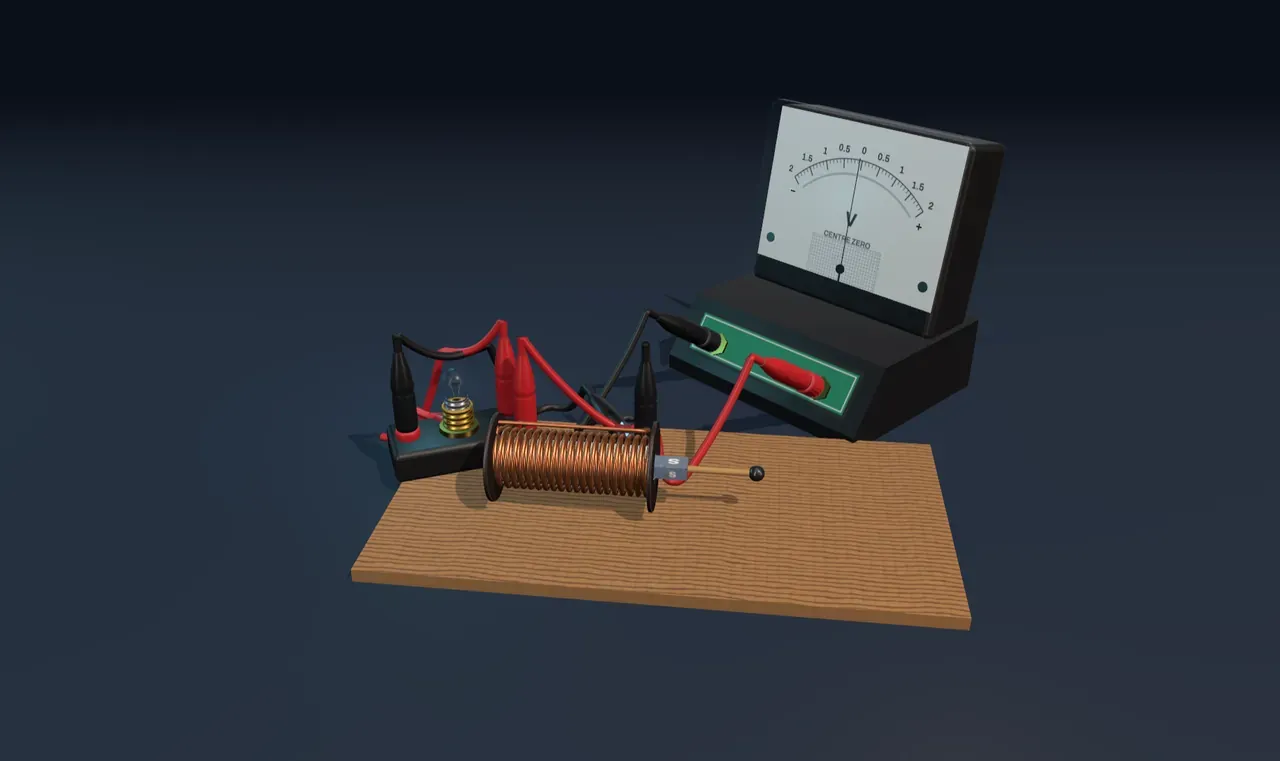
In 1831 Michael Faraday found that a magnet sitting inside a coil does nothing at all. Push it in and the needle of a meter connected to the coil flicks one way; pull it out and it flicks the other way. Hold it still, anywhere, and the needle returns to zero. Joseph Henry in America noticed the same effect at about the same time.
What matters is the magnetic flux through the coil: how much magnetic field passes through each turn. While the flux is changing, a voltage appears across the ends of the wire and, if the circuit is closed, a current flows. This is electromagnetic induction.
Faster, and more turns
The voltage is set by how quickly the flux changes, which is Faraday’s law: EMF = −N·ΔΦ/Δt, where N is the number of turns and ΔΦ/Δt is the change in flux each second. Moving the magnet twice as fast changes the flux in half the time, so the voltage doubles. Each turn of wire produces the same voltage as the next, and since the turns are joined end to end their voltages add, so twice the turns give twice the voltage. The minus sign is about direction, and comes next.
Try it: slide Speed to 0.5 per second and watch the meter, then up to 3 per second and the bulb lights. Slide Turns of wire down and watch it dim, then slide Speed down to 0.
The coil pushes back
When the bulb is lit, energy is leaving the circuit as light and heat. It comes from you: the induced current makes the coil itself a magnet, and its poles always oppose the motion that caused them. Push a north pole in and the near end of the coil becomes a north pole that repels it; pull it out and that end turns south and holds on to it. This is Lenz’s law, named after Heinrich Lenz, who stated it in 1834. If the coil helped the magnet along instead, it would be making energy from nothing.
Reveal the field to see the magnet’s field lines sweep through the coil, the arrows of the current along the wire, and the poles the coil takes on as the magnet moves.
Spinning instead of pushing
Switch Motion to Spin. Here the coil is wound on an iron core whose end sits beside the magnet, as in a bicycle dynamo. As the magnet turns, its north and south poles take turns facing the core, so the flux through the coil swings smoothly back and forth and so does the voltage. That is alternating current. A power-station generator works on the same principle; one with a single pair of poles turns 50 times a second to give 50 Hz mains, or 60 times in the Americas.
What this model leaves out
The magnet’s poles are treated as points, and its strength is chosen to give readable voltages rather than taken from a real magnet. The meter shows the voltage the coil makes without any current being drawn; in a real circuit the coil’s own resistance takes a share. The bulb responds to the average power over a stroke rather than flickering with each push, and the extra effort needed to move the magnet against the coil’s push is described, not simulated.