A changing magnetic field induces a voltage: magnetic flux, Faraday's law, why more turns and faster motion give more voltage, Lenz's law, and alternating and effective voltage.
Step 1 of 6 · The change is what counts
Step 1 of 6
The change is what counts
A current makes a magnetic field. Can a magnetic field make a current? Michael Faraday looked for it for years, and in 1831 found that it can, but only on one condition.
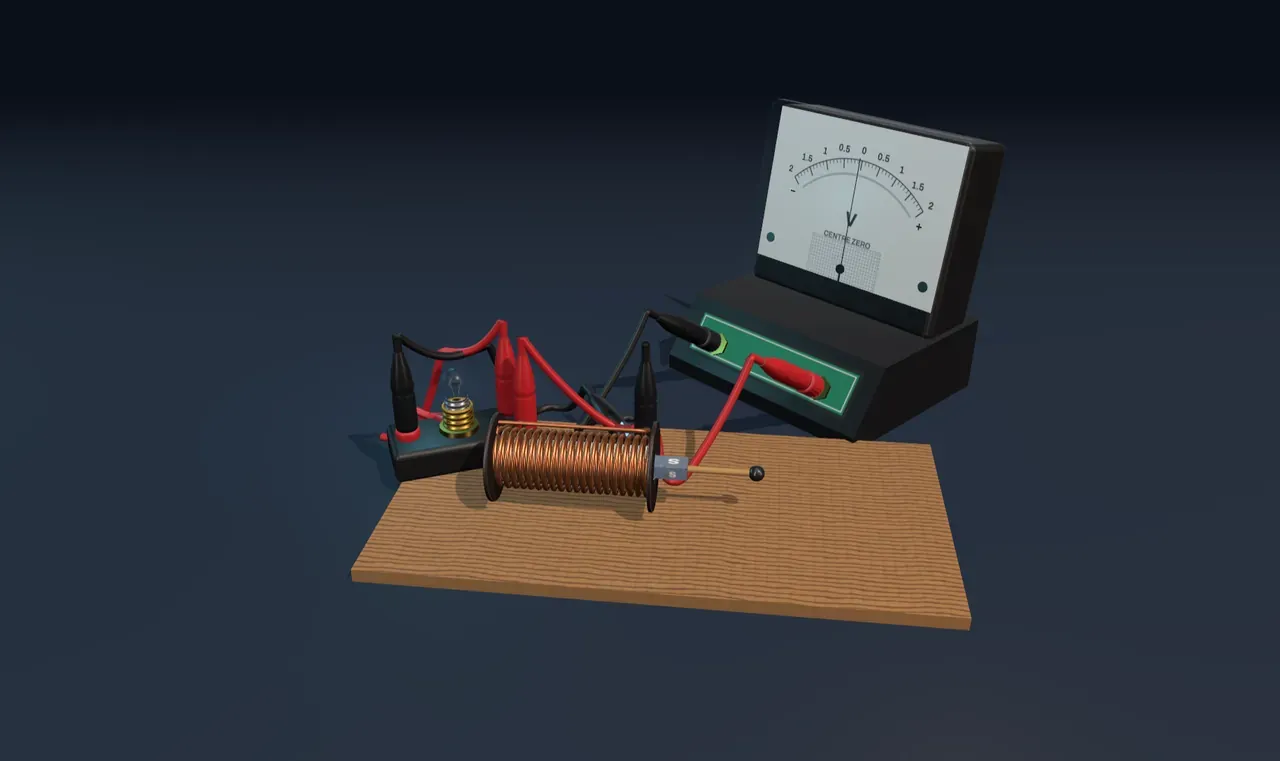
On the board is a coil of turns, connected to a centre-zero voltmeter and a small bulb. A bar magnet is pushed in and out once a second, and the needle swings one way as the magnet goes in and the other way as it comes out. Predict what will happen when the magnet stops.
Step 2 of 6
Faraday’s law
To say how much voltage appears, you need a new quantity: the magnetic flux through a turn, when the field is at right angles to the turn, that is, how much field passes through its area. Flux is measured in webers (Wb = T·m²).
When the flux through the turns changes, an induced voltage appears across the ends of the coil, the electromotive force (EMF) , and its size is given by Faraday’s law:
is the number of turns, because each turn makes the same voltage and they are joined one after another, and is the rate at which the flux changes. The minus sign comes in a moment.
Step 3 of 6
Faster, and with more turns
In the Scene, with turns and one push a second, the voltage peaks at 0.5 V. Now there are turns, and the magnet is pushed three times a second with the same stroke.
Step 4 of 6
Reach a peak
Now you set Speed and Turns of wire. Once the peak is high enough, the bulb lights too.
Step 5 of 6
The coil pushes back
While the bulb is lit, energy leaves the circuit as light and heat. Where does it come from? The induced current turns the coil itself into an electromagnet, and its poles always oppose the change that made them. This is Lenz’s law, and it is what the minus sign in Faraday’s law says.
Show field and current is On: the magnet’s field lines pass through the coil, the arrows show the current in the wire, and the poles the coil takes on while the magnet moves appear at its ends.
Step 6 of 6
Spinning: an alternating voltage
Spin is chosen under Motion: now the magnet turns twice a second beside the end of an iron core inside the coil, as in a bicycle dynamo. Its north and south poles face the core in turn, the flux rises and falls as a sine wave, and so does the voltage: an alternating voltage. Every generator in a power station works this way.
An alternating voltage is at its peak only for an instant. To say what it is “worth”, you use the effective voltage: the steady voltage that would heat the same bulb just as much. For a sine wave with peak :
Loading the interactive version…
Loading the interactive version…
Each step sets up the Scene for you, and a control marked “fixed” stays put for that step.
Practice · Predict, then look
The magnet is pushed in and out once a second, and the needle swings both ways. Now the magnet is stopped and left inside the coil. What will the meter show?
Practice · Predict, then look
The magnet is pushed in and out once a second, and the needle swings both ways. Now the magnet is stopped and left inside the coil. What will the meter show?
Practice · Calculate
A coil has turns. The magnetic flux through each turn rises steadily from zero to 3.0 mWb in 0.10 s. How large is the induced EMF?
Practice · Calculate
A coil has turns. The magnetic flux through each turn rises steadily from zero to 3.0 mWb in 0.10 s. How large is the induced EMF?
Practice · Calculate
With turns and one push a second, the voltage peaks at 0.5 V. Now there are turns, and the magnet is pushed three times a second with the same stroke. What is the peak voltage?
Practice · Calculate
With turns and one push a second, the voltage peaks at 0.5 V. Now there are turns, and the magnet is pushed three times a second with the same stroke. What is the peak voltage?
Practice · Reach the target
Change Speed and Turns of wire until the peak voltage is 1.5 V, then press Check.
Practice · Reach the target
Change Speed and Turns of wire until the peak voltage is 1.5 V, then press Check.
Practice · Choose
The north pole of the magnet is pushed into the coil. While it moves in, what does the end of the coil nearest the magnet become?
Practice · Choose
The north pole of the magnet is pushed into the coil. While it moves in, what does the end of the coil nearest the magnet become?
Practice · Calculate
The magnet spins twice a second beside the iron core, and with turns the voltage swings as a sine wave between +1.2 V and −1.2 V. What is the effective voltage, the one the bulb glows by?
Practice · Calculate
The magnet spins twice a second beside the iron core, and with turns the voltage swings as a sine wave between +1.2 V and −1.2 V. What is the effective voltage, the one the bulb glows by?
Lesson complete. Every practice question here is done.