Two coils on one core: the turns ratio sets the voltage, the current falls as the voltage rises, a transformer does nothing with direct current, and why power lines run at hundreds of thousands of volts.
Step 1 of 6 · The turns ratio
Step 1 of 6
The turns ratio
A transformer is two coils wound on the same iron core, with no electrical connection between them. Alternating current enters the primary coil, which is connected to the generator. It makes a flux in the core that rises, falls and reverses, and that changing flux passes through the secondary coil too and induces a voltage in it, by Faraday’s law from the last Lesson.
The same flux passes through every turn of both coils, so every turn gets the same voltage. Each coil’s voltage grows with its number of turns:
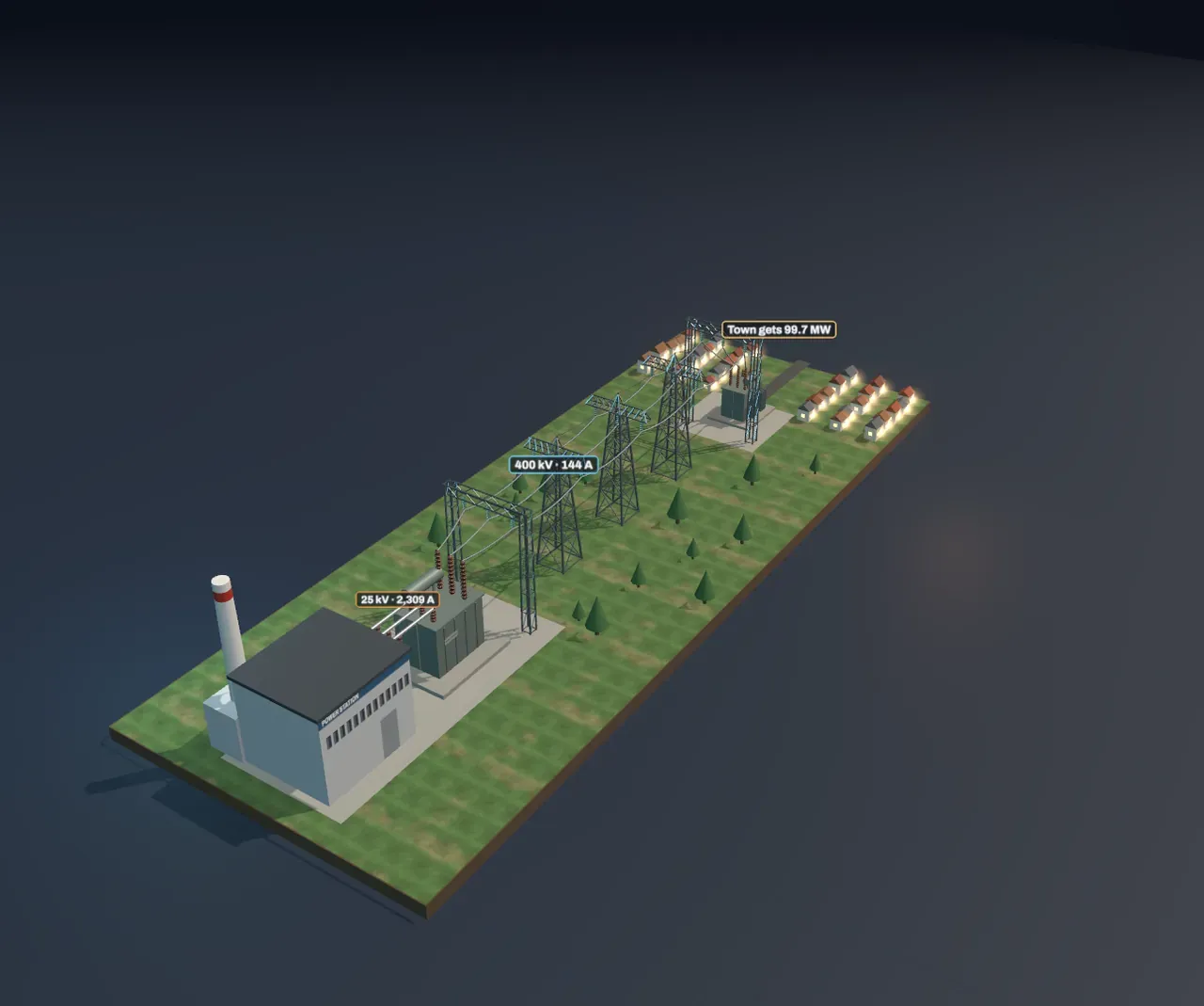
In the Scene, the power station’s generator makes 25 kV, and the transformer beside it feeds a 100 km power line to a town. Right now the Turns ratio is : both coils have the same number of turns.
Step 2 of 6
The current comes down
The tags above the Scene show the voltage and current on each side of the transformer. A transformer adds no energy, and a good one hardly loses any, so the power in equals the power out:
If the voltage goes up 16 times, the current must come down 16 times.
Step 3 of 6
The same power
Now the Turns ratio is , and the line runs at 400 kV. Show current and losses is On: the transformer’s tank is see-through, and each limb of the core has a few thick turns on the station side and 16 times as many thin turns on the line side. Compare the two tags.
Step 4 of 6
Alternating current only
Everything a transformer does goes through a changing flux in the core. That is why the grid runs on alternating current, which reverses 50 times a second.
Step 5 of 6
Heat in the line
Each wire of the line has resistance, and the current turns of power into heat in it. For the same power sent, a high voltage means a small current, and working out the loss in the line’s three wires gives
where is each wire’s resistance and the line’s voltage. The line now runs at 100 kV.
Step 6 of 6
Double the voltage
appears in the formula squared, in the denominator. Predict what will happen to the heat when the voltage doubles, then choose On under Show current and losses and look at the chart.
Try it: after predicting, slide Turns ratio from 1, no step-up at 25 kV, to 2, 4 and 16: 50 kV, 100 kV and 400 kV, and watch the wires cool and the town light up. That is why power lines run at hundreds of thousands of volts, and step-down transformers bring the voltage back to 230 V before it reaches a home.
Loading the interactive version…
Loading the interactive version…
Each step sets up the Scene for you, and a control marked “fixed” stays put for that step.
Practice · Calculate
Right now both coils of the transformer have the same number of turns, and the line runs at 25 kV, the generator’s voltage. If the coil on the line side had times as many turns as the coil on the station side, what voltage would the line run at?
Practice · Calculate
Right now both coils of the transformer have the same number of turns, and the line runs at 25 kV, the generator’s voltage. If the coil on the line side had times as many turns as the coil on the station side, what voltage would the line run at?
Practice · Calculate
The tag on the station side shows that each busbar leaving the generator carries 2,309 A. If the line side had times as many turns, what current would each wire of the line carry?
Practice · Calculate
The tag on the station side shows that each busbar leaving the generator carries 2,309 A. If the line side had times as many turns, what current would each wire of the line carry?
Practice · Choose
The step-up transformer raises the voltage 16 times. Take it to be ideal. How does the power it sends into the line compare with the power it takes in from the generator?
Practice · Choose
The step-up transformer raises the voltage 16 times. Take it to be ideal. How does the power it sends into the line compare with the power it takes in from the generator?
Practice · Choose
A 12 V battery is connected to the primary coil of a transformer whose secondary coil has times as many turns. What voltage appears across the secondary coil after the moment of connection?
Practice · Choose
A 12 V battery is connected to the primary coil of a transformer whose secondary coil has times as many turns. What voltage appears across the secondary coil after the moment of connection?
Practice · Calculate
The line now runs at 100 kV, the station sends 100 MW, and each wire of the line has a resistance of 5 Ω. How much power turns to heat in the line? Use .
Practice · Calculate
The line now runs at 100 kV, the station sends 100 MW, and each wire of the line has a resistance of 5 Ω. How much power turns to heat in the line? Use .
Practice · Predict, then look
The Turns ratio is doubled from to , and the line’s voltage rises to 200 kV. What will happen to the heat in the wires?
Practice · Predict, then look
The Turns ratio is doubled from to , and the line’s voltage rises to 200 kV. What will happen to the heat in the wires?
Lesson complete. Every practice question here is done.