A long way from the plug
The power that runs a kettle was made moments earlier in a power station that may be hundreds of kilometres away. It travelled there along metal wires, and metal wires are not perfect: every metre has a little resistance, and current pushed through resistance turns some of its energy into heat.
So the grid has a problem. It needs to move an enormous amount of power over a long distance through wires that waste some of it on the way. The answer it uses is the transformer, and the reason it works comes down to one line of arithmetic.
What a transformer does
A transformer is two coils of wire wound on the same iron core, with no electrical connection between them. The grid’s current is alternating: it swings back and forth 50 times a second (60 in the Americas). As the current in the first coil rises, falls and reverses, it makes a magnetic field in the iron that does the same, and that changing field drives a voltage in every turn of the second coil.
Each turn picks up the same voltage, so the second coil’s voltage depends on how many turns it has. A coil with 16 times as many turns makes 16 times the voltage. That is a step-up transformer, and the same thing wound the other way round is a step-down one. The ratio of the turns is the ratio of the voltages.
Try it: choose On under Show current and losses and the transformer’s tank turns clear. Each leg of the iron core carries a few thick turns on the station side and many thin ones on the line side. Drag Turns ratio and watch the line-side coil gain turns.
A transformer cannot make energy. If the voltage goes up 16 times, the current comes down 16 times, so the power on each side is the same. Large transformers manage this very well: they pass on more than 99% of what goes in.
Power is voltage times current
The power a wire carries is its voltage times its current, . The same 100 megawatts can travel as a modest voltage and a huge current, or as a huge voltage and a modest current.
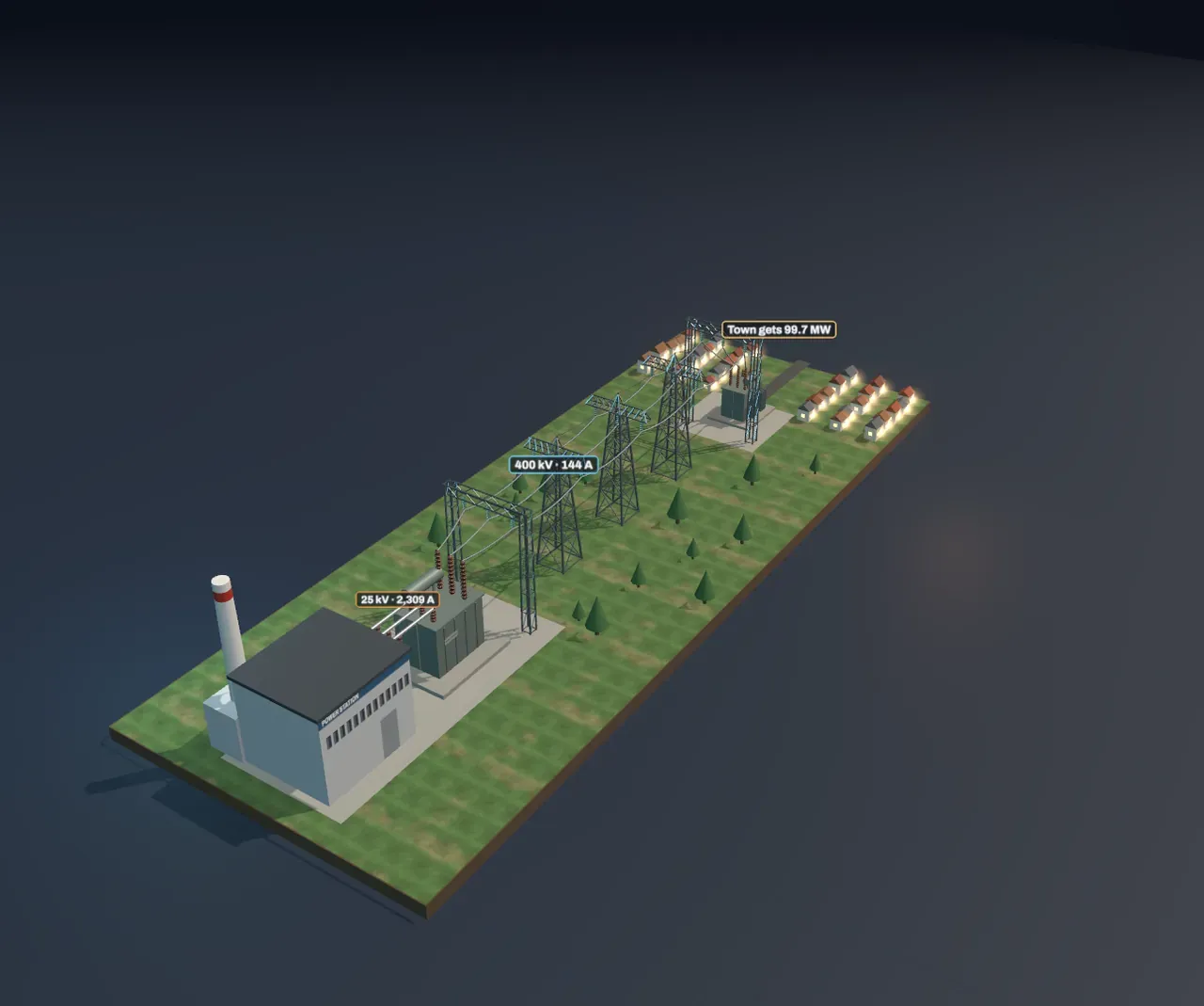
The generator in the scene makes 25 kilovolts. Sending 100 MW at that voltage takes about 2,300 amperes in each of the line’s three wires. Step it up to 400 kV and the same power needs only about 144 A.
Try it: compare the two tags over the scene. With Turns ratio at 16, a 400 kV line, the busbars from the generator carry about 2,300 A and the line only 144 A. Slide it down to 1, no step-up at 25 kV, and the line has to carry the full 2,300 A.
Losses grow with the square of the current
A wire with resistance carrying a current turns of power into heat. The current is squared, so twice the current makes four times the heat, and ten times the current makes a hundred times the heat.
That is why the voltage matters so much. Doubling the voltage halves the current needed for the same power, and halving the current quarters the heat lost. For a three-wire line carrying power at voltage the loss works out as
In the scene each wire has 5 Ω, roughly 100 km of aluminium cable about 2.7 cm thick. Sending 100 MW at 25 kV, this rule says 80 MW would be lost, four fifths of everything sent. At 400 kV the loss is about 0.3 MW, a third of a percent.
Try it: start with Turns ratio at 1, no step-up at 25 kV, then slide it to 2, 4 and 16: 50 kV, 100 kV and 400 kV. Each doubling of the voltage cuts the heat in the wires to a quarter, and more of the town lights up.
The power you send matters as well. Slide Power sent up to 120 MW, an evening peak, and the line has to carry more current, so its loss grows with the square of that too.
Heat you can see
The lost power warms the wires, and warm metal expands. A span of cable between two pylons grows a little longer and sags a little lower. In the scene, at low voltage, the wires turn orange and droop towards the ground. Real power lines do sag on hot days under heavy load, and that is one reason grid operators cap the current each line may carry: a line that sags too far can touch a tree or come too close to the ground.
Why not an even higher voltage?
If higher is better, why stop at 400 kV? Because high voltage is hard to hold back. It needs longer insulators, wider gaps between the wires, taller pylons and bigger transformers, and above a certain point the electric field around a wire starts to tear at the air itself, a faint crackle called corona that wastes power of its own. Each grid picks the voltage that balances these costs against the losses. Most use something between 110 kV and 765 kV for their longest lines, and China runs some at 1,000 kV and above.
Stepping back down
No home could use 400,000 volts. Near the town, a step-down transformer reverses the trick: fewer turns on its output side, so lower voltage and higher current. Over the last few kilometres, where distances are short and losses small, the voltage is stepped down again, through local substations and then the transformer on a pole or in a box at the end of a street, to the 230 V (or 120 V in North America) at the plug.
That is the shape of every electricity grid: generate, step up, transmit, step down, and step down again. It only works because the grid’s current alternates. A steady direct current makes no changing field, so a transformer cannot step it up or down.
What this model leaves out
The scene uses the textbook rule: it works out the current at the sending voltage, takes off as heat, and gives the town the rest. That is a good guide while the loss is small. When it is large, as at 25 kV, a real line would also drop much of its voltage along the way, the town’s voltage would collapse, and the line could not deliver that much power at all. Real grids never run a line like that.
Every voltage in the scene uses the same wire and the same 100 km, which keeps the comparison fair. Real low-voltage lines are shorter and carry less. The transformers are treated as perfect, and the line’s inductance and capacitance, which also matter on a long alternating-current line, are left out. The very longest links often use high-voltage direct current instead, converting it back to alternating current at each end.
The wires’ temperature is a rough steady-state estimate for a bare conductor in a light breeze. The orange tint is there to mark the heat: a wire hot enough to sag like that would not glow. The dots stand for shares of the current, not for electrons, which in fact only shuffle back and forth by far less than a millimetre. And the line, its pylons and the town are all squeezed together onto one board.