A magnet you can switch off
A scrapyard crane swings a steel disc over a heap of scrap, and a tangle of old car parts leaps up to meet it. The crane swings over a skip, the operator presses a button, and the whole lot drops. No ordinary magnet could do that, because an ordinary magnet never lets go. The disc on the crane is an electromagnet: a coil of wire that is a magnet only while electric current flows through it.
Smaller ones ring doorbells, hold security doors shut and drive loudspeakers.
Current makes a field
In 1820 Hans Christian Ørsted noticed that a compass needle twitched whenever he switched on a current in a wire nearby. Moving electric charge makes a magnetic field. Around a straight wire the field runs in circles, and it is weak: a few centimetres from a wire carrying one ampere it is a small fraction of the Earth’s own field.
Bend the wire into a loop and the circles all point the same way through the middle, so the field adds up. Wind many loops side by side into a coil and each loop adds its share. Inside, the field runs straight along the coil; outside it loops round from one end to the other. One end behaves as a north pole and the other as a south pole, exactly like a bar magnet. Reverse the current and the poles swap.
More turns, more current
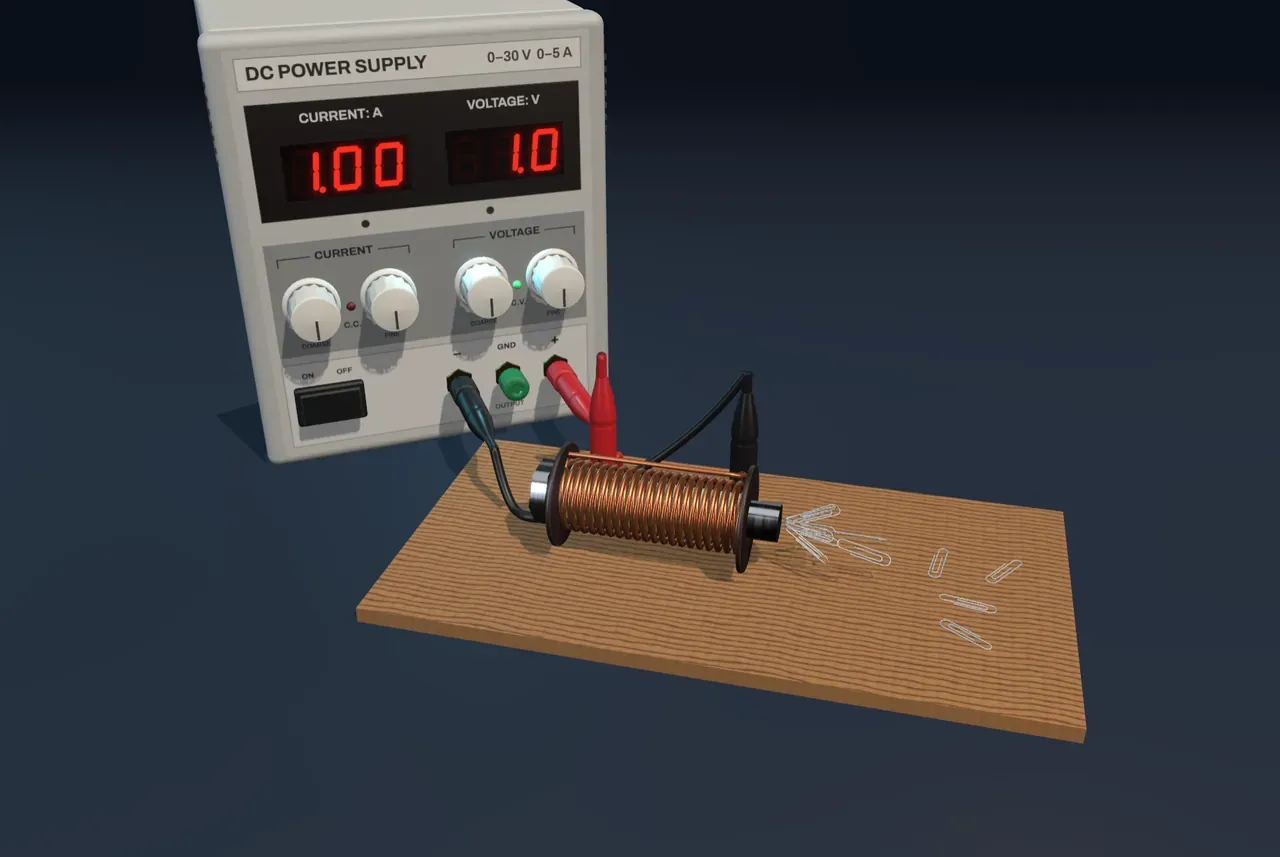
For a long coil the field inside is B = μ₀NI/ℓ: proportional to the number of turns N and the current I, and inversely proportional to the coil’s length ℓ. μ₀, the magnetic constant, sets how much field a current makes in empty space. Double the turns or double the current and the field doubles. The 200 turns in the scene carrying one ampere make about 4 milliteslas inside the coil, nearly a hundred times the Earth’s field at the surface, and still too weak on their own to lift a paper clip from the board.
Try it: take the Iron core out and slide Current up to 5 A with Turns of wire at 500. Then put the core back and drop the current to 0.5 A: a tenth of the current now lifts more clips than before.
Why iron helps so much
Iron is made of tiny regions called magnetic domains, each already a little magnet, normally pointing every which way so that their fields cancel. The coil’s field swings them into line, and their fields then add to the coil’s. A soft-iron core can multiply the field many times over, which is why almost every practical electromagnet is wound round iron.
The boost has a limit. Once nearly every domain is aligned the iron is saturated, somewhere around 1.5 to 2 teslas, and extra current adds only the coil’s own small share. Soft iron also forgets: when the current stops, its domains fall back into disorder and the clips drop. Hardened steel would keep much of its magnetism, which is how permanent magnets are made.
Reveal the field to see lines leave the north end of the iron and loop round to the south end. The arrows on the wire show which way the current flows; curl the fingers of your right hand that way round the coil and your thumb points to the north pole.
What this model leaves out
The scene uses the long-coil formula even though this coil is short, and it treats the iron as a fixed 25-times multiplier with a smooth limit, whereas a real core’s boost depends on its shape, its grade of iron and what it has been through before. How fast the field fades beyond the pole, and how much a clip needs before it jumps, are chosen to show the trend, not measured. A real coil carrying five amperes through thin wire would also grow warm, because the wire’s resistance turns some of the electrical energy into heat.