An electric current makes a magnetic field: the field inside a coil, how to work it out, what an iron core adds and where it stops, and which end of the coil is the north pole.
Step 1 of 6 · A current makes a field
Step 1 of 6
A current makes a field
In 1820 Hans Christian Ørsted noticed that a compass needle moved every time he switched on a current in a wire beside it. Every electric current makes a magnetic field round it. Round a straight wire the field lines are circles going round the wire, and the field is weak: a few centimetres from a wire carrying one ampere, it is far smaller than the Earth’s field.
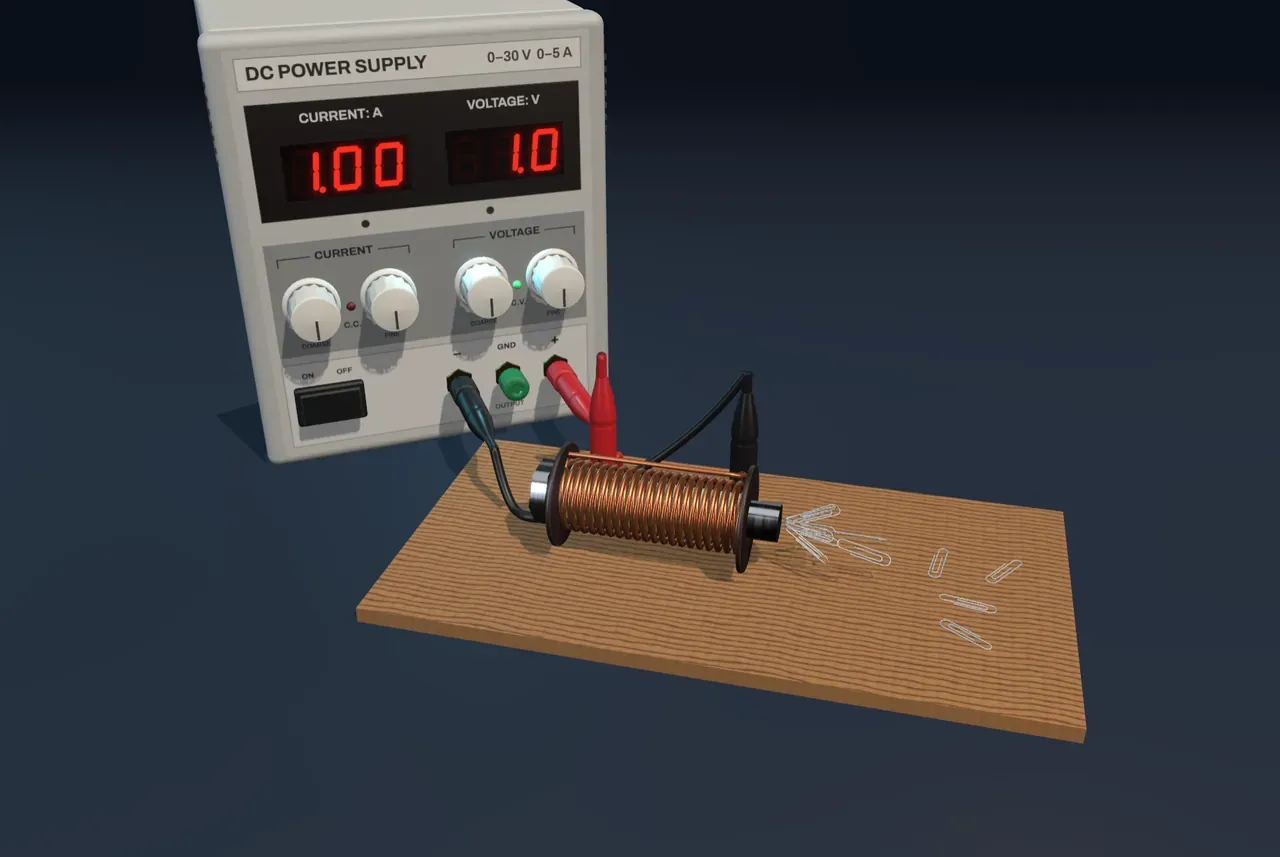
To get a strong field, the wire is wound into a coil. Each turn adds its own field, and inside the coil all the shares point the same way. On the board is a coil of copper wire 6 cm long, connected to a power supply, with an iron bolt in it. Right now no current flows, and the clips lie still.
Try it: raise Current and watch the clips jump to the bolt. Then set it back to zero.
Step 2 of 6
The field inside a coil
Inside a long coil the field is nearly uniform, and its strength is
where is the number of turns, the current, the coil’s length in metres, and the magnetic constant. The field is measured in tesla (T). One tesla is a very strong field; the Earth’s is about 50 µT, so millitesla (mT) are handy.
Now the core is out, and the current and the number of turns are fixed. Work out the field inside the coil.
Step 3 of 6
One product
In the formula, and appear only as a product. What sets the field is how much current goes round the coil in all, the ampere-turns: turns at 1 A and turns at 2 A give the same field.
Step 4 of 6
An iron core
Soft iron is made of tiny regions, magnetic domains, each of them a small magnet. Usually they point every which way and cancel. In the last Lesson you saw that a magnet lines them up; here the magnet is the coil itself.
Predict what will happen to the field when the bolt goes in, then look.
Step 5 of 6
Saturation
The iron’s boost has a limit. Once nearly all the domains are lined up, the iron saturates, around 1.6 T, and beyond that more current adds only the coil’s own small share. Now the current and the number of turns are at their maximum.
Step 6 of 6
Which end is north
Outside, a coil’s field looks like a bar magnet’s: the lines leave one end and enter the other. Which end is north is given by the right-hand grip rule: curl the fingers of your right hand the way the current runs in the turns, and your thumb points to the north pole. Reverse the current, and the poles swap.
Show the field is at Field: the arrows on the wire show the direction of the current, and the lines leave the end of the bolt.
Loading the interactive version…
Loading the interactive version…
Each step sets up the Scene for you, and a control marked “fixed” stays put for that step.
Practice · Calculate
The coil is 6 cm long, has turns, and carries a current of 1 A. The iron core is out. How strong is the magnetic field inside the coil? ()
Practice · Calculate
The coil is 6 cm long, has turns, and carries a current of 1 A. The iron core is out. How strong is the magnetic field inside the coil? ()
Practice · Reach the target
With no core, change Current and Turns of wire until the field inside the coil is 10 mT, then press Check.
Practice · Reach the target
With no core, change Current and Turns of wire until the field inside the coil is 10 mT, then press Check.
Practice · Predict, then look
The coil is still at 1 A and turns, with 4.2 mT inside it. The iron bolt is slid in. What will happen to the field at the centre of the coil?
Practice · Predict, then look
The coil is still at 1 A and turns, with 4.2 mT inside it. The iron bolt is slid in. What will happen to the field at the centre of the coil?
Practice · Calculate
Now the current is 5 A and there are turns. Without the core, the coil’s field would be 52 mT; with the core, the field at the centre is 1.08 T. By what factor does the iron boost the field now?
Practice · Calculate
Now the current is 5 A and there are turns. Without the core, the coil’s field would be 52 mT; with the core, the field at the centre is 1.08 T. By what factor does the iron boost the field now?
Practice · Choose
You look straight at one end of a coil. The current goes round that end anticlockwise. Which pole is it?
Practice · Choose
You look straight at one end of a coil. The current goes round that end anticlockwise. Which pole is it?
Lesson complete. Every practice question here is done.