Suck, squeeze, bang, blow
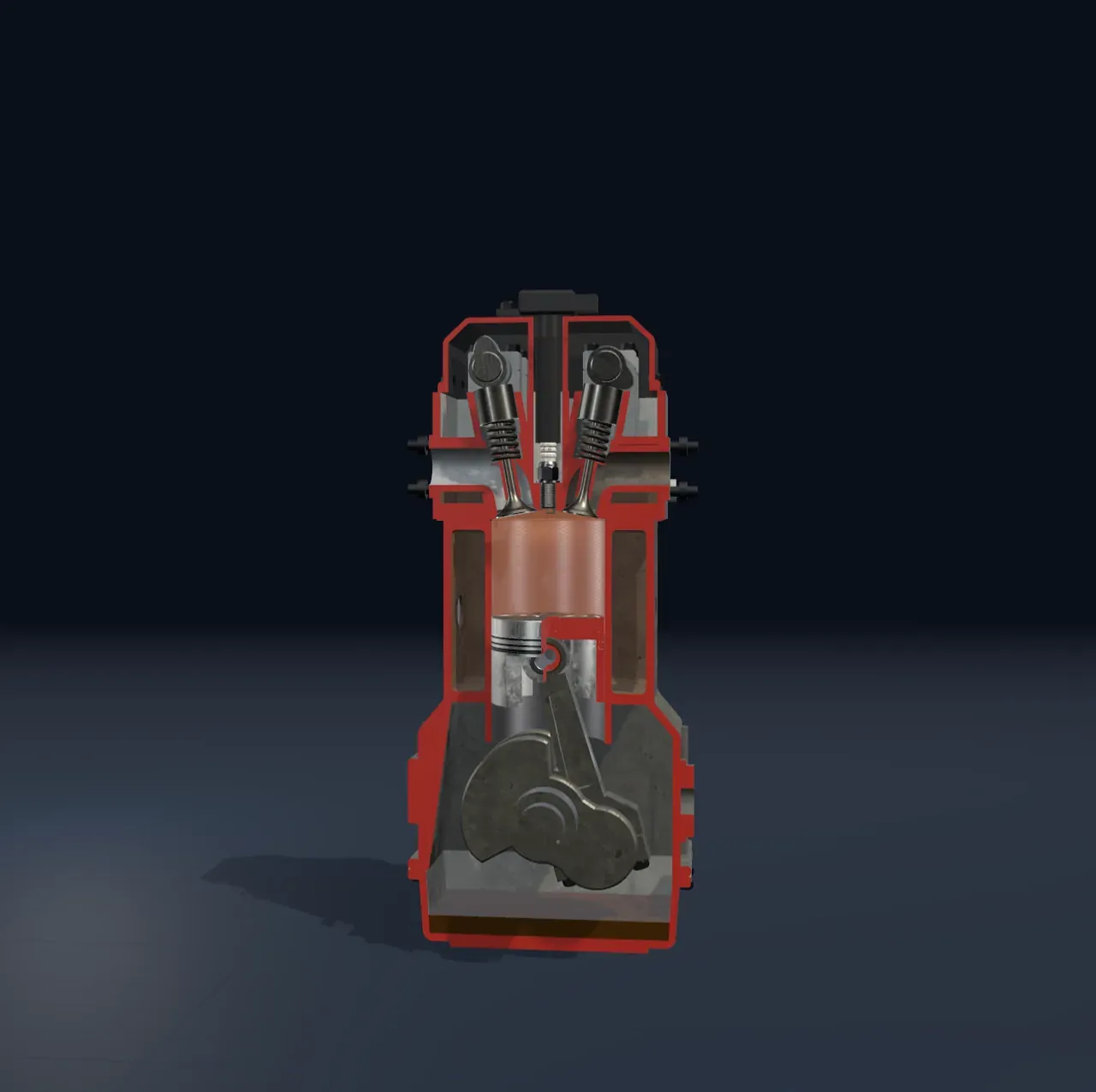
Inside a car’s engine, a metal plug called a piston slides up and down in a closed tube, the cylinder, many times a second. A connecting rod joins it to a crankshaft, whose offset crank turns the up-and-down motion into rotation, as your leg turns a bicycle pedal. A counterweight on the far side of the crank balances the swing.
A petrol engine repeats four steps, called strokes, each lasting half a turn of the crank:
- Intake. The piston moves down with the intake valve open, drawing in air with a fine mist of petrol.
- Compression. Both valves close and the rising piston squeezes the mixture into a small space at the top.
- Power. A spark plug fires. The mixture burns in a flash, its pressure leaps, and it drives the piston down hard.
- Exhaust. The exhaust valve opens and the rising piston pushes the burnt gas out.
That is two turns of the crank for every power stroke. Egg-shaped cams press on cup-shaped bucket followers to push the valves open against their springs; the camshafts turn at half the crank’s speed, so each valve opens once every two turns.
A cutaway engine
The Scene is cut through the middle, like the sectioned engines in museums and workshops, with the cut faces painted red. The cylinder is bored into a cast-iron block, round which a water jacket carries coolant to take heat away. An aluminium cylinder head closes the top. Its curved ports lead the mixture in and the exhaust out, and each is sealed by a valve on a hard ring, its seat. Piston rings in grooves round the piston seal it against the cylinder wall, and a hollow gudgeon pin joins it to the rod. The spark plug’s white ceramic insulator keeps its high voltage from leaking into the metal round it. Switch on Labels to name the parts.
Pressure times volume is work
When gas pushes a piston, the work it does is its pressure times the change in volume it sweeps out. Plot the gas pressure against the cylinder volume through all four strokes and you get a closed loop. The area inside it is the work the gas did on the piston in one cycle.
During compression the piston does work on the gas; after the spark, the hot gas at much higher pressure gives back far more on the way down. The difference, the shaded area, is what turns the wheels. Below it sits a thin, flat loop running the other way: the work the piston spends breathing, drawing fresh charge in and pushing exhaust out.
Try it: choose On under Draw the P–V loop, then slide Throttle (intake pressure) from 30 kPa up to 100 kPa. The tall loop grows and the pumping loop in the corner shrinks.
Each cycle does about the same work whatever the speed, so power, the work done each second, goes up in step with engine speed. Half-open at 2,000 revolutions a minute, this cylinder does about 370 joules per cycle and completes about 17 cycles a second, roughly 6 kilowatts. A four-cylinder engine has four of them.
How the throttle works
The accelerator pedal opens a flap, the throttle, in the air intake. Nearly closed, it lets air in slowly, so the pressure in the intake falls well below the air outside. Each intake stroke then fills the cylinder with thinner air, the injector adds fuel to match, and the whole loop shrinks. The piston must also pull against that partial vacuum, which is why an engine wastes a bigger share of its fuel when ticking over than when working hard.
Why squeeze first?
The compression ratio is how many times smaller the gas volume is at the top of the stroke than at the bottom. The more the mixture is squeezed, the more it expands after burning, and the more of its heat becomes work before the exhaust valve opens. For the ideal cycle the share of heat turned into work is
1 − r^(1−γ),
where r is the compression ratio and γ, about 1.4 for air, describes how gas heats as it is compressed. A ratio of 10 gives 60 %; 6 gives 51 %; 14 gives 65 %. Petrol engines stop at about 10 to 13, because squeezing harder heats the mixture enough to explode on its own before the spark, a damaging knock. Diesel engines use that effect deliberately: they squeeze plain air 15 to 20 times, then spray in fuel that ignites in the heat.
What this model leaves out
This is the ideal Otto cycle, a textbook model, not a measured engine. Real burning takes a few thousandths of a second, so the pressure peak is lower and rounder; heat leaks into the cooling water; friction and the pumps for oil and water take their share; and real valves open early and close late to help the gas flow, as the drawn cams do, though the pressures here ignore it. Together these bring a real engine’s efficiency down to about 30 to 40 % at best. The model also adds a fixed amount of heat per kilogram of charge, about two thirds of what the fuel holds, as a rough allowance for those losses. The motion is shown 60 times slower than real, the gas colours are a guide rather than what you would see, and only one cylinder is drawn.