A petrol engine is a heat engine: four strokes every two turns, an efficiency set by the compression ratio, heat that must leave in the exhaust, and power that grows with speed.
Step 1 of 10 · Four strokes
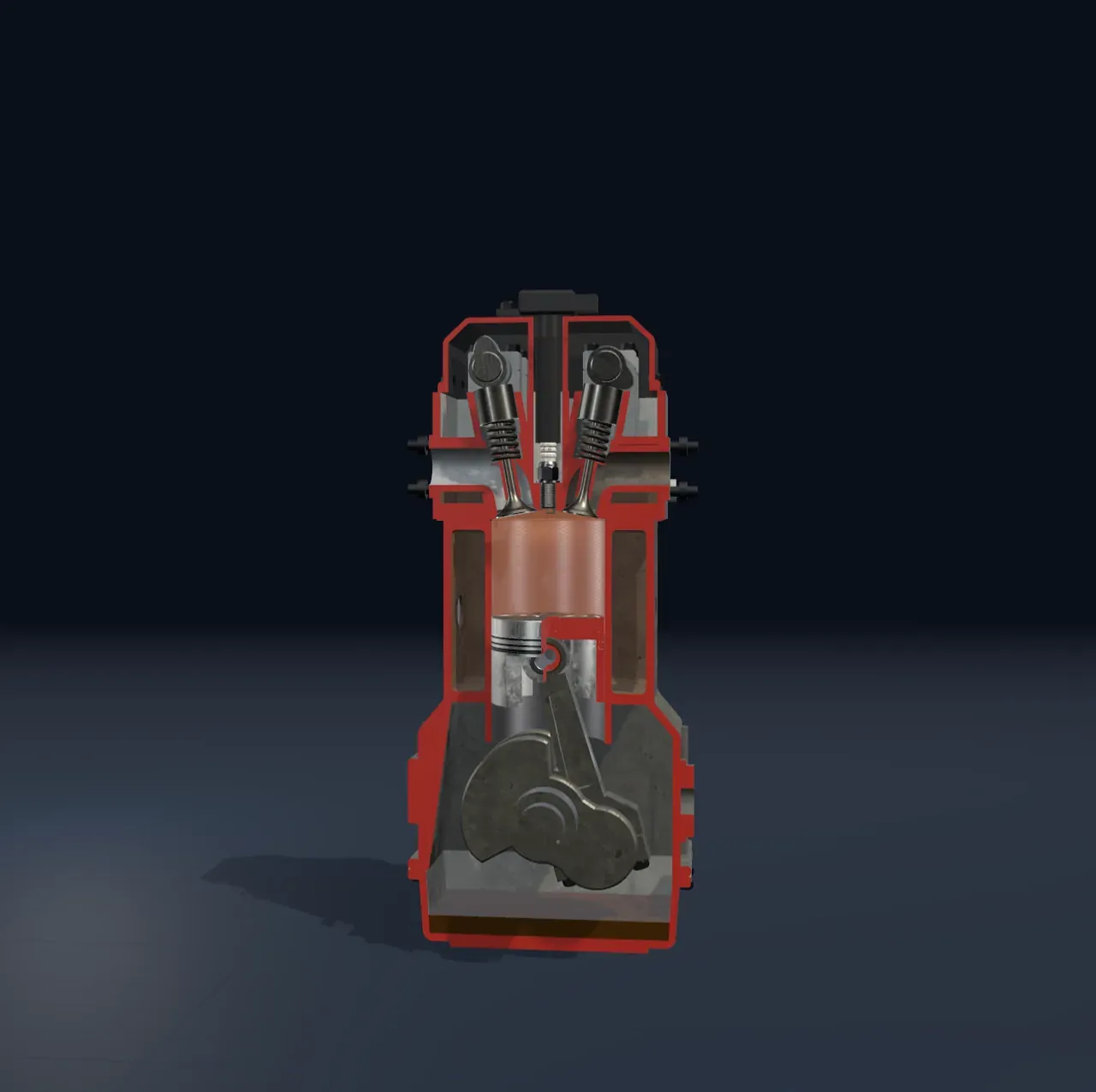
In the energy Unit you saw that energy is neither made nor lost, and that power is work done each second. A car engine turns the heat of burning petrol into work, and in this Lesson you will see how much of the heat it manages to turn, and why not all of it. The Scene shows one cylinder of a four-stroke engine in cutaway, slowed down 60 times.
Step 1 of 10
Four strokes
The piston moves up and down, and the connecting rod turns that motion into the crankshaft’s rotation. Each cycle has four strokes, each lasting half a turn: intake of air and fuel, compression, power after the spark, and exhaust of the burnt gas. Watch the piston through a whole cycle.
Step 2 of 10
Power strokes a second
The Engine speed is measured in revolutions a minute, rpm. A whole cycle takes two turns, and has just one power stroke.
Step 3 of 10
Compression ratio
The Compression ratio is the volume above the piston at the bottom of its stroke divided by the volume at the top. Draw the P–V loop shows the cycle as a loop: its area is the work done each cycle. In the ideal cycle of a petrol engine, the Otto cycle, the efficiency depends only on the compression ratio:
Here for air. The ratio is fixed at 10 for now.
Step 4 of 10
Where the heat goes
The burning adds heat to the gas. Part of it, , becomes work, and the rest leaves with the hot gas in the exhaust and through the cooling system. Conservation of energy says:
Step 5 of 10
Power
Power is work done each second: the work in each cycle times the cycles a second. The loop in the chart, and its work, do not depend on the engine speed, only on the Throttle (intake pressure) and the compression ratio. The throttle is now wide open.
Step 6 of 10
The cylinder
The cylinder in the Scene is one of four in an ordinary family car’s engine. A “two-litre engine” means the volume all the pistons sweep together.
Step 7 of 10
Opening the throttle
The accelerator pedal does not feed fuel directly: it opens a valve, the throttle, that lets the air in. The more air gets in, the more fuel the computer injects.
Step 8 of 10
The work it gives
Under Draw the P–V loop the area inside the loop is the work in each cycle. The throttle is wide open.
Step 9 of 10
After the spark
The spark lights the mixture, and the gas heats to thousands of degrees at once, before the piston has time to move.
Step 10 of 10
The highest pressure
The same temperature, but more gas. The top of the loop is the pressure just after the spark.
Loading the interactive version…
Loading the interactive version…
Each step sets up the Scene for you, and a control marked “fixed” stays put for that step.
Practice · Choose
In which of the four strokes does the gas push the piston and give the crankshaft its work?
Practice · Choose
In which of the four strokes does the gas push the piston and give the crankshaft its work?
Practice · Calculate
The Engine speed is fixed at 3000 rpm, three thousand turns of the crankshaft a minute. How many power strokes does this cylinder make each second?
Practice · Calculate
The Engine speed is fixed at 3000 rpm, three thousand turns of the crankshaft a minute. How many power strokes does this cylinder make each second?
Practice · Predict, then look
The ideal efficiency of the Otto cycle, with , is about 0.60 at a compression ratio of 10. What will it be at a Compression ratio of 14? Give a decimal.
Practice · Predict, then look
The ideal efficiency of the Otto cycle, with , is about 0.60 at a compression ratio of 10. What will it be at a Compression ratio of 14? Give a decimal.
Practice · Calculate
In one cycle, with the Throttle (intake pressure) at 60 kPa, the burning adds 653 J of heat to the gas, and the ideal efficiency is 0.602. How much heat leaves with the exhaust each cycle?
Practice · Calculate
In one cycle, with the Throttle (intake pressure) at 60 kPa, the burning adds 653 J of heat to the gas, and the ideal efficiency is 0.602. How much heat leaves with the exhaust each cycle?
Practice · Predict, then look
At an Engine speed of 3000 rpm with the throttle wide open the cylinder gives about 16 kW. The work in each cycle does not depend on the speed. Predict the power at 6000 rpm, in kilowatts.
Practice · Predict, then look
At an Engine speed of 3000 rpm with the throttle wide open the cylinder gives about 16 kW. The work in each cycle does not depend on the speed. Predict the power at 6000 rpm, in kilowatts.
Practice · Calculate
The cylinder is 86 mm across inside, and the piston travels 86 mm each stroke. What volume does the piston sweep each stroke, in cubic centimetres?
Practice · Calculate
The cylinder is 86 mm across inside, and the piston travels 86 mm each stroke. What volume does the piston sweep each stroke, in cubic centimetres?
Practice · Calculate
With the Throttle (intake pressure) at 60 kPa, the burning adds 653 J of heat to the gas each cycle. The throttle is opened wide, to 100 kPa. How much heat does the burning add each cycle now?
Practice · Calculate
With the Throttle (intake pressure) at 60 kPa, the burning adds 653 J of heat to the gas each cycle. The throttle is opened wide, to 100 kPa. How much heat does the burning add each cycle now?
Practice · Calculate
The throttle is wide open: the burning adds 1088 J of heat each cycle, and the Otto cycle’s efficiency at a Compression ratio of is . How much work does the cylinder give each cycle?
Practice · Calculate
The throttle is wide open: the burning adds 1088 J of heat each cycle, and the Otto cycle’s efficiency at a Compression ratio of is . How much work does the cylinder give each cycle?
Practice · Predict, then look
Throttle (intake pressure) at 60 kPa. Just after the spark the gas reaches about 3300 K. Predict: what will that temperature be when the throttle is opened wide, to 100 kPa?
Practice · Predict, then look
Throttle (intake pressure) at 60 kPa. Just after the spark the gas reaches about 3300 K. Predict: what will that temperature be when the throttle is opened wide, to 100 kPa?
Practice · Calculate
With the Throttle (intake pressure) at 60 kPa, the pressure in the cylinder just after the spark is about 6.2 MPa, more than sixty times the air’s. The throttle is opened wide, to 100 kPa, and the temperature after the spark does not change. What is the pressure now?
Practice · Calculate
With the Throttle (intake pressure) at 60 kPa, the pressure in the cylinder just after the spark is about 6.2 MPa, more than sixty times the air’s. The throttle is opened wide, to 100 kPa, and the temperature after the spark does not change. What is the pressure now?
Lesson complete. Every practice question here is done.