A fridge does not make cold, it moves heat from the box to the room. How much heat it moves for each joule of electricity, why a freezer costs more, and how the same loop heats a house.
Step 1 of 9 · A heat pump
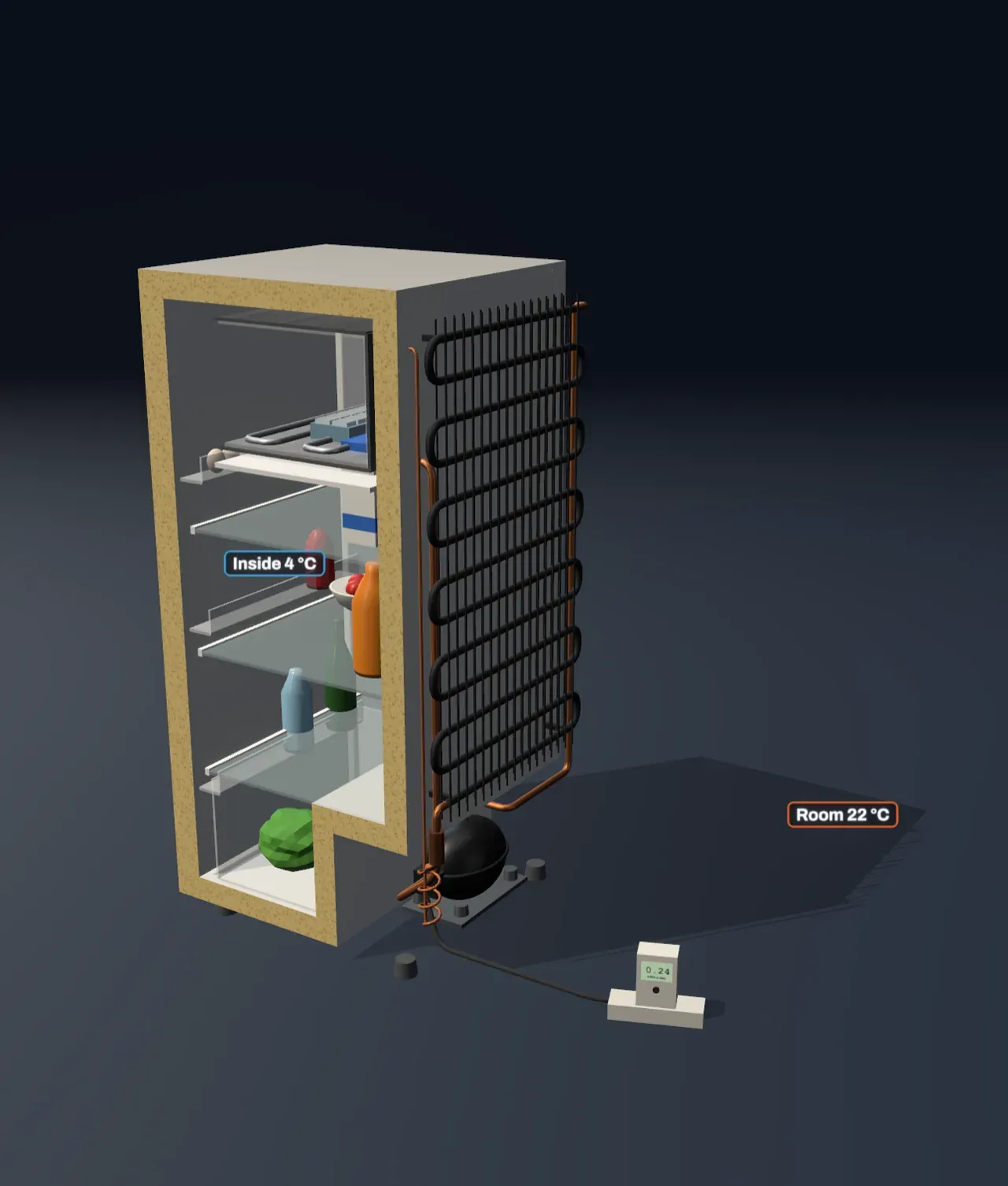
Heat flows on its own from hot to cold. A fridge makes it flow the other way, from the cold food to the warm kitchen, and pays for that with a compressor’s work. The Scene shows a household fridge in cutaway, with its refrigerant loop.
Step 1 of 9
A heat pump
Show the heat moved turns the pipes to glass. The refrigerant boils in the evaporator, the ice box at the top of the fridge, soaking up heat from the food. The compressor squeezes the vapour, and it condenses in the condenser, the black grille on the back, giving the heat out to the room. Touch the back of a fridge at home: it is warm.
Step 2 of 9
Coefficient of performance
A fridge’s coefficient of performance is the heat it takes from the box for each joule of electricity:
The ideal limit, Carnot’s, depends only on the refrigerant’s two temperatures, in kelvin: . The refrigerant boils about 10 K below the Inside temperature and condenses about 12 K above the Room temperature.
Step 3 of 9
A colder box
The wider the gap between the box and the room, the further the pump must lift the heat. Predict what will happen when the fridge becomes a freezer.
Step 4 of 9
Heating a house
Turn the loop round, so that the cold side is outdoors and the hot side indoors, and you have a heat pump: an air conditioner on heating. Conservation of energy sets how much heat comes out on the hot side:
Step 5 of 9
A heatwave
To hold the inside temperature, the fridge must take out all the heat that leaks in through the walls. It runs part of the time and rests the rest. Predict what will happen when the room warms up.
Step 6 of 9
A freezer
The refrigerant has to boil colder than the box, so heat flows into it, and condense hotter than the room. In the model it boils 10 K below the box and condenses 12 K above the room.
Step 7 of 9
The electricity
Under Show the heat moved the arrows show the heat drawn from the box, the electricity going into the compressor, and the heat given out to the room.
Step 8 of 9
Through the walls
The insulation in the walls slows the heat, but does not stop it. All the heat that leaks in, the fridge has to pump out again.
Step 9 of 9
A day of cooling
On the electricity bill you pay for energy, not power: how long the compressor ran, times how much it drew each second.
Loading the interactive version…
Loading the interactive version…
Each step sets up the Scene for you, and a control marked “fixed” stays put for that step.
Practice · Choose
Why is the black grille on the back of the fridge warm while it runs?
Practice · Choose
Why is the black grille on the back of the fridge warm while it runs?
Practice · Calculate
The refrigerant boils in the box at 267.15 K and condenses in the grille at 307.15 K. The ideal (Carnot) cooling coefficient of performance is , and a household fridge reaches about 40% of it. What is this fridge’s COP, the joules of heat it takes from the box for each joule of electricity?
Practice · Predict, then look
Turn the Inside temperature down from 277.15 K (fridge) to 255.15 K (freezer), with the room unchanged. What will happen to the coefficient of performance?
Practice · Predict, then look
Turn the Inside temperature down from 277.15 K (fridge) to 255.15 K (freezer), with the room unchanged. What will happen to the coefficient of performance?
Practice · Calculate
Turn the same loop into a heat pump that warms a house: the cold box outside, the hot grille indoors. The cooling COP is 2.67. How many joules of heat come out indoors for each joule of electricity?
Practice · Calculate
Turn the same loop into a heat pump that warms a house: the cold box outside, the hot grille indoors. The cooling COP is 2.67. How many joules of heat come out indoors for each joule of electricity?
Practice · Predict, then look
Raise the Room temperature from 295.15 K (kitchen) to 311.15 K (heatwave). What will happen to the share of the time the compressor runs?
Practice · Predict, then look
Raise the Room temperature from 295.15 K (kitchen) to 311.15 K (heatwave). What will happen to the share of the time the compressor runs?
Practice · Calculate
Inside temperature is locked at Freezer, 255.15 K, and the room is the Kitchen. The refrigerant now boils at 245.15 K and condenses at 307.15 K. What is the ideal, Carnot, coefficient of performance, ?
Practice · Calculate
Inside temperature is locked at Freezer, 255.15 K, and the room is the Kitchen. The refrigerant now boils at 245.15 K and condenses at 307.15 K. What is the ideal, Carnot, coefficient of performance, ?
Practice · Calculate
In the kitchen, while the compressor runs, the loop draws 187 J of heat out of the fridge box each second, and the coefficient of performance is . How much electricity, in watts, does the compressor draw while it runs?
Practice · Calculate
In the kitchen, while the compressor runs, the loop draws 187 J of heat out of the fridge box each second, and the coefficient of performance is . How much electricity, in watts, does the compressor draw while it runs?
Practice · Calculate
In the kitchen, at 295.15 K, 27 W of heat get into the box, at 277.15 K, through the walls and door. The Room temperature rises to a Heatwave, 311.15 K. How much heat will get in each second now?
Practice · Calculate
In the kitchen, at 295.15 K, 27 W of heat get into the box, at 277.15 K, through the walls and door. The Room temperature rises to a Heatwave, 311.15 K. How much heat will get in each second now?
Practice · Calculate
In the kitchen the compressor runs only 14.4% of the time, and while it runs it draws 70 W. How much electrical energy, in kilojoules, does the fridge use in a day?
Practice · Calculate
In the kitchen the compressor runs only 14.4% of the time, and while it runs it draws 70 W. How much electrical energy, in kilojoules, does the fridge use in a day?
Lesson complete. Every practice question here is done.