Heat running uphill
Leave a hot drink on the table and it cools to the temperature of the room; leave a cold one and it warms up. Heat flows by itself from hotter things to colder ones, never the other way. Yet a fridge sits in a warm kitchen and keeps its inside colder than the room, day and night.
It does it by moving heat. Touch the black grille on the back of an older fridge while it runs and it feels warm: that is the heat taken out of the food, plus a little more, being let go into the room. A fridge does not make cold. It takes heat out of a box and carries it uphill, from cold to warm, and that takes work.
Boiling soaks up heat
The trick is a liquid that boils at a low temperature, called the refrigerant. Most fridges today use isobutane, a gas a little like the one in a camping stove. At ordinary air pressure it boils at about −12 °C.
Boiling takes heat. Every kilogram of isobutane that turns from liquid to gas soaks up about 360 kilojoules without getting any warmer, the same way sweat cools your skin as it evaporates. So if the refrigerant is made to boil inside the fridge, in pipes colder than the food, heat flows from the food into the pipes and the boiling liquid carries it away as gas.
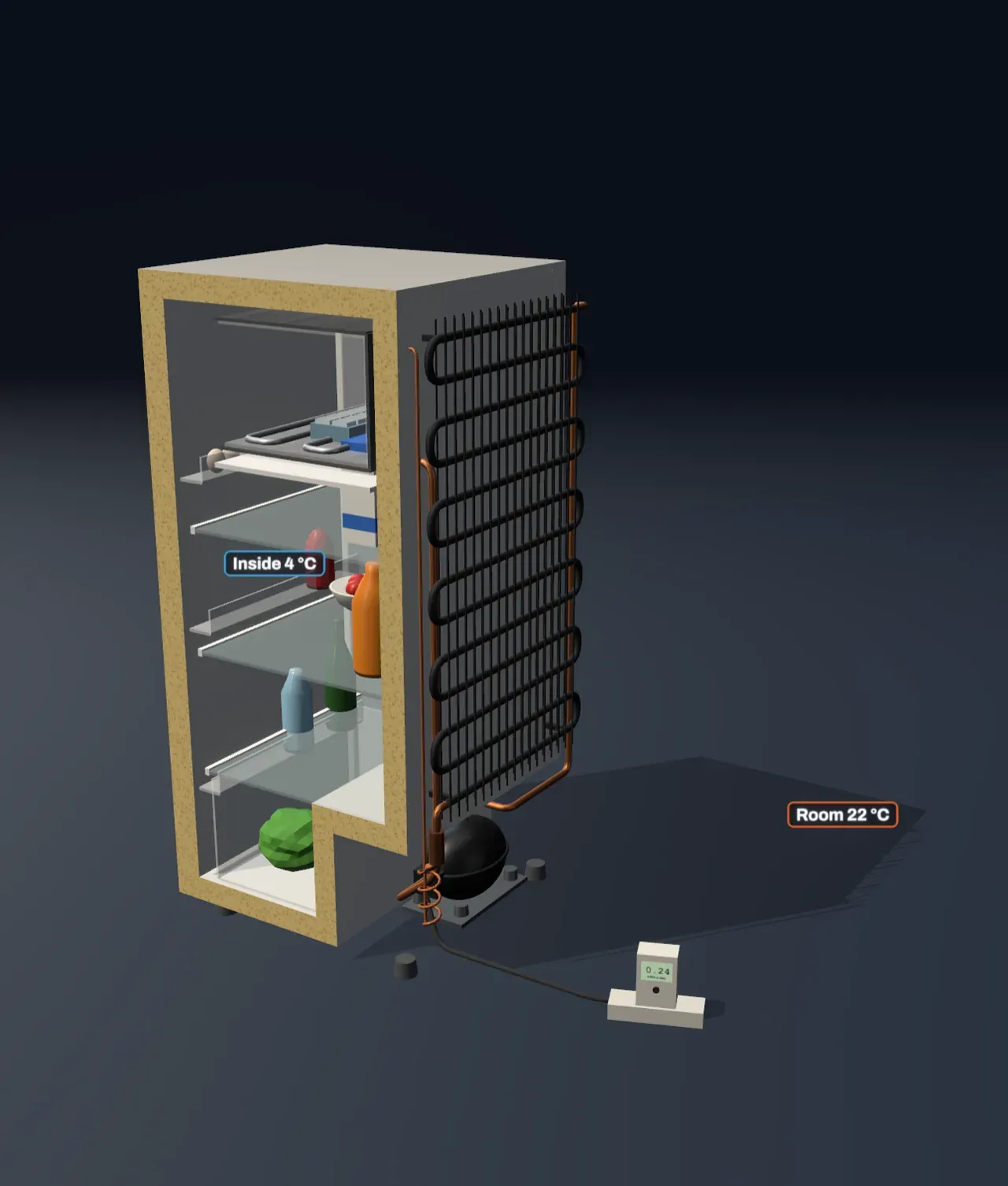
The pipes where this happens are the evaporator. In this fridge they run through the walls of the aluminium ice box at the top, which is why it is the coldest place in the fridge and grows frost.
Try it: slide Show the heat moved to about halfway. In the ice box, blue droplets of liquid turn into pale bubbles of gas as they go round.
Squeezing gives it back
Now the fridge has a pipe full of cold gas, holding the heat of the food. To get rid of that heat it has to make the gas hotter than the room, and then turn it back into liquid. Both happen by squeezing it.
The compressor, the black dome at the bottom, pumps the gas from the low-pressure side to the high-pressure side. A gas gets hot when it is squeezed, and the hot gas leaves the compressor at about 50 °C. More importantly, a liquid’s boiling point rises with pressure. In the default setting the refrigerant boils at −6 °C at 1.25 bar inside, while at 4.35 bar, three and a half times the pressure, it does not condense until 34 °C. That is warmer than the 22 °C room.
So in the black grille on the back, the condenser, heat flows out into the room, and as the gas cools it turns back into liquid, giving up the same heat it soaked up when it boiled. Finally the warm liquid squeezes through a capillary tube, a copper tube as thin as a pin, which lets its pressure fall back. A quarter of it boils at once, and that chills the rest to the evaporator’s temperature, ready to go round again.
Try it: watch the grille in Show the heat moved. Pale bubbles of gas enter at the top and leave at the bottom as a crowd of orange droplets: the liquid is dense, so it moves slowly and packs together.
More heat out than electricity in
Energy is never made or lost, so everything that goes into the loop must come out of it. Heat comes in from the food; energy comes in as electricity, through the compressor. All of it leaves as heat through the grille. In the default setting, each second the compressor runs, 187 joules of heat come out of the food and 70 joules of electricity go in, and 257 joules leave by the back.
The number that rates a fridge is how much heat it moves for each joule of electricity, its coefficient of performance (COP). Here it is 187 ÷ 70, about 2.7. That breaks no rule. The electricity is not turned into cold; it drives a pump that moves heat which was already there, and moving heat can take far less energy than the heat itself.
Try it: slide Show the heat moved to Heat moved. The blue and yellow arrows add up to the orange one, and the chart beside the experiment shows the sum.
Why colder costs more
The harder you ask a fridge to push, the more each joule of heat costs. Moving heat across a bigger temperature gap needs a bigger squeeze, and there is a firm limit, which follows from the engineer Sadi Carnot’s work on heat engines in 1824: no machine moving heat out of a cold place at temperature into a warm one at , both in kelvin, can do better than
The smaller the gap, the higher the limit. Real fridges reach a fraction of it.
A freezer needs its refrigerant to boil at −28 °C, so far below the room that the COP falls from 2.7 to 1.6. On top of that, more heat leaks in through the walls when the difference is bigger. Both together mean a freezer at −18 °C uses almost four times the energy of the same box kept at 4 °C. A hot kitchen hurts in the same way, from the other side.
Try it: choose Freezer, then Heatwave. The meter climbs from 0.24 to 1.6 kWh a day, and at −25 °C in a 43 °C room the fridge runs nonstop and still cannot keep up.
Most of the time a fridge does not need to run at all: a thermostat switches the compressor on when the inside warms a little and off when it is cold enough. The chart shows how much of the time it must run to keep up with the heat leaking in.
Heat pumps: the same loop, turned round
Point the loop the other way and it heats a house. A heat pump puts the evaporator outside, where the refrigerant boils colder than the winter air and soaks up its heat, and the condenser inside, where it gives that heat out into radiators or the air. Even air at 0 °C holds plenty of heat; it is only cold compared with us.
Because the heat that comes out is the heat drawn in plus the electricity, a heat pump’s COP as a heater is always one more than as a cooler. The fridge in its default setting would give out 3.7 joules of heat for every joule of electricity, where an electric heater gives exactly one. That is why heat pumps can heat a home for a third of the electricity of a heater. Like a fridge, they do best when the gap is small: a mild day and warm floors beat a bitter frost and hot radiators.
An air conditioner is the same machine again, with the evaporator in the room and the condenser outside, and many heat pumps have a valve that swaps the two sides, cooling in summer and heating in winter.
What this model leaves out
The scene fixes the temperatures the refrigerant boils and condenses at, 10 °C below the inside and 12 °C above the room, and takes the fridge to reach 40 % of Carnot’s limit between them. Real fridges change these with their design and with how hard they are working. The compressor is taken to draw a steady 70 W while it runs, where a real one draws less when the suction pressure is low, and its cooling falls with it. The pressures come from a simple fit of isobutane’s boiling curve that is within about 10 % of measured values.
One compartment is shown. Many fridges have a separate freezer, fans that blow air over a hidden evaporator, and a heater that melts the frost now and then. The heat that comes in when the door opens, or with warm food, is left out, and the thermostat’s on-and-off running is shown only as the share of time in the chart. In the x-ray the pipes are drawn wider than life, and the beads of refrigerant are a picture of droplets and bubbles, not of real molecules.