A hydraulic lift raises a car with a hand's push: the pressure is the same throughout the oil, the force grows with the area, and the distance shrinks by the same ratio, so the work is conserved.
Step 1 of 6 · The same pressure
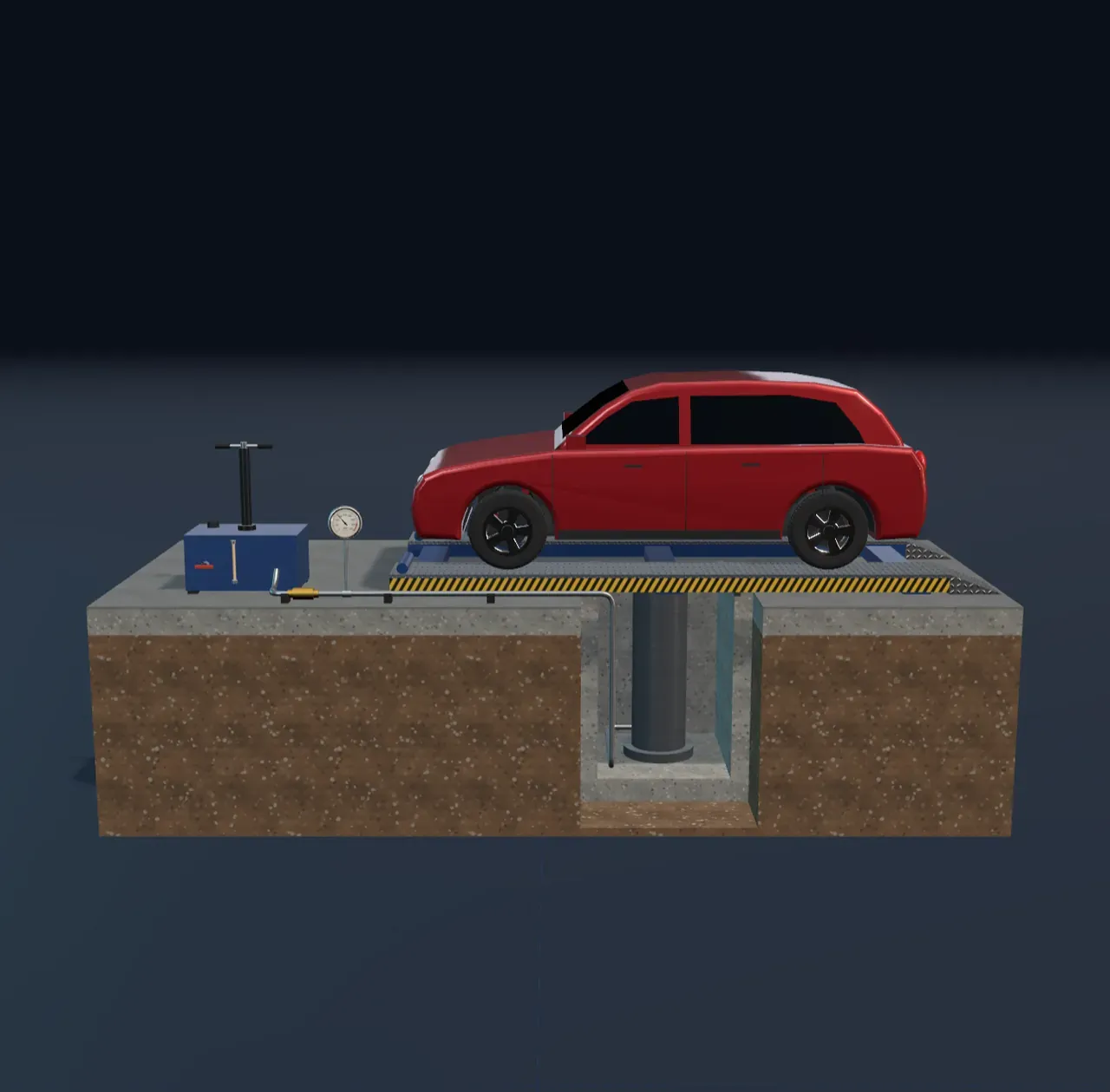
In a garage a car of over a tonne is lifted with pushes of a hand. The hydraulic lift in the Scene does it with oil: a handle pushes a small piston, and the oil pushes a big piston that carries the car. What you learned about work and simple machines will tell you the price.
Step 1 of 6
The same pressure
Pressure is force on each unit of area, , measured in pascals, newtons per square metre. Oil barely compresses, so a pressure applied at one end reaches all of the oil: Pascal’s law. Choose On under Show the pressure inside to see the pressure.
Step 2 of 6
The pressure in the oil
The Piston area ratio is how many times larger in area the big piston is than the small one. It is fixed at 40 to 1 for now, and the Push on the handle at 350 N.
Step 3 of 6
The force on the ram
The same pressure acts on the big piston, but on an area 40 times larger. Since , the ratio of the forces equals the ratio of the areas.
Step 4 of 6
One hand
The car with its platform has a mass of 1200 kg. The Push on the handle is now fixed at 150 N, the push of one hand.
Step 5 of 6
No free work
A hydraulic lift is a simple machine, like a lever. In the energy Unit you saw that a simple machine multiplies force but not work: . What is the price here?
Step 6 of 6
Holding the car up
Under Show the pressure inside you see the oil filling both pistons. Its pressure pushes on every square centimetre of the big piston with the same force.
Loading the interactive version…
Loading the interactive version…
Each step sets up the Scene for you, and a control marked “fixed” stays put for that step.
Practice · Choose
The handle pushes the small piston, and the oil lifts the car on the big piston. Where is the pressure in the oil greater?
Practice · Choose
The handle pushes the small piston, and the oil lifts the car on the big piston. Where is the pressure in the oil greater?
Practice · Calculate
The Push on the handle is 350 N, and all of it reaches the small piston. The big piston’s area is 0.1 m², and the Piston area ratio is 40 to 1. What pressure does the push make in the oil?
Practice · Calculate
The Push on the handle is 350 N, and all of it reaches the small piston. The big piston’s area is 0.1 m², and the Piston area ratio is 40 to 1. What pressure does the push make in the oil?
Practice · Calculate
The same push, 350 N, and the same Piston area ratio, 40 to 1. With what force does the oil push the big piston up?
Practice · Calculate
The same push, 350 N, and the same Piston area ratio, 40 to 1. With what force does the oil push the big piston up?
Practice · Reach the target
The Push on the handle is fixed at 150 N, one hand. Change the Piston area ratio until that push lifts the car, then press Check.
Practice · Reach the target
The Push on the handle is fixed at 150 N, one hand. Change the Piston area ratio until that push lifts the car, then press Check.
Practice · Calculate
At a Piston area ratio of 40 to 1 each push moves the small piston 40 cm. How far does the car rise in one push?
Practice · Calculate
At a Piston area ratio of 40 to 1 each push moves the small piston 40 cm. How far does the car rise in one push?
Practice · Calculate
The car has a mass of 1200 kg, and the big piston’s area is 0.1 m². What pressure in the oil holds the car up? Take g = 9.81 m/s².
Practice · Calculate
The car has a mass of 1200 kg, and the big piston’s area is 0.1 m². What pressure in the oil holds the car up? Take g = 9.81 m/s².
Lesson complete. Every practice question here is done.