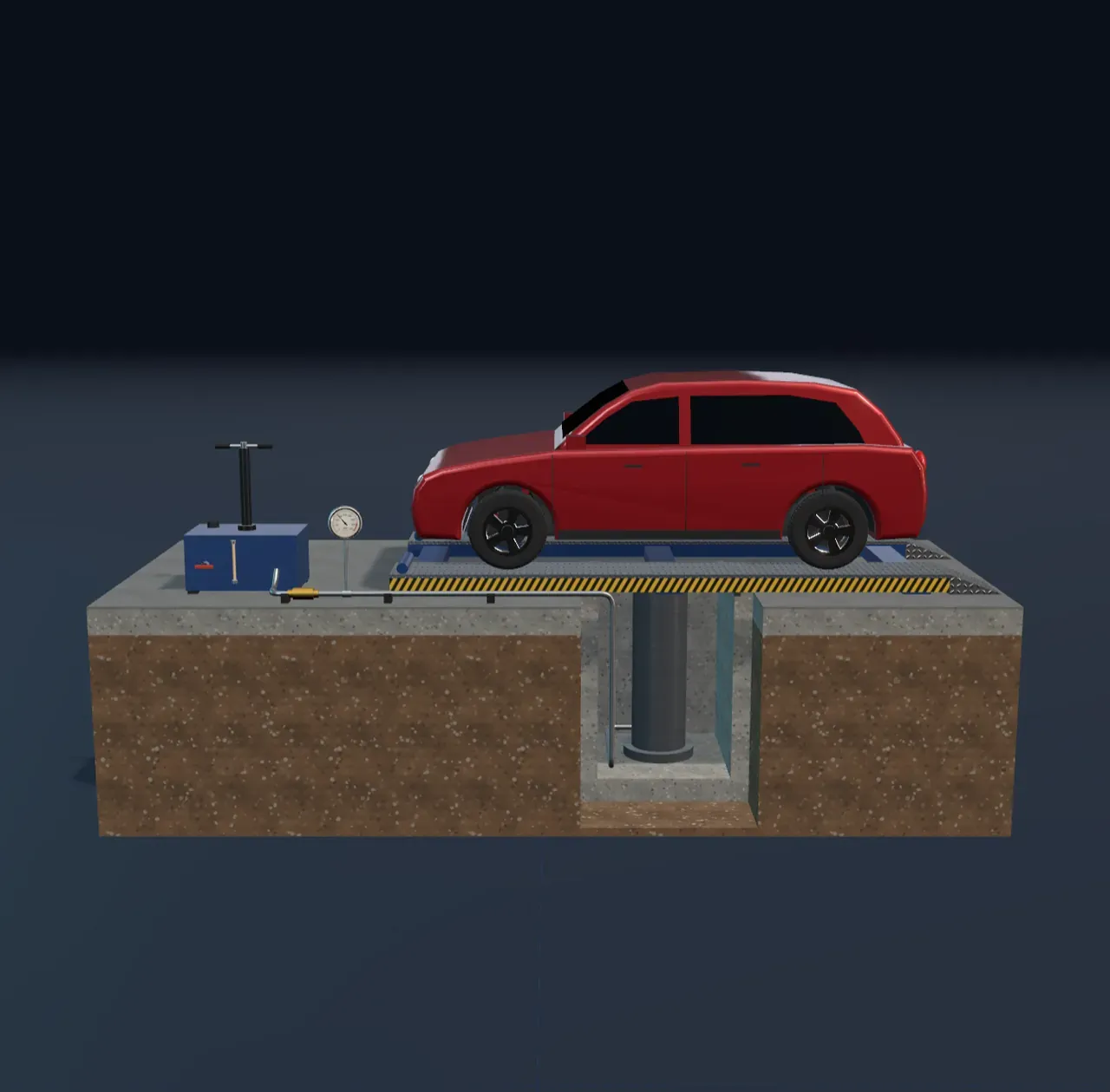
A car on a column of oil
Drive into a garage for new tyres and the mechanic may raise the whole car above head height without breaking a sweat. A hydraulic jack does the same at the roadside: a few easy pumps of a handle and one corner of the car leaves the ground. Nobody is strong enough to lift a car, which weighs as much as fifteen or twenty adults. The trick is a liquid trapped between two pistons of different sizes.
In the Scene, a car stands on a platform carried by one big piston, the ram, which slides up out of a steel cylinder sunk in a pit. A pipe joins the bottom of that cylinder to a hand pump: a much smaller piston in a much narrower cylinder, standing on a tank of oil. Push the pump’s handle down and oil is forced along the pipe and under the ram.
Pressure goes everywhere
Squeeze a sealed bag of water and it bulges wherever it can, not only where you press. A liquid pushed on one side pushes back on every surface it touches. That push is pressure: force spread over an area, measured in pascals, one newton on each square metre (the Pressure Article shows where it comes from in a gas).
The French scientist Blaise Pascal noticed in the seventeenth century that a liquid at rest in a closed container passes any extra pressure on to every part of itself, undiminished. This is Pascal’s principle. Push on the oil in one place and the pressure rises by the same amount everywhere in it: under the small piston, all along the pipe, and under the big piston too.
Try it: choose On under Show the pressure inside. The cylinders, tank and pipe are cut open, and the oil is coloured by its pressure: amber in the tank, where nothing presses on it, and orange to crimson where it is squeezed. White arrows show the oil pushing on each surface, all the same length.
Force grows with area
Pressure is force divided by area, so force is pressure times area. Push down on the small piston with 350 newtons. If its face is 25 square centimetres, the oil’s pressure rises by 350 N ÷ 0.0025 m², or 140 kilopascals. That same pressure presses up on the big piston, whose face is 40 times larger, so it pushes up with 40 times the force: 14,000 newtons. That beats the car’s weight of about 11,800 newtons, and the car rises.
The arrows show why. The big piston’s face is as big as 40 of the small one’s, and the oil presses on each of those 40 patches exactly as hard as it presses on the small piston. The ratio of the areas is the factor the force is multiplied by:
Try it: slide Piston area ratio down to 1 to 1. The pump grows as wide as the ram, and the push needed becomes the whole weight of the car, far more than anyone can give. Slide it up to 100 to 1 and choose One hand: 150 newtons, about the weight of a 15 kg bag, now lifts the car.
The catch: distance
The oil cannot be squeezed into less space, so every litre pushed out of the pump arrives under the ram. A litre spread over the small piston’s face is a tall column; spread over the big one’s face it is a thin layer. At 40 to 1 the small piston travels 40 cm in a stroke and the car rises just 1 cm. The force is multiplied by 40 and the distance divided by 40.
That is no accident. Work, a force times the distance it moves, is a transfer of energy, and a machine cannot give out more than it takes in. The 294 newtons that just balance the car, pushed through 40 cm, do 118 joules of work; the car’s 11,800 newtons raised 1 cm gain the same 118 joules. A hydraulic lift is a simple machine like a lever or a block and tackle: it trades force for distance and keeps the work the same.
Try it: with Show the pressure inside at On, watch the labels by the pump and the platform, and the chart beside the Scene, as you move Piston area ratio. The push needed and the car’s rise per stroke fall together, while the work per stroke stays at 118 joules.
Pumping, holding, letting down
To raise a car a metre at 40 to 1 you would need a small piston that moves 40 metres. A jack gets round this by pumping. A one-way check valve lets oil out of the pump towards the ram on each push and closes when the handle comes back up, so the car’s weight cannot push the oil back. As the small piston rises again it draws fresh oil up from the tank through a second valve. Each stroke adds one thin layer of oil under the ram, and a hundred strokes raise the car a metre. To lower it, a release valve opens a path from the ram back to the tank and the car’s weight slowly pushes the oil home.
In the Scene the car climbs a centimetre a stroke at the default settings, holds at the top for a moment, then sinks back as the red release knob turns. Show the pressure inside during the return stroke and the pump’s oil goes amber while the oil under the ram stays orange: the valve is shut, and the car’s weight alone is holding up that pressure.
If the push is too small, the small piston cannot move at all. The oil has nowhere to go: it cannot squeeze, and it cannot lift a car that its pressure, spread over the big piston, does not outweigh.
Why oil, and not air
A gas would not work nearly as well. Air squashes easily, so pushing on it first shrinks it and stores the work as a spring would, and the far piston barely moves; release the push and the air springs back. Liquids hardly compress at all: even at a hundred times atmospheric pressure, oil shrinks by less than one per cent. That is why air in a car’s brake lines makes the pedal feel spongy, and why mechanics bleed it out.
Oil is used rather than water because it does not rust the steel, it lubricates the seals and pistons it slides past, and it neither freezes nor boils in the conditions a machine meets.
Hydraulics all around
The same principle works a car’s brakes. The pedal pushes a small piston in the master cylinder, and the brake fluid carries that pressure to bigger pistons at each wheel, which clamp pads on to the discs. Diggers, cranes, aircraft landing gear and the presses that stamp car body panels use pumps driven by engines to push oil at pressures far higher than the Scene’s, so that a piston the size of a drinks can exerts many tonnes. The idea of the hydraulic press itself is old: Joseph Bramah patented one in London in 1795.
What this model leaves out
The Scene’s oil has no weight. Real oil does, so its pressure grows with depth, the same effect that makes things float (see Floating and buoyancy). Here the big piston sits about a metre and a half below the small one, which would add roughly 13 kilopascals under it, about a tenth of what holds the car up. Real seals rub, and some of the work goes into heat, so a real pump needs a little more than the ideal push. In a real lift a push bigger than needed would also make the car move faster, while here it rises at the pump’s steady pace. Real garage lifts are driven by electric pumps at much higher pressures than the Scene’s, which lets their pistons be far smaller.