Something for nothing?
A crowbar lets you lift a paving slab you could never raise by hand. A car jack lets one person hold up a car. A set of pulleys lets a builder haul bricks up a wall with one hand. Each of these is a simple machine: a device with few or no moving parts that changes the size or direction of a force.
The number that describes how much a machine helps is its mechanical advantage, the load it lifts divided by the effort you put in. An advantage of 4 means a 40 newton load needs only 10 newtons of effort.
The lever
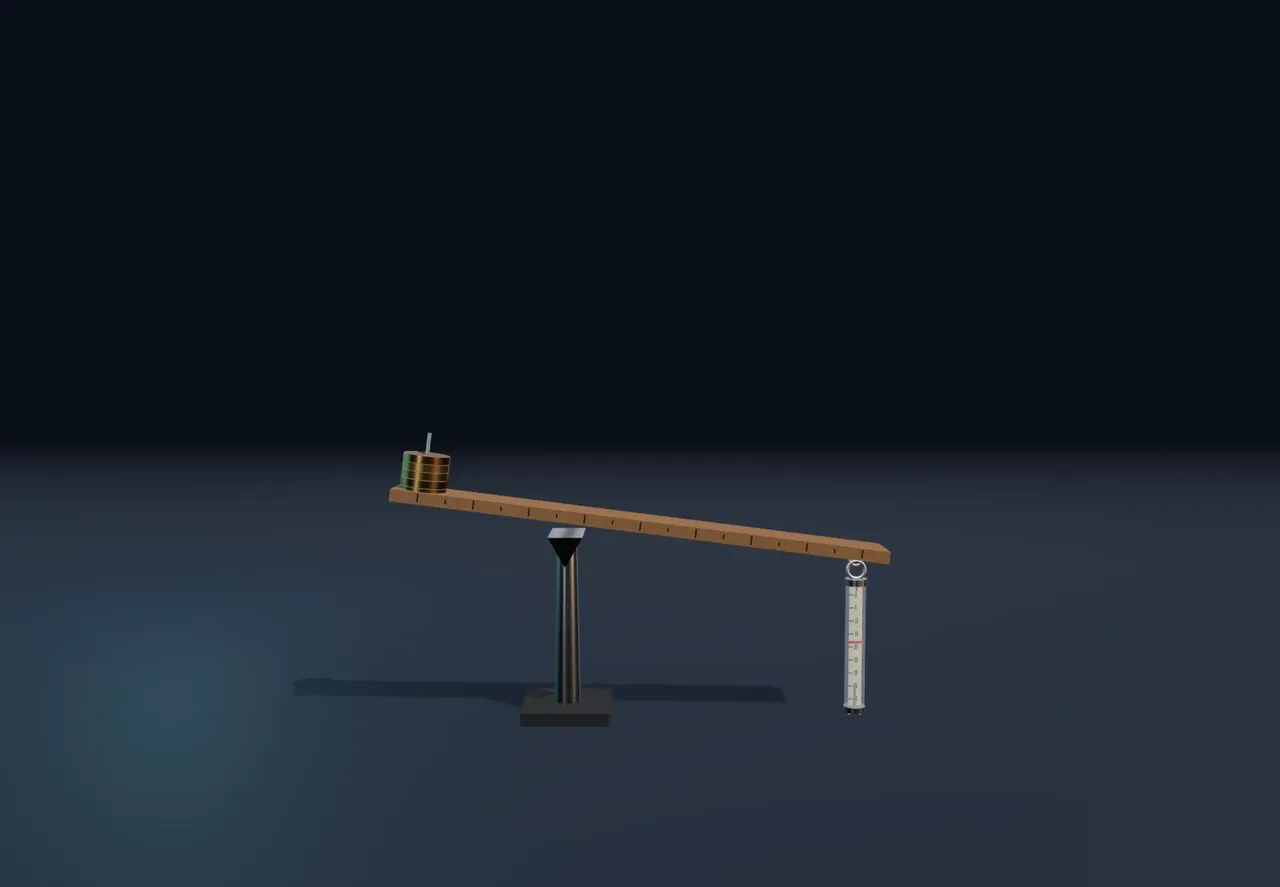
A lever is a rigid bar that turns about a pivot called the fulcrum. What matters is not just how hard each force pushes but how far from the fulcrum it acts. The turning effect, the moment, is the force times that distance. The lever balances when the moments on the two sides are equal.
So move the fulcrum toward the load. The load’s side gets shorter and the effort’s side longer, and a small effort far from the fulcrum balances a big load close to it. Archimedes worked out this rule more than two thousand years ago.
The pulley
A single fixed pulley changes only the direction of a pull: you pull down to lift up, with the same force. Add a pulley that rises with the load, and run the rope back and forth between the two blocks, and the load hangs on several stretches of rope at once. Each stretch carries an equal share. With four of them, each holds a quarter of the load, and your hand on the free end holds just one share.
Try it: choose Pulleys for Machine and step Mechanical advantage from 1 to 4. Choose Forces under Show the forces and compare how far the load rises with how far the rope end is pulled.
Gears
A small gear driving a large one is a lever that never runs out of room. Each tooth pushes its partner tooth across with the same force, but the large gear’s teeth sit further from its axle, so they turn it with more twisting force. The price is speed: a gear with four times the teeth turns once for every four turns of the small one. The lowest gear on a bicycle uses the same trade to get you up a hill.
The catch: work is conserved
In every case the hand moves further than the load. Halve the effort and you must move it twice as far; quarter it and you move it four times as far. Work, a force times the distance it moves, comes out the same on both sides. That is no coincidence. Work is a transfer of energy, and energy cannot be created, so a machine can trade force for distance but cannot give more work out than goes in.
What this model leaves out
The scene shows ideal machines. Real pulleys and gears have weight and friction, so the effort needed is always a little more than the ideal figure and some of the work turns into heat. A real lever also bends slightly, and a real rope stretches. The rule that work out never exceeds work in still holds exactly; real machines simply fall short of it.