A lever, pulleys and gears lift a heavy load with a small force. The mechanical advantage, the distance the effort moves, the work that does not change, and what efficiency is.
Step 1 of 7 · Less force
Now that you know what work is, and that energy is never made from nothing, test some machines that promise to save effort. Each machine in the Scene lifts a stack of slotted masses, about 10 N per disc, and a spring balance shows the force you have to apply. The machines are ideal: no friction, and parts that weigh nothing.
Step 1 of 7
Less force
The block and tackle in the Scene hangs the load on four runs of rope, and each run carries an equal share of it. Your hand pulls only one run. The load divided by the effort is the machine’s mechanical advantage. With the load and the effort , the mechanical advantage is .
Here the mechanical advantage is , the number of rope runs holding the load.
Step 2 of 7
The price: distance
As the load rises, each of the four runs gets shorter by the same amount. All that rope comes out at the free end, in your hand. Predict how far you have to pull, then choose Forces under Show the forces and see the brackets that measure the two distances.
Step 3 of 7
The work does not change
The force is four times smaller, and the distance four times bigger. The work you do, the effort times its distance, equals the work the machine does on the load, the load times the height it rises:
Here is how far the load rises and how far your hand pulls.
A machine can trade force for distance, but it cannot save work. If it gave out more work than was put in, it would be making energy from nothing.
Step 4 of 7
The lever
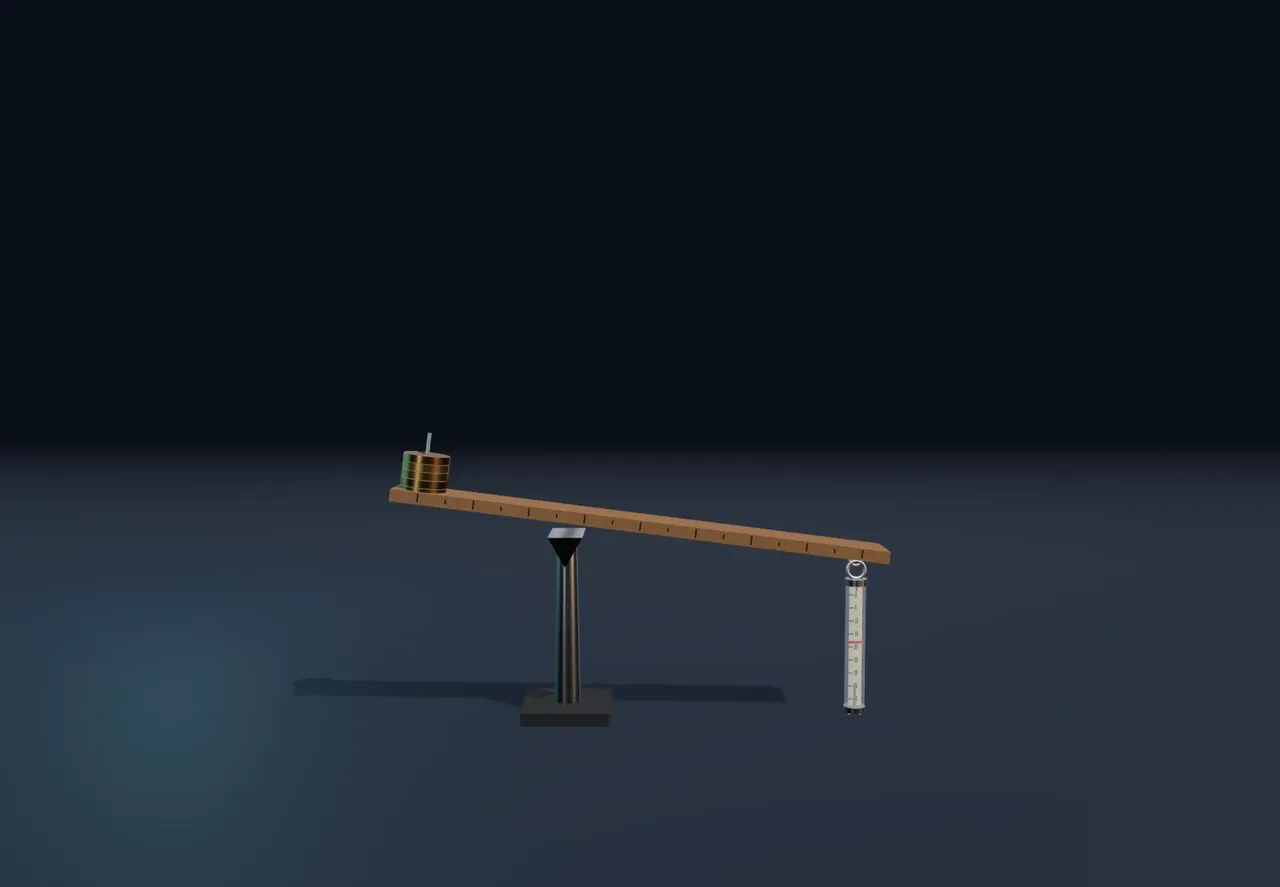
In a lever, a bar that turns about a fulcrum, the rule looks different. A force acting far from the fulcrum turns the bar harder than the same force close to it. A force times its distance from the fulcrum is its moment, and the lever balances when the moments on the two sides are equal:
Here and are the distances from the fulcrum, the arms. The effort’s arm is three times as long, so the mechanical advantage is . As the lever turns, the long end also moves three times as far: the same work on both sides.
Step 5 of 7
Choosing a machine
Each of the three machines can give any mechanical advantage from to . Choose what you need with Machine and the other controls.
Step 6 of 7
Efficiency
A real machine loses part of the work put into it: friction in the axles warms them, and the pulleys themselves have to be lifted too. The efficiency of a machine is the share of the work that reaches the load: the work the machine does on the load, , divided by the work put into it, :
For an ideal machine, like the ones in the Scene, the efficiency is . For a real machine it is always less.
Step 7 of 7
In summary
- The mechanical advantage is the load divided by the effort. In a block and tackle it is the number of rope runs holding the load, and in a lever the ratio of the arms.
- What you save in force you pay in distance: in an ideal machine the work in equals the work out.
- Efficiency is the work out divided by the work in. In a real machine it is less than , and the rest becomes heat.
Loading the interactive version…
Loading the interactive version…
Each step sets up the Scene for you, and a control marked “fixed” stays put for that step.
Practice · Calculate
The block and tackle hangs a 40 N load on four runs of rope. How hard do you have to pull the free end of the rope to lift the load? Work it out before you look at the spring balance.
Practice · Calculate
The block and tackle hangs a 40 N load on four runs of rope. How hard do you have to pull the free end of the rope to lift the load? Work it out before you look at the spring balance.
Practice · Predict, then look
The load rises 9 cm. How far do you have to pull the free end of the rope?
Practice · Predict, then look
The load rises 9 cm. How far do you have to pull the free end of the rope?
Practice · Calculate
You pull the rope with a force of 10 N through 36 cm, and the 40 N load rises 9 cm. How much work do you do?
Practice · Calculate
You pull the rope with a force of 10 N through 36 cm, and the 40 N load rises 9 cm. How much work do you do?
Practice · Calculate
On the lever a 60 N load sits 20 cm from the fulcrum, and the effort pulls 60 cm from it, on the other side. What effort balances the load?
Practice · Calculate
On the lever a 60 N load sits 20 cm from the fulcrum, and the effort pulls 60 cm from it, on the other side. What effort balances the load?
Practice · Reach the target
The load is 80 N, and you can apply only 20 N. Choose a Machine and a Mechanical advantage so that the spring balance reads exactly 20 N, and press Check.
Practice · Reach the target
The load is 80 N, and you can apply only 20 N. Choose a Machine and a Mechanical advantage so that the spring balance reads exactly 20 N, and press Check.
Practice · Calculate
In a real block and tackle with four runs of rope, lifting a 40 N load by 9 cm takes 36 cm of rope pulled with 12.5 N, not 10 N. What is the system’s efficiency, in per cent?
Practice · Calculate
In a real block and tackle with four runs of rope, lifting a 40 N load by 9 cm takes 36 cm of rope pulled with 12.5 N, not 10 N. What is the system’s efficiency, in per cent?
Lesson complete. Every practice question here is done.