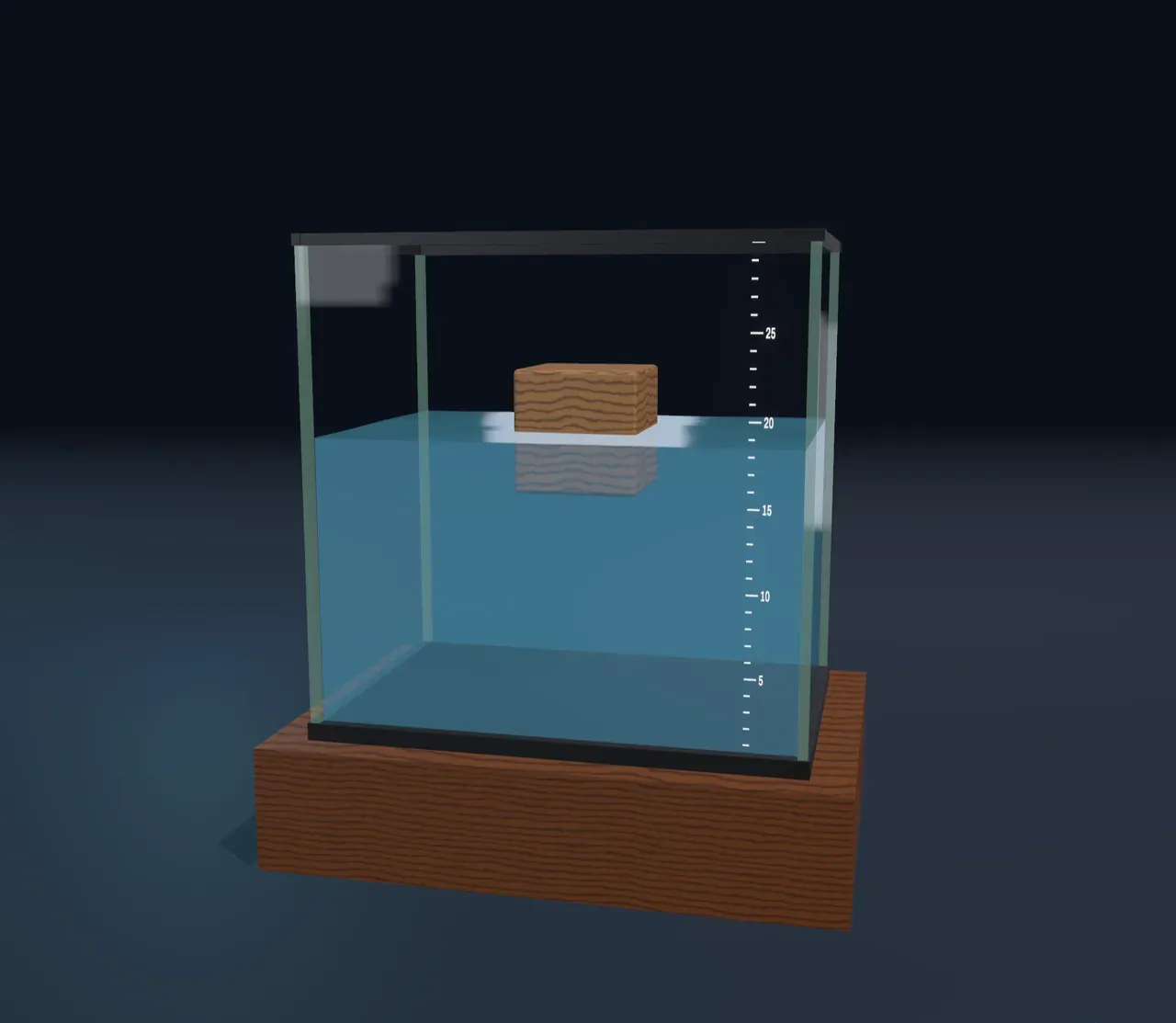
Some things float, some things sink
Drop a cork, a pebble and an ice cube into water. The cork bobs high, the ice floats low with most of it underwater, and the pebble goes straight to the bottom. It is not a matter of weight alone: a huge log floats while a tiny pebble sinks.
What decides is density: how much mass is packed into each bit of space. Water has 1,000 kilograms in every cubic metre. Cork has about a quarter of that, pine about half, steel nearly eight times as much.
The push from below
Any object in a liquid gets pushed upward. Liquid presses on everything in it, and it presses harder the deeper you go, so the push on an object’s underside is stronger than the push on its top. The difference is an upward force called buoyancy.
About 2,200 years ago, Archimedes of Syracuse worked out how big that force is. It equals the weight of the liquid the object pushes out of the way. Put an object in water and the level rises; the water that had to move aside would weigh exactly as much as the upward push.
Try it: choose Pine, then choose On under Show the forces. The cube sinks in until the blue buoyancy arrow matches the weight arrow. The blue block marks the space it took from the water; the blue layer is how far the water rose. Both hold the same volume.
Floating is a balance
A cube lighter than water sinks in only until the water it has pushed aside weighs as much as the whole cube. Then the forces balance and it floats. That makes the fraction underwater easy to predict: it is the cube’s density divided by the liquid’s. Pine at 500 kg/m³ floats half under. Ice at 917 floats with about nine-tenths under, which is why most of an iceberg is hidden.
A cube denser than the liquid can never push aside enough to balance its weight, even fully under. It sinks, and the floor supplies the rest of the upward push.
A cube’s size changes how much the water rises, but not the fraction that sits underwater. Try Cube size and watch.
The liquid matters too
The same cube floats differently in different liquids. Sea water is about 2.5% denser than fresh water because of its dissolved salt, so a ship rides a little higher at sea than in a river; cargo ships carry a painted mark showing how deep they may safely sit in each kind of water. Cooking oil is lighter than water, so things sit lower in it. Mercury, a liquid metal, is 13.5 times as dense as water: aluminium and even steel float on it, and only something as dense as gold or platinum sinks.
This is how a steel ship floats. It is not solid steel but a hollow shell full of air, so the ship as a whole is far less dense than water. A submarine dives and surfaces by flooding tanks with water or blowing them full of air.
What this model leaves out
The scene uses typical densities: real woods, oils and sea water vary by several per cent, and liquids change density slightly with temperature. It shows a solid cube that stays upright; real floating objects can tip until they find a stable way up. It ignores surface tension, which lets a needle or an insect rest on water without floating in this sense, and it does not model the liquid flowing as the cube moves, only a few illustrative ripples.