Why things float or sink: density, the buoyant force and Archimedes' principle, what share of a floating cube is under water and why it doesn't depend on size, what holds up a cube that has sunk, and steel that floats on mercury.
Step 1 of 10 · Density
Step 1 of 10
Density
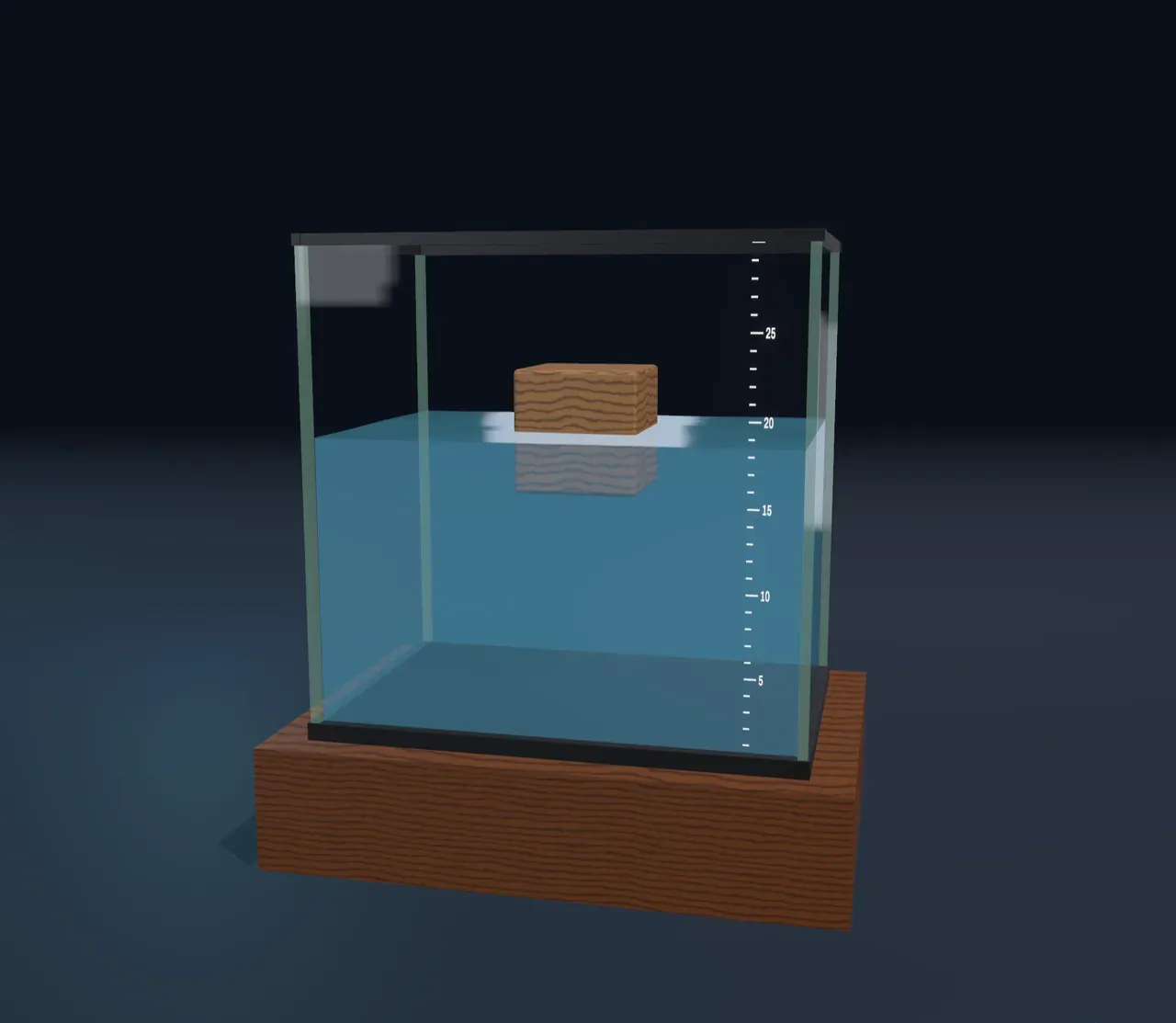
Drop a cork, a pebble and an ice cube into water. The cork bobs high, the ice floats low with most of it under water, and the pebble goes straight to the bottom. The Scene has a tank of water with one cube in it, and you can change the Cube density, the Cube size and the Liquid.
Density is the mass in each unit of volume: . Water has 1000 kg/m³, cork about a quarter of that, pine about half, and steel nearly eight times as much.
Step 2 of 10
Archimedes’ principle
Every body in a liquid is pushed upward. The liquid presses harder the deeper you go, so the push on the body’s underside is stronger than the push on its top. The difference is an upward force, the buoyant force. Archimedes found how big it is:
The buoyancy equals the weight of the liquid pushed aside, the liquid that was in the body’s sunken volume. Show the forces is Off, and the cube, the liquid and the size are fixed.
Step 4 of 10
A bigger cube
Now it is Pine in Fresh water, and the Cube size is free.
Try it: after predicting, choose Cooking oil under Liquid, and watch the cube sink in deeper.
Step 5 of 10
A cube that has sunk
A cube denser than the liquid can never push aside enough liquid to balance its weight, even fully under. It sinks, and the floor makes up the rest. Here it is a Steel cube with 8 cm sides, and all three are fixed.
Step 6 of 10
Steel that floats
A steel ship floats because it is not a solid lump of steel but a hollow shell full of air, so the ship as a whole is less dense than water. A submarine dives and surfaces by flooding tanks with water or blowing them full of air. But you can make a solid lump of steel float too.
Step 7 of 10
Weighing with water
A floating body pushes aside exactly its own weight of liquid. So it can be weighed without scales: it is enough to know how much of it is under the surface.
Step 8 of 10
Pine in oil
Oil floats on water because it is less dense: 920 kg/m³. Now the cube floats in Cooking oil.
Step 9 of 10
The level rises
The water the cube pushes aside does not vanish: it raises the level across the whole tank. Under Show the forces the blue layer at the top is the water that rose.
Step 10 of 10
Which liquid?
The same ratio works backwards. Knowing how dense the body is and how much of it is under, you can find how dense the liquid is. That is how a hydrometer works: a weighted glass tube that floats in the liquid.
Loading the interactive version…
Loading the interactive version…
Each step sets up the Scene for you, and a control marked “fixed” stays put for that step.
Practice · Choose
A log of hundreds of kilograms floats in a river, and a pebble of a few grams sinks in it. What explains this?
Practice · Choose
A log of hundreds of kilograms floats in a river, and a pebble of a few grams sinks in it. What explains this?
Practice · Calculate
A Pine cube, 500 kg/m³, with 8 cm sides, floats in Fresh water. What is the buoyant force on it? Take g = 9.81 m/s².
Practice · Calculate
A Pine cube, 500 kg/m³, with 8 cm sides, floats in Fresh water. What is the buoyant force on it? Take g = 9.81 m/s².
Practice · Predict, then look
A Pine cube with 8 cm sides floats half under. Cube size is raised to 12 cm. Predict: what share of its height will be under?
Practice · Predict, then look
A Pine cube with 8 cm sides floats half under. Cube size is raised to 12 cm. Predict: what share of its height will be under?
Practice · Calculate
A Steel cube, 7850 kg/m³, with 8 cm sides, sinks to the floor of a tank of Fresh water. How hard does the floor push up on it? Take g = 9.81 m/s².
Practice · Calculate
A Steel cube, 7850 kg/m³, with 8 cm sides, sinks to the floor of a tank of Fresh water. How hard does the floor push up on it? Take g = 9.81 m/s².
Practice · Reach the target
Cube density is fixed at Steel. Make it float.
Practice · Reach the target
Cube density is fixed at Steel. Make it float.
Practice · Calculate
Cube density is hidden. The cube, with 8 cm sides, floats in Fresh water with 4 cm of its height below the surface. What is its mass?
Practice · Calculate
Cube density is hidden. The cube, with 8 cm sides, floats in Fresh water with 4 cm of its height below the surface. What is its mass?
Practice · Calculate
A Pine cube, 500 kg/m³, with 8 cm sides, floats in Cooking oil, whose density is 920 kg/m³. How much of its height is below the surface of the oil?
Practice · Calculate
A Pine cube, 500 kg/m³, with 8 cm sides, floats in Cooking oil, whose density is 920 kg/m³. How much of its height is below the surface of the oil?
Practice · Calculate
The tank is 30 cm wide and 20 cm deep, filled with Fresh water. A Pine cube with 8 cm sides goes in, and floats with half its height in the water. By how much does the water level rise?
Practice · Calculate
The tank is 30 cm wide and 20 cm deep, filled with Fresh water. A Pine cube with 8 cm sides goes in, and floats with half its height in the water. By how much does the water level rise?
Practice · Calculate
The Liquid is hidden. An Ice cube, 917 kg/m³, with 8 cm sides, floats in it with 7.16 cm of its height below the surface. What is the liquid’s density?
Practice · Calculate
The Liquid is hidden. An Ice cube, 917 kg/m³, with 8 cm sides, floats in it with 7.16 cm of its height below the surface. What is the liquid’s density?
Lesson complete. Every practice question here is done.