Water in a pipe that narrows: continuity and water that speeds up in the throat, pressure that falls where the water is fast, Bernoulli's equation, a pressure drop that grows as the square of the flow, air drawn in, and a perfume atomiser.
Step 1 of 6 · Faster where it is narrow
Step 1 of 6
Faster where it is narrow
Put your thumb over the end of a garden hose and the water comes out faster. The tap still sends the same number of litres a second, so where the opening is smaller the water must move faster to get them all through. Water hardly compresses, so whatever goes in one end of a pipe must pass every section at the same rate. That is the continuity equation:
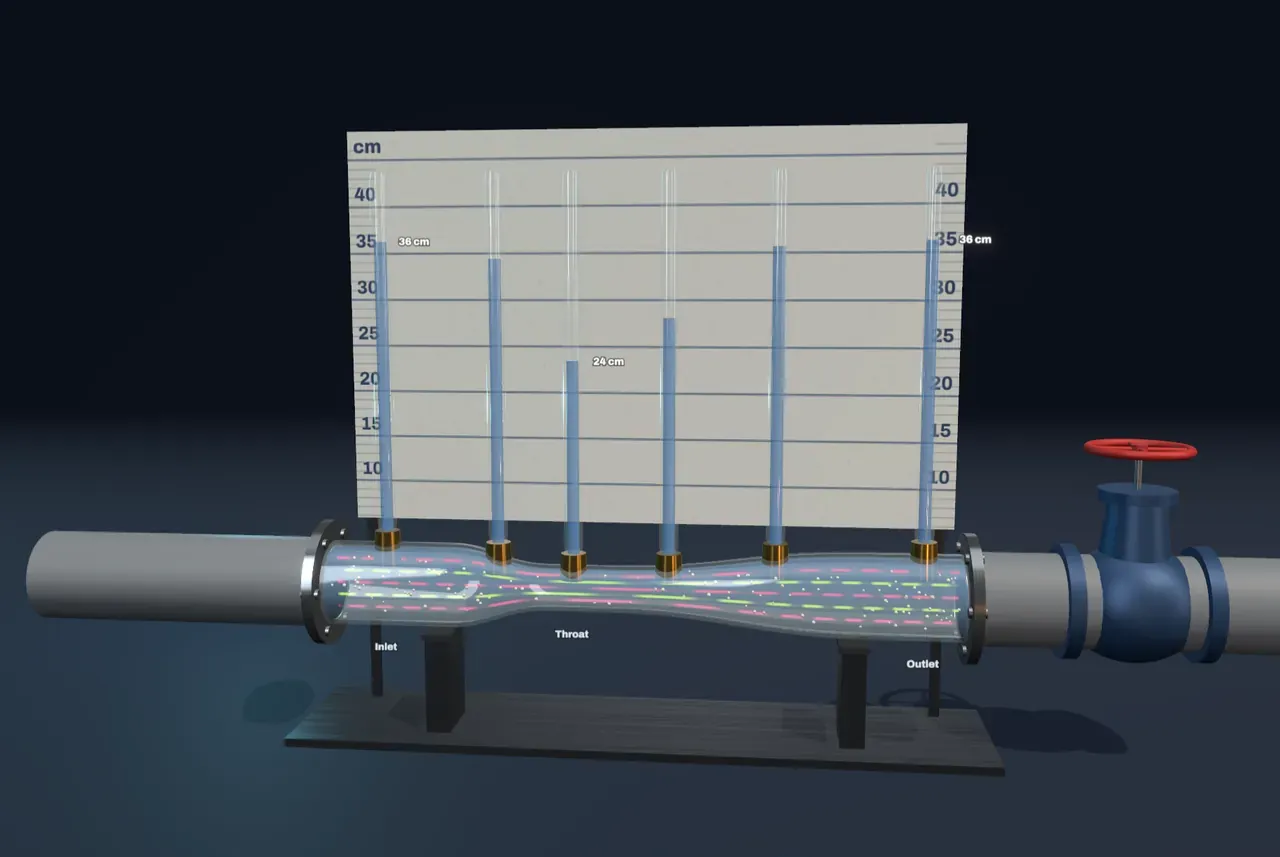
The flow rate equals the section’s area times the water’s speed . The Scene has a Venturi tube: it is 80 mm wide, narrows smoothly to a short throat, and widens slowly back. The Flow rate and the Throat width are fixed now.
Step 2 of 6
The columns
Six glass columns stand on small holes along the top of the pipe, each open to the air at the top. Water rises in a column until its weight balances the pressure in the pipe below, so each column’s height gauges the pressure there: 10 cm of water is about 1 kPa above the air’s pressure. Here it is a Straight pipe, and the Flow rate is fixed.
Step 3 of 6
Bernoulli’s equation
Daniel Bernoulli put it in one rule in 1738: along the flow, the pressure and the motion share a fixed budget of energy. In each cubic metre of water the pressure counts as energy, and so does the motion, . For steady flow without friction, at one height:
Show pressure and speed is on Pressure and speed: the water turns from blue to amber where its pressure falls, and beside each column a blue bar for pressure carries an amber bar for speed. Every pair reaches the same dashed line.
Step 4 of 6
Twice the flow
Here the Flow rate is 1 L/s, and the Throat width is fixed at 40 mm.
Step 5 of 6
Below the air’s pressure
If the water is fast enough, the pressure in the throat can fall below the pressure of the air outside. Then no water at all can stand in the column over the throat: it empties, and air is drawn in through the hole and swept away as bubbles. The inlet’s pressure is always held at 36 cm of water, as if a pump were turned up and down to keep it there.
Step 6 of 6
An atomiser
Engineers use this on purpose. A laboratory water pump sucks air out of a flask this way, and an old car’s carburettor drew petrol into the air rushing through a narrow throat. A perfume atomiser works the same way.
Loading the interactive version…
Loading the interactive version…
Each step sets up the Scene for you, and a control marked “fixed” stays put for that step.
Practice · Calculate
The pipe is 80 mm wide, and two litres a second flow through it at about 0.40 m/s. The Throat width is 40 mm. How fast does the water flow in the throat?
Practice · Calculate
The pipe is 80 mm wide, and two litres a second flow through it at about 0.40 m/s. The Throat width is 40 mm. How fast does the water flow in the throat?
Practice · Predict, then look
In a Straight pipe every column stands at the same height. It is changed to a Venturi meter, whose throat is 40 mm wide. Predict: what will happen to the column over the throat?
Practice · Predict, then look
In a Straight pipe every column stands at the same height. It is changed to a Venturi meter, whose throat is 40 mm wide. Predict: what will happen to the column over the throat?
Practice · Calculate
The water comes in at 0.40 m/s and flows through the throat at 1.59 m/s. How much lower is the pressure in the throat than at the inlet? The water’s density is 1000 kg/m³.
Practice · Calculate
The water comes in at 0.40 m/s and flows through the throat at 1.59 m/s. How much lower is the pressure in the throat than at the inlet? The water’s density is 1000 kg/m³.
Practice · Predict, then look
At a Flow rate of 1 L/s the column over the throat stands about 3 cm lower than the inlet’s. The flow is doubled to 2 L/s. Predict: how much lower will it stand now?
Practice · Predict, then look
At a Flow rate of 1 L/s the column over the throat stands about 3 cm lower than the inlet’s. The flow is doubled to 2 L/s. Predict: how much lower will it stand now?
Practice · Reach the target
Change the Flow rate and the Throat width until the pressure in the throat falls below the air’s, and air is drawn in through the hole.
Practice · Reach the target
Change the Flow rate and the Throat width until the pressure in the throat falls below the air’s, and air is drawn in through the hole.
Practice · Choose
In a perfume atomiser air is blown fast across the top of a thin tube whose lower end is in the bottle. Why does the perfume rise up the tube?
Practice · Choose
In a perfume atomiser air is blown fast across the top of a thin tube whose lower end is in the bottle. Why does the perfume rise up the tube?
Lesson complete. Every practice question here is done.