A liquid that climbs a thin tube with no pump: surface tension and the glass's pull, why a tube half as wide holds a column twice as tall, Jurin's law, mercury that sinks, and why capillary action alone can't lift water to the top of a tree.
Step 1 of 6 · A liquid that climbs
Step 1 of 6
A liquid that climbs
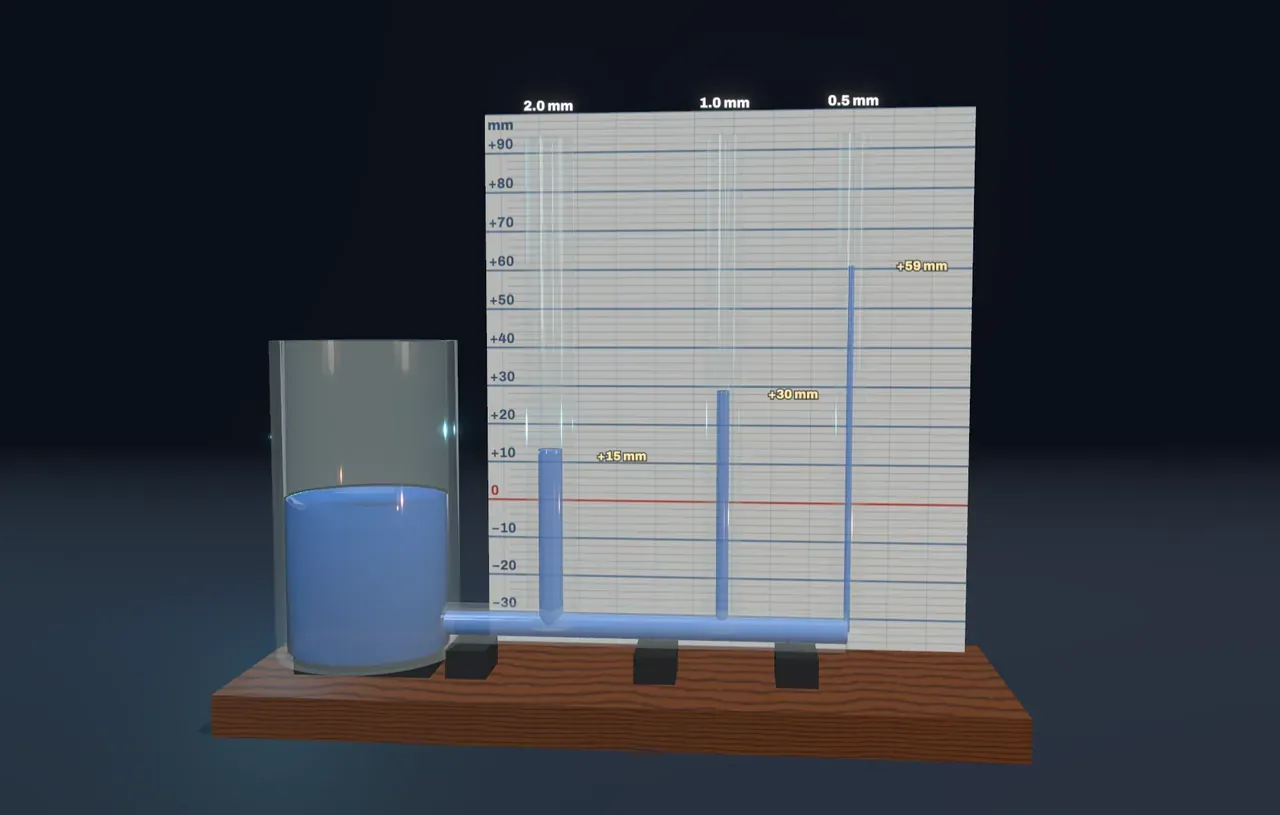
Stand a thin glass tube in a glass of water and the water inside rises above the water outside. No pump, no suction: the liquid simply climbs and stops. This is capillary action, and it is why a paper towel soaks up a spill and a sugar cube drinks coffee from the bottom up. The Scene has a wide vessel joined at the bottom to three thin tubes, each twice as wide as the one before.
Try it: choose Molecules under Zoom to the molecules. The molecule inside the liquid is pulled equally every way; the one at the surface is not pulled upward, so its pulls add up to one arrow pointing in.
Step 2 of 6
The tube’s width
The surface’s pull along the rim grows with the tube’s circumference, . The water it has to lift grows with the area of the section, . The Liquid is fixed now: Water.
Step 3 of 6
Jurin’s law
The column stops where the pull along the rim holds up exactly the weight of the raised water. That is Jurin’s law:
is the surface tension, the force along each metre of the surface’s edge, in N/m. is the contact angle, the angle at which the liquid’s surface meets the glass; is the liquid’s density and the tube’s inner radius. Water’s surface tension is unusually high, which is why a carefully placed paper clip can rest on water without sinking. Both Parameters are fixed now.
Step 4 of 6
Forty millimetres
Now you can change the Narrowest tube.
Try it: after answering, choose Soapy water under Liquid. The soap gathers at the surface and weakens its pull, and the columns climb less than half as high.
Step 5 of 6
Mercury
Not every liquid climbs. What decides is which pulls harder: the glass on the liquid’s molecules, or the liquid on itself. Glass pulls water nearly as hard as water pulls itself, so water wets glass. Mercury is a liquid metal, and its atoms pull on each other very hard.
Step 6 of 6
Trees
Capillary action carries ink along the fibres of paper, lifts melted wax up a candle’s wick, and draws water through the gaps in soil. But trees grow tens of metres tall.
Loading the interactive version…
Loading the interactive version…
Each step sets up the Scene for you, and a control marked “fixed” stays put for that step.
Practice · Choose
The water climbs the thin tubes above the level in the wide vessel, with no pump. What lifts it?
Practice · Choose
The water climbs the thin tubes above the level in the wide vessel, with no pump. What lifts it?
Practice · Predict, then look
Narrowest tube is 1 mm. It is changed to 0.5 mm. Predict: what will happen to the height of its column?
Practice · Predict, then look
Narrowest tube is 1 mm. It is changed to 0.5 mm. Predict: what will happen to the height of its column?
Practice · Calculate
Use Jurin’s law to work out how high Water climbs in a tube 1 mm across inside. Water’s surface tension is 0.0728 N/m, its density 998 kg/m³, and it wets glass completely, . Take g = 9.81 m/s².
Practice · Calculate
Use Jurin’s law to work out how high Water climbs in a tube 1 mm across inside. Water’s surface tension is 0.0728 N/m, its density 998 kg/m³, and it wets glass completely, . Take g = 9.81 m/s².
Practice · Reach the target
Change the Narrowest tube until the water climbs 40 mm above the level in it.
Practice · Reach the target
Change the Narrowest tube until the water climbs 40 mm above the level in it.
Practice · Predict, then look
The Liquid is changed to Mercury. Predict: what will happen in the tubes?
Practice · Predict, then look
The Liquid is changed to Mercury. Predict: what will happen in the tubes?
Practice · Choose
The water-carrying vessels in a tree are about 0.04 mm wide. Can capillary action alone lift water to the top of a 30 m tree?
Practice · Choose
The water-carrying vessels in a tree are about 0.04 mm wide. Can capillary action alone lift water to the top of a 30 m tree?
Lesson complete. Every practice question here is done.