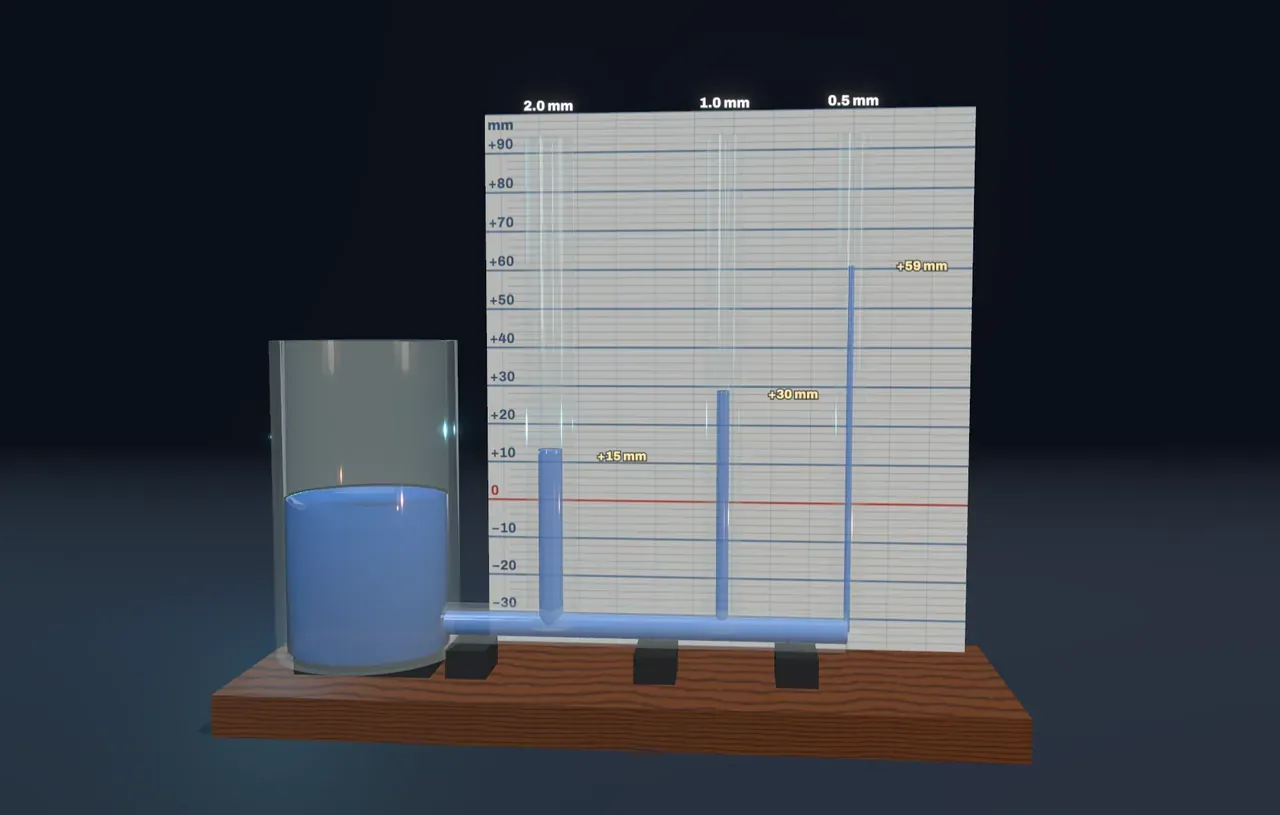
Water climbs, mercury sinks
Stand a thin glass tube in a glass of water and the water inside rises above the water outside. No pump, no suction: the liquid simply climbs and then stops. Use a thinner tube and it climbs higher. This is capillary action, and it is why a paper towel soaks up a spill, why a sugar cube drinks coffee from the bottom up, and how water creeps into the tiny gaps in soil.
Not every liquid climbs. In a glass tube, mercury does the opposite: it sits lower inside the tube than outside, and the narrower the tube, the lower it sits.
A surface that pulls
The cause lies at the surface. A liquid’s molecules attract their neighbours. Deep inside, a molecule is surrounded on every side, so the pulls cancel. A molecule at the surface has neighbours below and beside it but almost none above, so it is pulled inward. The whole surface behaves as if it were a stretched skin trying to shrink. That effect is surface tension, measured as the pull along each metre of surface edge. Water’s is about 0.073 newtons per metre, unusually high for a liquid, which is why a carefully placed paper clip can rest on water.
Try it: choose Molecules under Zoom to the molecules. The magnified view grows out of the narrowest tube’s surface. The molecule in the middle of the liquid has six equal pulls; the one at the surface has none upward, so its pulls add up to one arrow pointing in.
Why the liquid climbs
Where the surface meets the glass, a second attraction joins in: the glass itself pulls on the liquid. Glass pulls water molecules about as hard as water molecules pull each other, so water spreads over clean glass and wets it. At the wall the surface turns up, and the liquid’s edge forms a dish-shaped meniscus.
The skin along that edge then pulls upward all the way round the inside of the tube. The pull grows with the tube’s circumference, which is proportional to its width. The water it has to lift grows with the tube’s cross-section, which is proportional to the width squared. So the column stops where the pull round the rim holds up the weight of the raised water, and in a tube half as wide that happens twice as high. This is Jurin’s law, . Here is the surface tension, the angle at which the surface meets the glass, the liquid’s density, the pull of gravity and the tube’s inner radius. In a 1 mm tube, water climbs about 30 mm.
Try it: with Water, slide Narrowest tube from 0.5 mm to 1 mm, then 2 mm. Each time the width doubles, every column drops to half its height.
Changing the liquid
Soapy water is almost exactly as dense as water, but soap gathers at the surface and weakens its pull to well under half. The columns rise well under half as high. Ethanol has a weaker surface pull too, partly offset by being lighter, and it also climbs well under half as high as water.
Mercury is the striking case. Its atoms pull on each other far harder than glass pulls on them, so it does not wet glass: its edge curls away from the wall and the meniscus bulges up like a dome. The surface pull round the rim now points down, and the column sits below the level outside, by about 11 mm in a 1 mm tube. In the formula, the angle is about 140°, so is negative and so is the height.
Try it: choose Mercury, then look inside again. The blue arrow at the glass, the wall’s pull, is now tiny next to the liquid’s own pull.
Where you meet it
Capillary action carries ink along the fibres of paper and melted wax up the wick of a candle. It draws water up through the gaps in soil. It is not what lifts water to the top of a tall tree, though: capillarity alone could raise water only a metre or so in a plant’s vessels, and the rest of the pull comes from water evaporating from the leaves. Surface tension pulls small drops of rain and dew into near-spheres, lets insects such as pond skaters walk on water, and is why washing-up liquid helps water soak into greasy fabric.
What this model leaves out
The scene uses typical values for clean glass near 20 °C. Real glass is rarely perfectly clean, and dirt or grease changes the angle at which water meets it, so real columns are often a little lower. Surface tension also falls slightly as a liquid warms. Soapy water’s pull depends on how much soap it holds.
The heights come from Jurin’s law, corrected for the small amount of liquid held in the curved meniscus. That is accurate for tubes much narrower than a few millimetres; in the widest tubes the meniscus flattens and the true rise is somewhat smaller. The scene shows the columns at rest: it does not model how fast they climb, which depends on the liquid’s stickiness and takes from a fraction of a second to minutes. The tubes are drawn three times wider than their real bore so the thinnest column can be seen. The magnified view is a sketch: real molecules are a few tenths of a nanometre across, far too small to see in any microscope that uses light, and the arrows only compare pulls rather than measure them.