Faster where it is narrow
Put your thumb over the end of a garden hose and the water shoots out faster. The tap still sends the same number of litres each second, so where the opening is smaller, the water has to move faster to get them all through. Water hardly compresses, so whatever goes in one end of a pipe must come out of the other, and it must pass every section in between at the same rate. That rule is called continuity: the flow rate equals the cross-section’s area times the water’s speed.
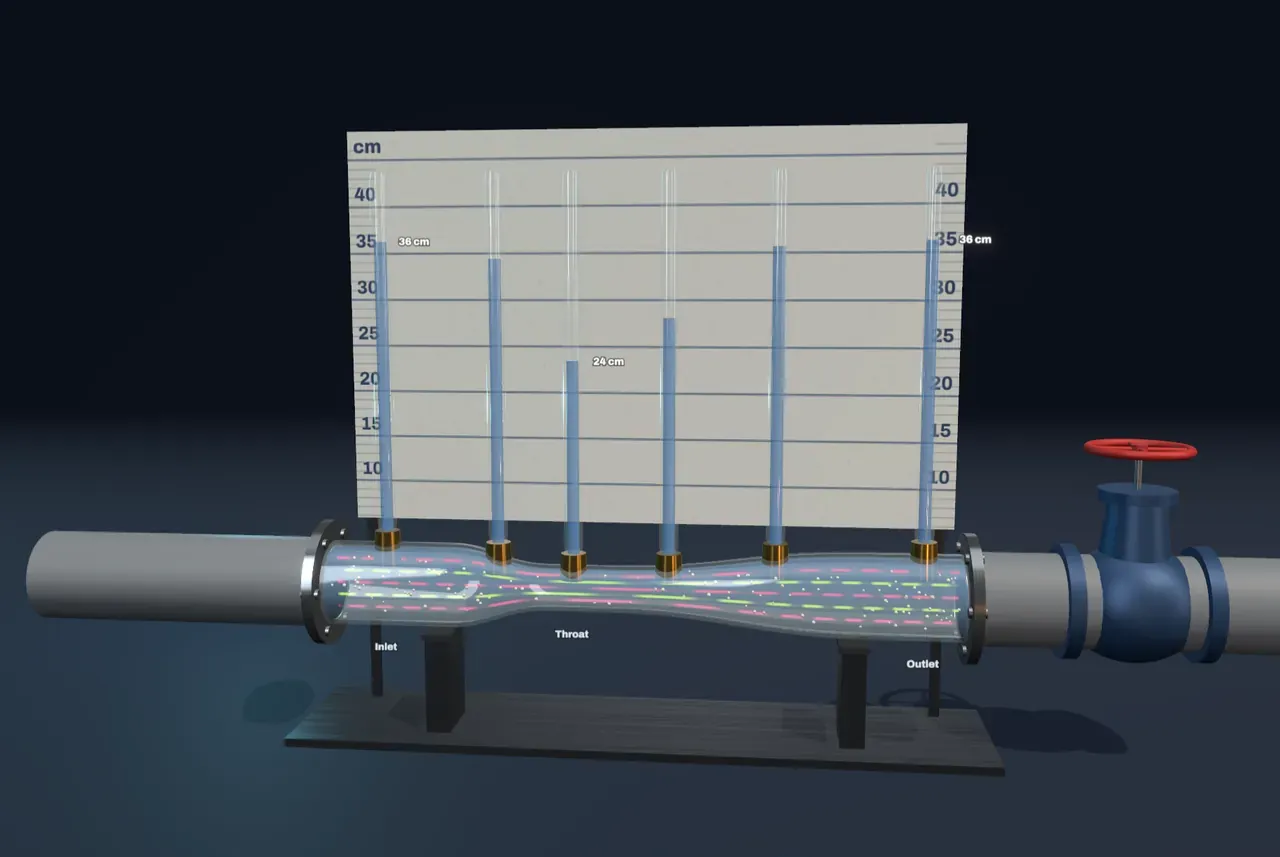
The pipe in the scene is a Venturi tube. It is 80 mm across, narrows smoothly to a short throat, and then widens slowly back to 80 mm. Halve the width and the area falls to a quarter, so the water in a 40 mm throat moves four times as fast as in the pipe. The coloured dye threads show this. They crowd together through the throat, and their stripes stretch out where the water hurries.
Try it: under Throat width, choose Straight pipe, then Venturi meter, then Tight throat. The dye threads squeeze together and the flecks race through the throat, faster each time.
Pressure falls where the water speeds up
Six glass columns stand on small holes along the top of the pipe. Each is open to the air at the top. Water rises in a column until the weight of the water inside balances the pressure in the pipe below it, so the height of each column is a gauge of the pressure at that point. 10 cm of water stands for about 1 kilopascal above the air’s pressure.
With still water every column stands at the same height. Let the water flow through the narrowing and the columns no longer agree: the column over the throat stands lower than the one at the inlet. As the pipe widens again, the columns climb back. The water’s pressure is lowest exactly where the water moves fastest.
That can seem backwards, since a narrow pipe looks like it should squeeze the water harder. But think about what it takes to speed water up. A slug of water entering the narrowing has to go faster, and only a push can do that. The push comes from the pressure behind it being greater than the pressure ahead. So along the cone into the throat the pressure must fall, and in the long cone out of the throat, where the water slows down again, the pressure must rise.
Try it: slide Flow rate to 2 L/s and choose Tight throat. The throat’s column drops to about 5 cm while the inlet’s stays at 36 cm. Now slide Flow rate down to 0: with no flow, every column comes back level.
Bernoulli’s equation
Daniel Bernoulli put this into one rule in 1738. Along the flow, a fluid’s pressure and its motion share a fixed budget of energy. In each cubic metre of water, the pressure counts as energy, and so does the motion, , where is the density and the speed. For steady flow without friction, at one height:
Divide everything by the weight of a cubic metre of water and each term becomes a height. The pressure becomes the height of the column. The motion becomes the speed head : how high the water could coast upward if it were aimed straight up. Their sum stays the same all along the pipe.
At the scene’s starting settings, 2 litres a second flow through the 80 mm pipe at 0.4 m/s, a speed head of less than 1 cm. In the 40 mm throat the water runs at 1.6 m/s, a speed head of almost 13 cm. Those extra 12 cm must come out of the pressure, and the throat’s column stands 12 cm lower, a drop of about 1.2 kilopascals. Because the speed head grows with the square of the speed, doubling the flow makes the drop four times as large.
Try it: choose Pressure and speed under Show pressure and speed. The water turns from blue to amber where its pressure falls. Arrows inside the pipe show the speed, and beside each column a blue bar for pressure carries an amber bar for speed on top. Every pair reaches the same dashed line.
Below the air’s pressure
Push hard enough and the throat’s pressure can fall below the pressure of the air outside. Then no water can stand in the throat’s column at all. The column empties, and air is sucked in through the hole and swept away as bubbles.
Try it: slide Flow rate up to 2.5 L/s and choose Tight throat. The water races through the throat at about 3 m/s, its column empties, and bubbles stream along the top of the pipe.
Engineers use this on purpose. A water-jet aspirator in a school laboratory sucks air out of a flask this way. A perfume atomiser blows air fast across the top of a thin tube and lifts the liquid up it. An old car’s carburettor drew petrol into the air rushing through a narrow throat.
Where you meet it
The Venturi tube itself is a flow meter. The difference between its inlet and throat pressures depends only on how fast the water runs, so measuring that difference tells you the flow rate without anything in the way of the water. Water companies, power stations and chemical plants use them. The same idea is used in an aircraft’s airspeed indicator, which compares the pressure of the air rammed into a tube facing forward with the pressure of the air flowing past.
The equation also describes air moving round a wing. Where the air moves faster, over the top, its pressure is lower, and the difference pushes the wing up. Bernoulli’s equation links the speed to the pressure, but it does not say why the air speeds up there; that needs the whole flow around the wing, as the Flight article shows. The popular story that air over the top must “catch up” with air underneath is not true: it actually arrives at the back first.
What this model leaves out
The scene treats the water as if it had no friction. Real water drags on the walls, so in a long straight pipe each column stands a little lower than the one before. In a real Venturi tube, the long, gentle cone after the throat wins most of the pressure back, but typically a tenth or so of the drop is lost for good as heat. The scene also gives the water one speed right across each section. Real water flows fastest along the middle and slowest at the walls.
The inlet is held at 36 cm of water above the air’s pressure whatever the flow, as if a pump were turned up and down to keep it there. The flow is shown moving ten times slower than real so that you can follow it. When air is drawn in at the throat, the scene shows the bubbles but does not work out how they change the flow. The columns show the pressure at the pipe’s centre line, and ignore the small difference across the pipe’s own width.