A wing turns the air
Hold your hand flat out of a car window and tilt the front edge up a little. Your hand is pushed upward, firmly. A wing works the same way. It is shaped and tilted so that the air flowing past it leaves heading slightly downward. To turn that much air downward, the wing must push on it; the air pushes back on the wing, upward. That upward push is lift.
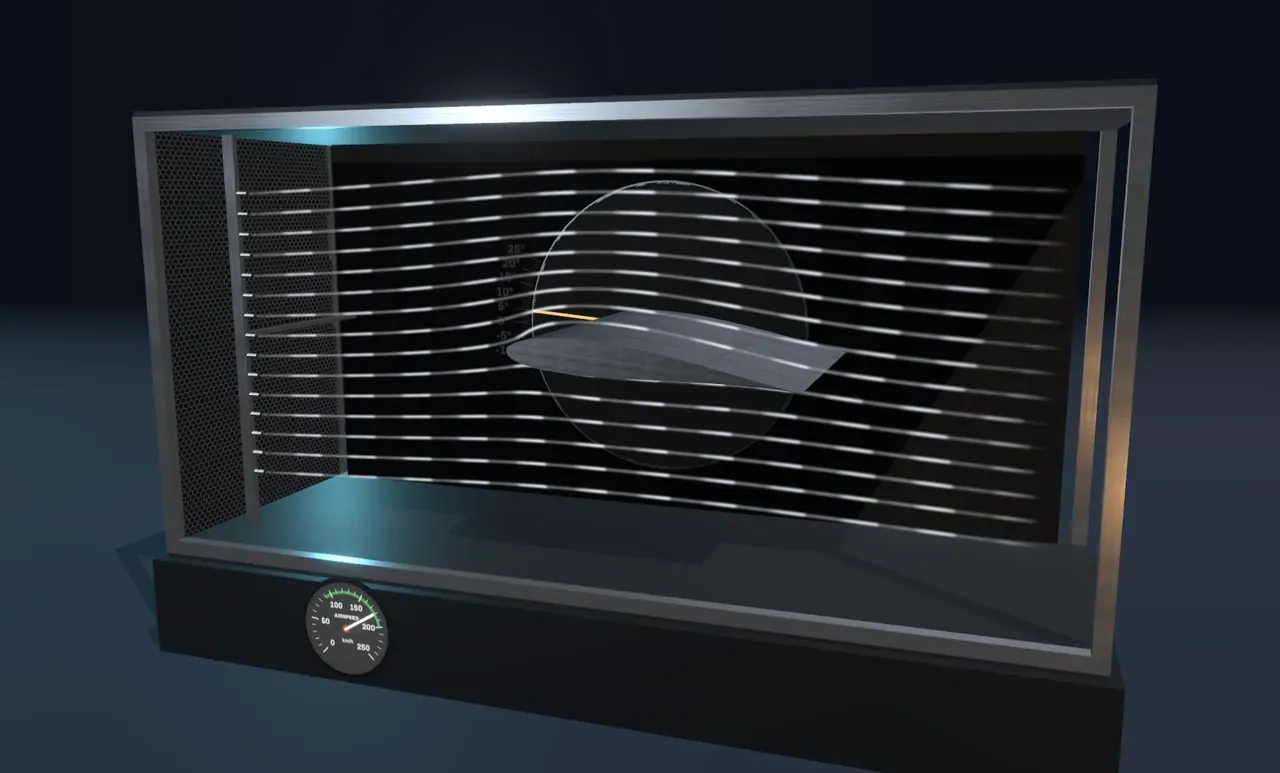
The tilt between the wing and the oncoming air is the angle of attack. In the tunnel you can watch it act. Lines of smoke released upstream bend round the wing: they rise a little ahead of it, sweep over and under, and leave the back edge travelling slightly downward.
Faster over the top
The smoke comes out in puffs, and the puffs tell a second story. Puffs that pass over the wing race ahead of their neighbours that go underneath, and arrive at the back edge first. The air does not wait to meet up again; the air over the top simply moves faster.
Where air speeds up, its pressure falls. This is Bernoulli’s principle: along a streamline, faster air has lower pressure and slower air higher pressure. So the air over the top of the wing presses down on it less than the air beneath presses up. Spread over every square metre of a wing, that small difference is the lift. The two descriptions, air turned downward and lower pressure on top, are not rival explanations. They are the same flow, described once by its momentum and once by its pressure.
Try it: slide Angle of attack to 7° and choose On under Show the pressure. The air above the wing turns blue for low pressure, the air below orange for high, and the arrows show the air being turned down behind the wing.
How much lift?
Lift grows with the square of the airspeed. Double the speed and every pressure difference round the wing quadruples, because the push comes from the energy of the moving air, which goes as speed squared. Engineers write lift per square metre of wing as ½ρv² × C_L, where ρ is the density of the air, v the airspeed and C_L the lift coefficient, a number that depends on the wing’s shape and its angle of attack.
At a cruising 50 metres per second and an angle of 5°, each square metre of this wing carries about 1,100 newtons, enough to hold up 110 kilograms. A light aircraft needs only about 70 kilograms per square metre, so it can cruise with its wings tilted a degree or two. When it slows down to land, the same weight must be held up at lower speed, so the pilot raises the nose and the angle of attack climbs.
The stall
Raising the angle buys more lift, but only up to a point. The air flowing over the top must follow the curve of the upper surface down toward the back edge, climbing into rising pressure as it slows again. Past about 15° on this wing it cannot. The flow separates: it breaks away from the upper surface and leaves a churning, turbulent wake behind it.
That is a stall. The smooth flow over the top is lost, the low pressure that held the wing up collapses, lift falls and drag soars. Stalling has nothing to do with the engine stopping; it is purely about angle. A wing can stall at any speed if the angle is too high, and the cure is to lower the nose so the air can follow the wing again.
What this model leaves out
The tunnel shows a slice of a wing that spans wall to wall, so the flow is the same at every point along it. A real wing has tips, and air spills round them from the high-pressure underside to the low-pressure top, trailing vortices that tilt the air flow behind the whole wing downward and cost extra drag.
The smoke follows ideal flow, worked out exactly for this wing shape by a classic mathematical mapping (the Joukowski aerofoil), with the condition that the air leaves the sharp back edge smoothly. Ideal flow ignores the thin layer of air that clings to the skin, so it predicts no drag at all and slightly too much lift; the figures shown are trimmed about 15 % for that layer and add a typical drag. The stalled wake is a picture of separated flow, not a simulation of it, and the real stall angle depends on the wing’s shape, its surface and its size. The tunnel walls are ignored, and the smoke moves 50 times slower than the air it marks.