A wing lifts a plane because it turns air downward. How much lift each square metre gives, why it goes with the square of the speed, and what happens at too steep an angle.
Step 1 of 5 · Turning the air
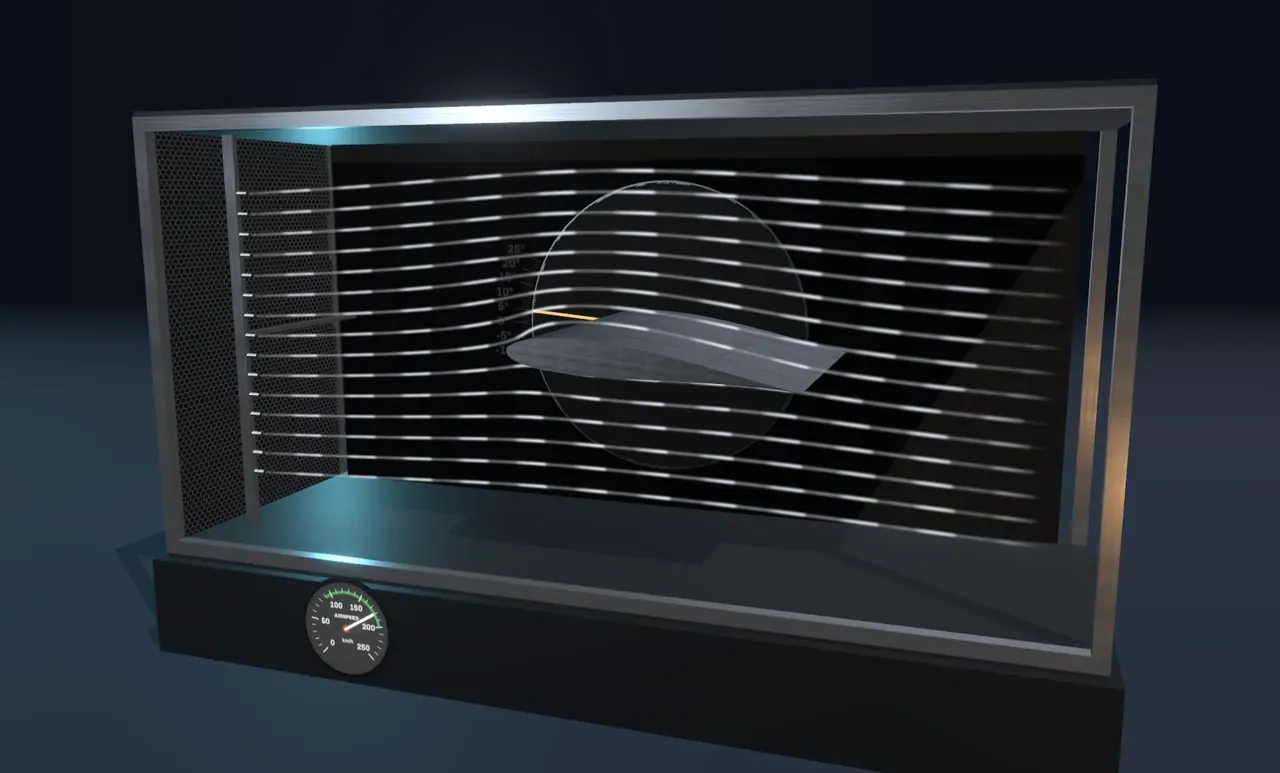
An airliner weighs hundreds of tonnes, and still the air holds it up. The Scene shows a wing section in a wind tunnel, with smoke lines that show how the air flows round it. Newton’s laws and the air’s kinetic energy are enough to understand most of what happens.
Step 1 of 5
Turning the air
The Angle of attack is the angle between the wing and the oncoming air. Watch the smoke lines before and after the wing, then choose On under Show the pressure.
Step 2 of 5
Lift on a square metre
The lift on a wing is written:
is the dynamic pressure, the kinetic energy of a cubic metre of air. , the lift coefficient, depends on the wing’s shape and the angle of attack, and is the wing’s area. The Airspeed and the angle of attack are fixed for now.
Step 3 of 5
Half the speed
In the formula the speed is squared. Predict what will happen to the lift when the plane slows to half its speed, then watch the pressure on the wing change.
Step 4 of 5
The stall
The larger the angle, the more air the wing turns down, but only up to a point. Predict what will happen beyond it.
Step 5 of 5
Coming in to land
When landing the plane is slow, so the pilot raises the angle of attack to keep the lift. An Airspeed of 30 m/s, about 110 km/h, is a light aircraft’s landing speed.
Loading the interactive version…
Loading the interactive version…
Each step sets up the Scene for you, and a control marked “fixed” stays put for that step.
Practice · Choose
What makes the wing lift?
Practice · Choose
What makes the wing lift?
Practice · Calculate
An Airspeed of 50 m/s and an Angle of attack of 5°, where the wing’s lift coefficient is . The air’s density is 1.225 kg/m³. What is the lift on each square metre of wing? (Newtons per square metre are pascals.)
Practice · Calculate
An Airspeed of 50 m/s and an Angle of attack of 5°, where the wing’s lift coefficient is . The air’s density is 1.225 kg/m³. What is the lift on each square metre of wing? (Newtons per square metre are pascals.)
Practice · Predict, then look
Bring the Airspeed down from 50 m/s to 25 m/s, with the Angle of attack still 5°. What will happen to the lift?
Practice · Predict, then look
Bring the Airspeed down from 50 m/s to 25 m/s, with the Angle of attack still 5°. What will happen to the lift?
Practice · Predict, then look
Raise the Angle of attack from 14° to 18° at the same speed. What will happen to the lift?
Practice · Predict, then look
Raise the Angle of attack from 14° to 18° at the same speed. What will happen to the lift?
Practice · Calculate
On the approach to land: an Airspeed of 30 m/s and an Angle of attack of 10°, where . How many kilograms does each square metre of wing hold up?
Practice · Calculate
On the approach to land: an Airspeed of 30 m/s and an Angle of attack of 10°, where . How many kilograms does each square metre of wing hold up?
Lesson complete. Every practice question here is done.