Neighbours with opposite characters
Chlorine is a yellow-green gas that bleaches cloth, kills bacteria in swimming pools and was used as a weapon in the First World War. Argon, the very next element in the periodic table, has one more proton and one more electron. It is so unreactive that it is pumped into light bulbs and welding torches precisely because nothing happens to it. Fluorine and neon, bromine and krypton, iodine and xenon are the same story one row up or down.
These two families sit in the last two columns of the periodic table. Column 17 holds the halogens, a name meaning “salt makers”. Column 18 holds the noble gases, named for keeping to themselves. What separates them is a single electron in the outermost shell.
Seven and eight
Electrons fill an atom in shells, each further from the nucleus than the last. The outermost shell decides how an atom behaves with other atoms. For these elements it can hold eight electrons.
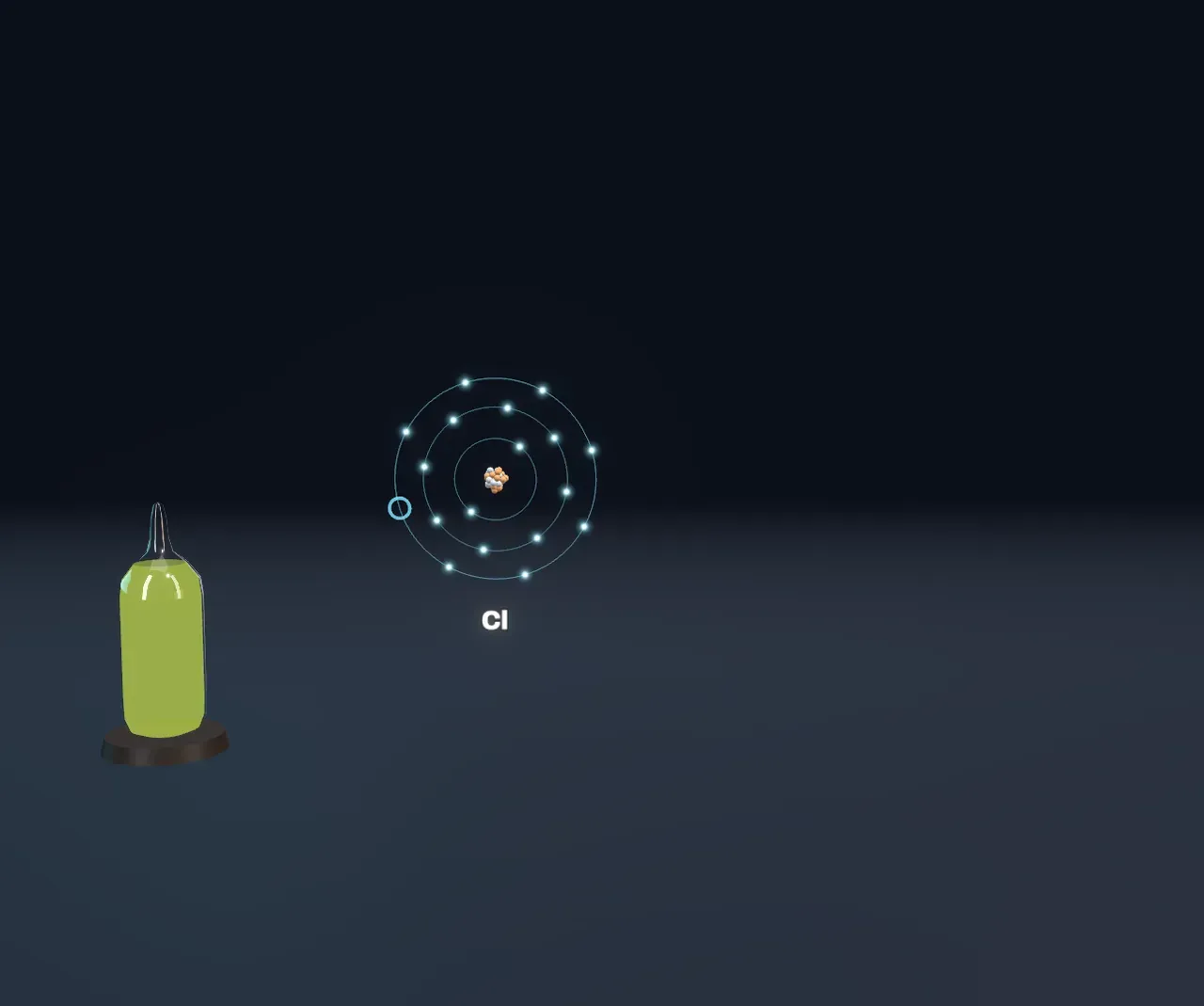
A halogen has seven outer electrons: one place in the outer shell is empty. A noble gas has eight: its outer shell is full. Count them in the Scene; the empty place in a halogen’s shell is marked with a small ring.
Try it: choose Halogen (group 17) and drag Bring in sodium to Meets sodium. Then switch Family to Noble gas (group 18) and drag it again.
Why one gap makes an atom grab
The nucleus of a chlorine atom has 17 protons. Its inner shells hold 10 electrons, which screen out most of that positive charge, but an electron in the outer shell still feels a strong pull. An extra electron arriving in the gap feels that same pull, and dropping into it releases energy: 349 kilojoules for every mole of chlorine atoms. That number, the electron affinity, is in the readings beside the experiment.
Sodium has the opposite problem. Its eleventh electron sits alone in a third shell, far out and screened by the ten beneath it, so it takes only 496 kJ/mol to pull it off. When the two meet, the electron moves across. Sodium becomes a positive ion, Na⁺, and chlorine becomes a negative chloride ion, Cl⁻. Count the shells: both now have full outer shells, like the noble gases on either side of them. Opposite charges attract, and the two hold together as salt, which is how the halogens got their name. Forming a mole of sodium chloride from sodium metal and chlorine gas releases 411 kJ, the flash in the Scene.
A full shell turns everything away
A noble gas has nowhere to put an extra electron. It would have to start a whole new shell, further out, where the eight electrons beneath screen the nucleus almost completely. The dashed ring shows where that new shell would be. An electron there is not held at all, so no noble gas forms a stable negative ion.
Nor does a noble gas give an electron up easily. Neon’s outer electrons feel a strong pull from a small distance, so it takes 2081 kJ/mol to remove one, the second-highest value of any element after helium. With nothing to gain by giving or taking, sodium simply bounces off.
Down the group
Moving down a column adds a shell each row, so the atoms get bigger: the Atom radius in the readings goes from 57 picometres for fluorine to 139 for iodine. The outer shell sits further from the nucleus and behind more electrons, so the nucleus’s pull at the edge gets weaker.
For the halogens that means less fierce reactions. Set Period (row) to 2 and back to 5 with Bring in sodium on Meets sodium: the flash is largest for fluorine, the most reactive element there is, and smallest for iodine, which is gentle enough to dab on a cut as an antiseptic. Fluorine’s electron affinity is slightly less than chlorine’s, because its tiny shell is already crowded, but its bonds to other atoms are so strong that it still reacts hardest.
For the noble gases a weaker pull makes the outer electrons easier to remove: 2081 kJ/mol for neon, 1170 for xenon. That is low enough for the most electron-hungry element of all to take a share. In 1962 chemists made the first compound of a noble gas, and xenon and krypton are now known to form fluorides such as XeF₂. Neon and helium still form no stable compounds.
What this model leaves out
Electrons are not beads circling on rings. Each is spread through a cloud around the nucleus, and the shells are layers of those clouds; the Atoms Scene shows them. Only the outer shell here is drawn to scale, using measured atomic and ionic radii; the inner shells are spread out so they can be counted, and the nucleus, really about a hundred thousand times smaller than the atom, is drawn large enough to see.
In a real reaction the electron does not wait for the atoms to touch. It can jump across several atom widths, which is why sodium vapour and chlorine react so quickly. Chlorine and the other halogens also exist as two-atom molecules, Cl₂, which must be split first, and the heats quoted are for a whole mole of solid salt forming from the elements, not for one pair of atoms. The sample of fluorine is drawn in glass for comparison; real fluorine attacks glass and is kept in metal.