Why atoms give or take electrons, how positive and negative ions form, what sets their charge, and how to write the formula of an ionic compound.
Step 1 of 6 · A gap and a spare
Step 1 of 6
A gap and a spare
In the last Unit the noble gases, with full outer shells, hardly reacted at all. Most other atoms reach a full shell when they meet: one gives electrons away and the other takes them.
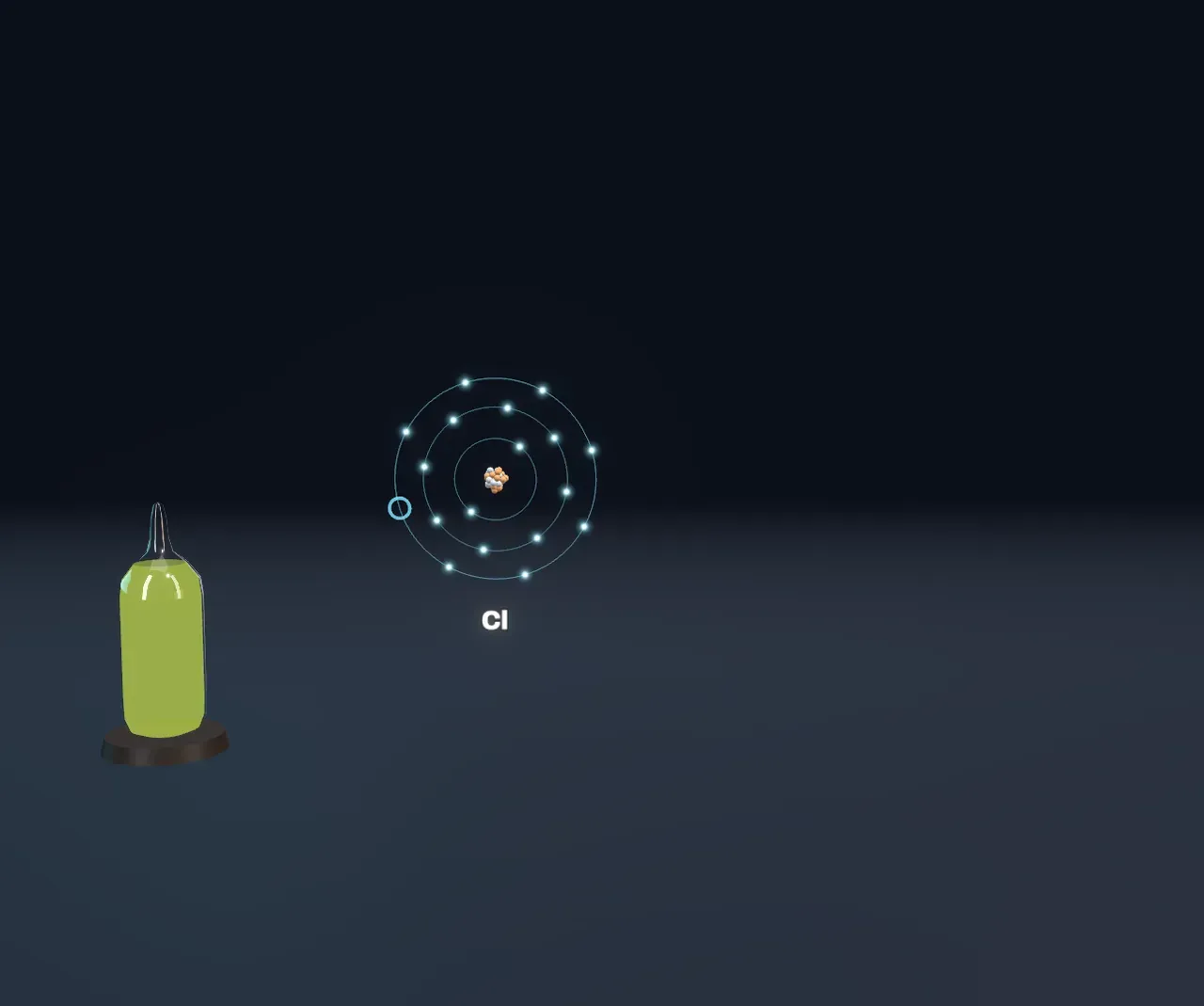
The Scene shows a chlorine atom, 2,8,7: it is one electron short of a full shell, and the free place in its outer shell is marked. Sodium, 2,8,1, carries one spare electron in a third shell. Predict what happens when they meet, then move Bring in sodium to Meets sodium.
Step 2 of 6
Counting the ions
An atom that has given or taken electrons is no longer neutral: it is an ion. Sodium is left with protons and electrons, so its charge is : a sodium ion, Na⁺, arranged 2,8, like neon. Chlorine took an electron, so its charge is : a chloride ion, Cl⁻, arranged 2,8,8, like argon.
Notice the sizes too: the sodium ion lost a whole shell and is much smaller, and the chloride ion, with an extra electron in the same shell, has grown. The ions, positive and negative, attract each other with a strong electric force. That attraction is the ionic bond.
Step 3 of 6
A full shell says no
Now the Scene shows argon, 2,8,8. Predict what happens when sodium comes close.
Step 4 of 6
The charge from the group
Each atom gives or takes the number of electrons that most quickly brings it to a full shell. Metals, with few outer electrons, give them away and become positive ions. Non-metals, close to a full shell, take electrons and become negative ions.
| Group | 1 | 2 | 13 | 15 | 16 | 17 |
|---|---|---|---|---|---|---|
| Outer electrons | | | | | | |
| Charge of the ion | | | | | | |
| Example | Na⁺ | Mg²⁺ | Al³⁺ | N³⁻ | S²⁻ | F⁻ |
The Scene shows fluorine, which took an electron and became F⁻. Oxygen sits next to it in the table, in group 16.
Step 5 of 6
Balancing the charges
An ionic compound is neutral overall: the positive and negative charges cancel. So the ions combine in the ratio that balances them. Na⁺ and Cl⁻ balance one to one: NaCl. A calcium ion, Ca²⁺, and an oxide ion, O²⁻, are also one to one: CaO. But aluminium and oxygen need two Al³⁺, a charge of , against three O²⁻, a charge of : Al₂O₃.
The formula of an ionic compound does not describe a molecule but the ratio of the ions. The lattice they sit in comes in the next Lesson.
Step 6 of 6
Small ions hold tighter
When ions pull together, energy is released, shown here as a flash. The smaller the ions, the closer their centres, and the stronger the pull. The Scene shows bromine and sodium: sodium bromide, NaBr. Change Period (row) and compare the flashes and the energy in the note beside the ions.
Loading the interactive version…
Loading the interactive version…
Each step sets up the Scene for you, and a control marked “fixed” stays put for that step.
Practice · Predict, then look
Sodium, 2,8,1, has a spare outer electron, and chlorine, 2,8,7, is one short. What happens when they meet?
Practice · Predict, then look
Sodium, 2,8,1, has a spare outer electron, and chlorine, 2,8,7, is one short. What happens when they meet?
Practice · Calculate
Chlorine has protons. How many electrons does the chloride ion, Cl⁻, have?
Practice · Calculate
Chlorine has protons. How many electrons does the chloride ion, Cl⁻, have?
Practice · Predict, then look
Argon has a full outer shell, 2,8,8. What happens when sodium comes close?
Practice · Predict, then look
Argon has a full outer shell, 2,8,8. What happens when sodium comes close?
Practice · Choose
Oxygen, 2,6, has six outer electrons. Which ion does it form when it meets a metal?
Practice · Choose
Oxygen, 2,6, has six outer electrons. Which ion does it form when it meets a metal?
Practice · Choose
Magnesium forms an Mg²⁺ ion, and chlorine a Cl⁻ ion. What is the formula of magnesium chloride?
Practice · Choose
Magnesium forms an Mg²⁺ ion, and chlorine a Cl⁻ ion. What is the formula of magnesium chloride?
Practice · Reach the target
Change Period (row) until you find the halogen whose salt with sodium releases the most energy, then press Check.
Practice · Reach the target
Change Period (row) until you find the halogen whose salt with sodium releases the most energy, then press Check.
Lesson complete. Every practice question here is done.