Three gases, three answers
Hydrogen, oxygen and nitrogen are all colourless gases with no smell. Fill three jars with them and you cannot tell them apart by looking. A burning wooden splint tells them apart at once, and it is the test chemistry classes use.
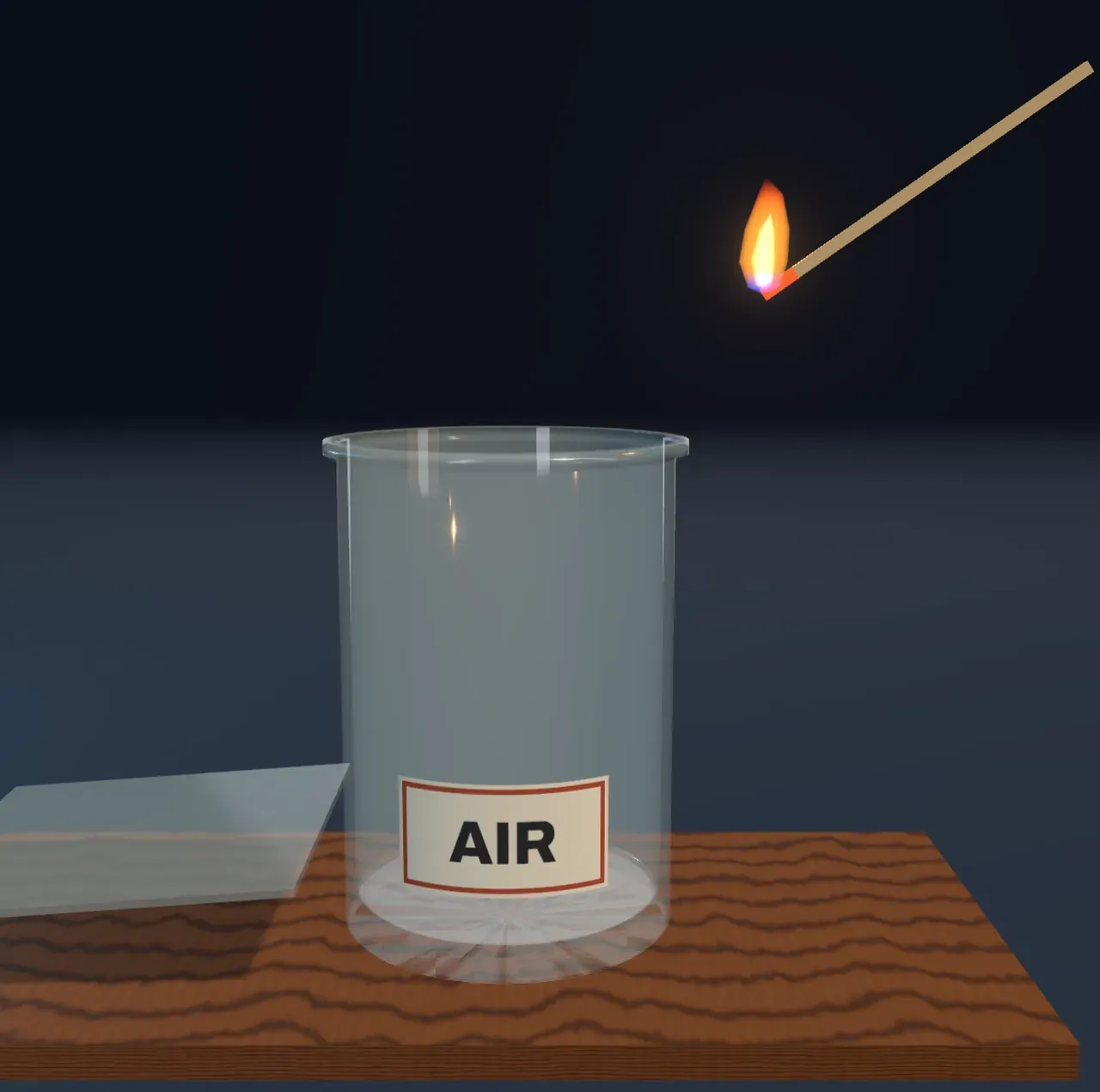
In a jar of oxygen, the flame suddenly grows bigger and brighter. In a jar of nitrogen, it goes out. Held at the mouth of a jar of hydrogen, it sets off a small, squeaky pop. In a jar of ordinary air, nothing much happens: the flame keeps burning as it did outside.
Try it: under Gas in the jar, choose Oxygen, then Nitrogen, then Hydrogen, and watch the splint each time it dips in. Go back to Air to compare.
Burning is a reaction with oxygen
A flame is a chemical reaction. The hot wood gives off gases that combine with oxygen, releasing energy as heat and light. Air is only about a fifth oxygen, and most of the rest is nitrogen that takes no part. In a jar of pure oxygen, the flame meets about five times as much oxygen, so the reaction runs much faster and the flame blazes. This is also why a splint that has only a glowing tip bursts back into flame in oxygen. That is the standard test for the gas.
In pure nitrogen there is no oxygen at all, so the reaction stops and the flame dies, leaving a wisp of smoke. Nitrogen does not put fires out by doing anything to them. It simply takes the place of the oxygen. Carbon dioxide puts a flame out the same way.
Why nitrogen does nothing
All three gases are made of molecules of two atoms joined together: H₂, O₂ and N₂. What joins them is a covalent bond: the two atoms share electrons between them, in pairs. Two hydrogen atoms share one pair, a single bond. Two oxygen atoms share two pairs, a double bond. Two nitrogen atoms share three pairs, a triple bond.
The more pairs two atoms share, the tighter they hold together. Splitting a mole of nitrogen molecules (about 28 grams) into atoms takes 945 kilojoules, nearly twice the 498 kJ needed for oxygen and more than twice the 436 kJ for hydrogen. A reaction has to break the old bonds before new ones can form, and for nitrogen that first step is so costly that almost nothing manages it at everyday temperatures. That is why nitrogen makes up most of the air yet reacts with almost nothing in it.
Try it: move Zoom to the molecules toward Molecules. The jar closes and you see what is in it, then one molecule lifts out, enlarged, with its shared pairs drawn as sticks. Choose each gas in turn and compare the bonds in the table beside the experiment.
The same molecules explain the air in the jar. Of every hundred molecules of dry air, about 78 are nitrogen, 21 are oxygen and one is an argon atom, a gas so unreactive that its atoms never pair up at all. Hydrogen is barely there.
Hydrogen: light, fast and eager to burn
A hydrogen molecule weighs about 2 atomic mass units, against 28 for nitrogen and 32 for oxygen. A litre of it weighs about a fourteenth as much as a litre of air, which is why a hydrogen balloon rises so strongly. In a real lab a jar of hydrogen is often held mouth down so the gas does not float away.
At the same temperature, every kind of molecule in a gas has the same average energy of motion. That energy is half the mass times the speed squared, so a light molecule must move faster to carry the same energy. At 20 °C hydrogen molecules average about 1,750 metres per second, nearly four times as fast as nitrogen’s 470 and oxygen’s 440. Warm the gas and they all speed up, by the square root of the absolute temperature: four times the temperature in kelvin, twice the speed.
Try it: look inside with Hydrogen, then switch to Oxygen. Then try Freezer and Hot oven under Temperature and watch the speeds in the table.
Hydrogen burns because the bonds it can form with oxygen hold much tighter than the ones it gives up. Making two molecules of water, H₂O, breaks two H–H bonds and one O=O bond, about 1,370 kJ per mole of oxygen, but forms four O–H bonds worth about 1,850 kJ. The difference, roughly 480 kJ, comes out as heat. At the mouth of the jar, the escaping hydrogen mixes with air and the flame sets the whole small pocket burning at once: the pop is a tiny explosion. The water it makes condenses as a mist on the cold glass.
Where you meet them
You breathe oxygen: your cells use it to release energy from food in a slower version of burning. Hospitals give pure oxygen to patients who struggle to get enough from air, and welders burn fuel in it to reach higher temperatures.
Nitrogen’s unreactiveness is useful too. Bags of crisps are filled with it to keep the oxygen out and the food fresh, and liquid nitrogen at −196 °C freezes things quickly. Yet every living thing needs nitrogen atoms to build proteins and DNA, and almost nothing can split the triple bond to get them. Some soil bacteria can, and lightning does. Since the early 20th century, the Haber process has done it in factories, joining nitrogen to hydrogen at high pressure over an iron catalyst to make ammonia for fertiliser.
Hydrogen is the most common element in the universe, the fuel of the stars, and in space rockets it burns with oxygen in the main engines. On Earth almost all of it is locked up in water and other compounds. Burning it makes only water, which is why it is studied as a clean fuel, though most hydrogen made today still comes from natural gas.
What this model leaves out
The scene shows the known result of each test rather than simulating the chemistry of a flame. A real test depends on how pure the gas is, how quickly the splint goes in and how much has leaked out of the jar. Hydrogen mixed with a little air pops loudly; very pure hydrogen pops more quietly and then burns at the mouth with a pale flame that is hard to see in daylight. The scene relights the splint between tests and repeats the test as if with a fresh jar every time.
The molecules are drawn tens of millions of times larger than they are and slowed down more than ten thousand times, so they can be followed by eye. They are also far too few: a jar like this holds about 10²² molecules. In a real gas they collide with each other billions of times a second; here they only bounce off the glass, as in the ideal gas of textbooks. Their speeds follow the real spread for each gas and temperature. The bond energies in the table are for splitting the molecules in the gas at room temperature, and the shares of air are for dry air, leaving out water vapour and the 0.04 % of carbon dioxide.